Louise Bourget
Death on the NileLouise Bourget is Linnet Doyle’s maid aboard the Karnak and a witness whose attempt to turn secret knowledge into money makes her a second victim of the murder plot. Her brief appearance changes meaning as the investigation advances: first she seems frightened and evasive, then Poirot recognizes that her careful answer concealed an encounter with the killer, and finally Jacqueline de Bellefort admits that Louise was killed while being paid to remain silent.
Identity and place in Linnet Doyle’s household
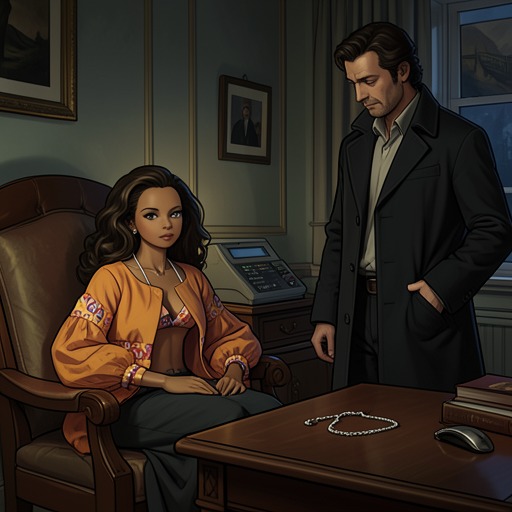
Louise is introduced as a Latin brunette whom Hercule Poirot had noticed previously for her vivaciousness. At the murder inquiry, however, she is crying and frightened. The investigators also detect what they regard as a sharp, cunning quality in her expression. This contrast establishes her as more than a background servant: she can appear vulnerable while withholding important information, and her guarded manner becomes part of the evidence Poirot must interpret.
On the night Linnet was killed, Louise says she waited in her mistress’s cabin to help her undress. She places the visit sometime after eleven, says the task took about ten minutes, and recalls that Linnet was tired and asked her to put out the lights when she left. Louise says she then returned to her own cabin on the deck below. These details put her close to Linnet shortly before the murder while also giving the investigators a reason to ask what she might have seen or heard afterward.
Testimony and the alternative motive
When asked whether she had seen or heard anything that could assist the inquiry, Louise insists that she had not. Under Poirot’s questioning, she maintains that answer, and Colonel Race presses her to say whether she knows anyone who bore Linnet a grudge. Louise then surprises the investigators by agreeing that there was such a person, while making clear that she means someone other than Jacqueline de Bellefort.
Louise identifies the supposed grievance as a matter involving her predecessor, Marie, and an engineer named Fleetwood. According to her account, Fleetwood wanted to marry Marie, who would have accepted, but Linnet made inquiries and discovered that he was already married. Louise says the existing marriage had not ended, although the wife had returned to her own people. This is Louise’s allegation, offered as an alternative source of hostility toward Linnet; the cited investigation does not establish it as the motive for the murders. Its importance in the interview is that Louise is willing to supply a possible explanation for someone else’s anger while continuing to deny that she herself witnessed anything.
The concealed knowledge and blackmail
The investigation later finds a corner of what Poirot identifies as a thousand-franc note still held in Louise’s hand. Race recognizes the implication: Louise knew something and was demanding money from the murderer in exchange for keeping it secret. Poirot connects this clue to her interview. Her answer had not simply denied seeing anything; it had described, in a hypothetical and indirect way, how she might have seen someone entering or leaving Linnet’s cabin if she had gone upstairs. Poirot concludes that she had in fact gone up and witnessed such a person.
That realization turns Louise’s evasion into evidence. Poirot reasons that she was hinting not to the investigators but to the person she meant to blackmail, who was present when she gave the answer. The money fragment and the carefully qualified testimony together reveal the pressure she had placed on the murderers. Her greed, as the investigators characterize it, gives her a temporary means of leverage, but it also exposes her to retaliation. The note is not merely money left behind: it is the surviving trace of a bargain that failed to keep her safe.
Death and the final revelation
Poirot’s reconstruction identifies Louise as a blackmailer who was killed after the murderers realized she could expose them. The later account clarifies who carried out the attack. Jacqueline admits that Louise had made her knowledge plain to Simon Doyle; Simon then told Jacqueline what she had to do. Jacqueline took the money they could gather, went to Louise, and pretended to submit to the demand. While Louise was counting the notes, Jacqueline stabbed her. The confession makes Louise’s death part of the continuing effort to protect the original crime, rather than an unrelated act of violence.
Jacqueline also explains that the danger did not end with Louise. Rosalie Otterbourne had seen Jacqueline go to Louise’s cabin and was moving to find Hercule Poirot and Colonel Race. Jacqueline says she then acted to prevent Rosalie from revealing what she knew. Louise’s murder therefore belongs to a chain of concealment: her blackmail forces the conspirators to act, and the witness to that killing becomes the next urgent threat. Jacqueline describes her own action as frighteningly easy once she had crossed that boundary, a recognition that gives Louise’s fate a wider consequence in the confession: murder has made further violence possible.
Narrative role
Louise is a limited but structurally decisive figure in the investigation. Her first denial appears to close off a line of inquiry; its peculiar wording instead provides the opening for Poirot to reconsider what happened. The thousand-franc fragment confirms that her silence had a price, while Jacqueline’s confession supplies the act and its immediate cause. Each stage revises the meaning of the last: the maid who claimed to have seen nothing had become a witness, a blackmailer, and finally a victim silenced by the people she threatened to expose.