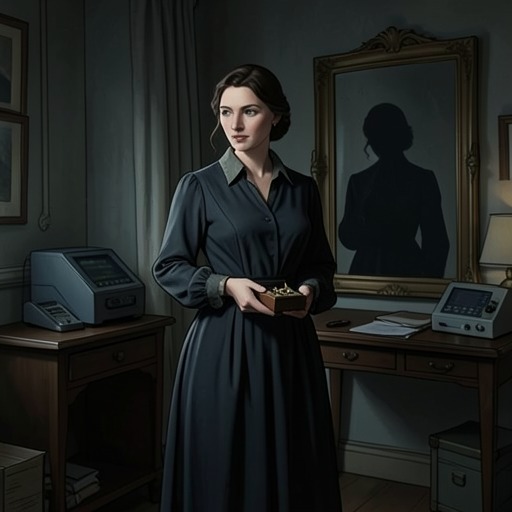
Miss Van Schuyler’s velvet stole
Death on the NileMiss Van Schuyler’s velvet stole is a personal possession whose disappearance briefly unsettles the ordered social scene aboard the Karnak. Its last reported place is precise—the chair in the observation saloon after dinner—but a search by Cornelia Robson and Jim Fanthorp does not recover it. The scene makes the stole significant through this change: from an item its owner expects to have at hand, it becomes an absent object whose whereabouts are suddenly in question.
Possession and setting
The stole is introduced through Miss Van Schuyler’s recollection of where she left it. When Cornelia returns, Miss Van Schuyler asks what has become of it; she remembers having it in the observation saloon just after dinner and says it was on a chair. She also insists that she has not left the room. These details establish the object’s last known location without establishing who moved it, when it disappeared, or whether anyone took it.
The exchange takes place on an unusually hot, sultry evening after most of the passengers have gone ashore to see the temple and retired early. In the observation saloon, Miss Van Schuyler has been talking with Dr. Bessner about some of his royal patients. The stole belongs to this ordinary social setting: it is mentioned as something that should still be where its owner left it, rather than as an object already treated as evidence.
The book’s broader attention to wealth gives possessions a public dimension. Linnet Doyle’s pearls, for example, are admired and valued at about fifty thousand pounds, while plans for her estate include swimming pools, Italian gardens, a ballroom, and rebuilding part of the house. No price or special history is supplied for the stole. Its importance in this scene comes instead from its sudden absence and from the certainty with which its owner identifies its last location.
The disappearance and search
Miss Van Schuyler’s first response is to question Cornelia, who has just returned and apologizes for having taken a long time. Looking at her watch, Miss Van Schuyler rebukes her for not hurrying and asks about the missing stole. Cornelia offers to check the cabin, but Miss Van Schuyler rejects that suggestion: she recalls having the stole in the saloon and says she has not moved from there. The cabin is proposed as a possible place to look, not established as where the stole was left.
Cornelia searches the saloon without much urgency, and Jim Fanthorp rises from a nearby table to help her. Together they fail to find it. That unsuccessful search is the scene’s decisive result: the remembered chair provides a specific starting point, but neither the owner’s confidence nor the two-person search restores the object. The account leaves the immediate question open rather than identifying a taker or explaining the disappearance.
The search occurs among other passengers and visitors to the saloon. Earlier that evening, Linnet Doyle and Simon Doyle have been playing bridge with Andrew Pennington and Colonel Race; Hercule Poirot is also there, near the door. Their presence gives the room a social context, but the account does not say that any of them saw the stole disappear or connect any of them to its absence.
From accessory to unanswered question
The stole’s narrative force comes from a small shift in attention. Before it is missing, it is simply something Miss Van Schuyler has had with her. Once it cannot be found, the chair and the room acquire a new importance: the remembered location becomes the point against which the search is measured, and the saloon is no longer just a shared sitting room but the setting of an unexplained loss. The object’s ordinary usefulness gives way to its evidentiary possibility, although this scene does not settle what happened to it.
The exchange also exposes the relations of authority around the search. Miss Van Schuyler speaks in commands, and Cornelia obeys; Jim Fanthorp joins the effort by getting up to assist. Yet the owner’s certainty about the stole’s last place does not produce a result. The contrast between a definite recollection and an unsuccessful search keeps the absence unresolved, while the presence of other people prevents the room from feeling private or empty. The stole matters here not because its value is stated, but because an expected possession has become something no one in the scene can locate.