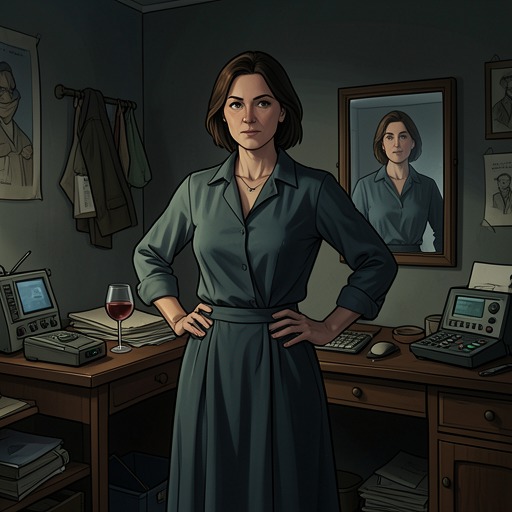
Rosalie Otterbourne–Mrs. Otterbourne relationship
Death on the NileThe relationship between Rosalie Otterbourne and Mrs. Otterbourne is marked by competing accounts of care. Mrs. Otterbourne describes herself as devoted and neglected; Rosalie gives little reassurance and, in a private conversation, speaks with sharp resentment about her mother. Their exchanges reveal an imbalance in which the mother demands attention and sympathy while the daughter appears burdened by the demand. The evidence does not resolve their conflict into reconciliation: it shows instead how complaint, silence, and reluctant response recur as they travel together.
Family Life and Friction
In Jerusalem, Mrs. Otterbourne proposes moving on to Egypt and complains that the hotel has treated her discourteously, including by requiring their room. Rosalie does not answer at first. When her mother rebukes her for failing to respond, Rosalie asks whether she really wants to go to Egypt, then says she wishes they could get away altogether. Her sigh and wish for escape contrast with her mother’s focus on the perceived slight and on the practical necessity of leaving. The exchange establishes that they share a journey but not an evident sense of its purpose: Mrs. Otterbourne voices grievance, while Rosalie expresses weariness with the situation.
The newspaper gives their departure a wider context. Rosalie is looking at a reproduction of Linnet Doyle, identified in the caption as newly married and honeymooning in Egypt, when Mrs. Otterbourne is discussing their own travel plans. Rosalie’s attention to the report briefly interrupts the mother’s complaint, but the scene does not show her explaining her interest. It does, however, place the pair’s private dissatisfaction beside the public news of another woman’s marriage and journey. The contrast is limited but telling: their movement toward Egypt is framed by Mrs. Otterbourne’s sense of mistreatment and Rosalie’s desire to get away, rather than by shared excitement.
Competing Accounts of Care
When Mrs. Otterbourne speaks to Hercule Poirot on the hotel terrace, she describes Rosalie as attractive but hard, lacking sympathy when her mother is ill and believing she knows better than Mrs. Otterbourne about her health. This is Mrs. Otterbourne’s account, not an independent confirmation of Rosalie’s conduct. Its importance lies in how the mother interprets disagreement: Rosalie’s judgment about her health becomes evidence, in Mrs. Otterbourne’s eyes, that her daughter is unsympathetic. Mrs. Otterbourne thus presents care as something she needs and believes she has earned, while treating Rosalie’s efforts to judge what is best as a source of conflict.
Rosalie’s behavior elsewhere supplies a different, though incomplete, perspective. When Mrs. Otterbourne emerges from her cabin distressed by the boat’s motion, she says that she has been left alone and that her daughter has no understanding of her. She goes on to portray herself as having sacrificed for Rosalie and to threaten to tell everyone how badly she is treated. These statements reveal the intensity of Mrs. Otterbourne’s grievance, but they remain her accusations; the scenes do not establish that Rosalie has deliberately neglected her. Rosalie is not present for this outburst. Poirot instead tells her that her mother wants her, and the previously cheerful Rosalie’s expression clouds as she looks at him suspiciously and hurries away. Her response demonstrates that the summons carries emotional weight for her, even though the reason for her suspicion is not explained.
Rosalie’s Resentment and the Journey
In Nubia, Rosalie speaks more openly to Poirot than she does in the earlier exchanges with her mother. She says that the country makes her feel that the unfairness in life rises to the surface, and compares her own mother unfavorably with other people’s mothers. She also makes a bitter, disparaging remark about Mrs. Otterbourne’s public persona. This is the clearest evidence of Rosalie’s private resentment: her frustration is not confined to impatience during travel but extends to how she understands her mother as a person. Poirot encourages her to let the feelings emerge in conversation rather than suppress them. The exchange provides a rare space in which Rosalie articulates her dissatisfaction directly, instead of responding only through silence, a sigh, or a hurried departure.
That openness does not settle the relationship. The contrast between Rosalie’s candid conversation with Poirot and her guarded response when he carries her mother’s request shows that what she can say about Mrs. Otterbourne to a listener is not the same as what she says to her mother. Conversely, Mrs. Otterbourne’s complaint to Poirot depicts Rosalie as the person who fails to understand her, while Rosalie’s own words suggest that she experiences the family relationship as unfair. The accounts remain in tension, and the narrative offers no simple measure of which one is complete.
Repeated Pattern and Significance
Across these scenes, Mrs. Otterbourne repeatedly seeks an audience for her grievances. She complains about the hotel, her health, the journey, and what she sees as Rosalie’s lack of sympathy; when she threatens to take her complaint to everyone aboard, Poirot redirects her by promising to send Rosalie to her. Rosalie, meanwhile, is shown first withholding a reply, then sighing, later speaking bitterly to Poirot, and finally hurrying to answer her mother’s summons. The pattern is not one of total indifference: Rosalie does go to her mother. But neither does the evidence show that her response repairs the underlying mistrust.
The relationship gives a personal form to the broader contrast between outward performance and private strain. Mrs. Otterbourne casts herself as a mother who has sacrificed and deserves consideration, while Rosalie’s remarks expose resentment beneath her comparatively restrained manner. Their disagreement is presented through brief encounters and conflicting testimony rather than a settled explanation of the past. As a result, the reader sees the pressure of their shared dependence and irritation without being given grounds to treat either woman’s account as the whole truth. The journey brings their conflict into view, but the available scenes leave its resolution open.