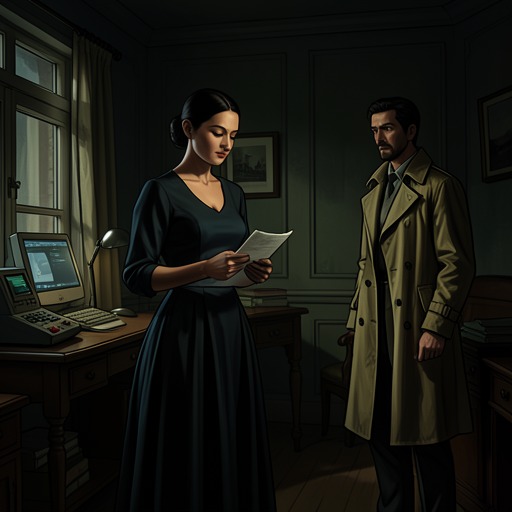
Salome Otterbourne
Death on the NileSalome Otterbourne is a novelist traveling in Egypt with her daughter, Rosalie Otterbourne. She appears first as a restless, self-dramatizing mother and later as an amateur interpreter of the crimes aboard the S.S. Karnak. Her most consequential contribution is not the theory she announces but the observation she is about to explain: she saw someone enter Louise Bourget’s cabin. Before she can identify that person, she is killed, and the interruption turns her final attempt to speak into a central part of the mystery.
Identity and Arrival
Salome’s introduction establishes both her appetite for attention and the strain in her relationship with Rosalie. While they are in Jerusalem, she proposes moving on to Egypt and complains that the people there have treated them cavalierly. She regards her presence as publicity and believes she should receive a special reduction in her terms. Rosalie answers with little enthusiasm, wishing that they could get away altogether. Their exchange sets up a recurring imbalance: Salome demands an audience, while her daughter often responds with silence or resignation.
A newspaper reproduction of Linnet Doyle brings the newly married couple into Salome and Rosalie’s immediate plans. The notice identifies Linnet as a former society beauty and says that she and Simon Doyle are spending their honeymoon in Egypt. Salome’s interest in moving on is presented alongside her grievance about their treatment in Jerusalem, rather than as a response to any established connection with the couple. The newspaper, however, places the Doyles in the same destination toward which mother and daughter are traveling.
Salome is also a working author, not merely a tourist seeking diversion. She tells Hercule Poirot that she is in Egypt partly for local color for her new novel, Snow On The Desert's Face. She describes a book whose title and proposed material lean into an impassioned, melodramatic image of the desert. She says that her public is becoming impatient and that her publisher has been appealing by post and even by cable. The detail makes her literary ambition part of her characterization: she is eager to turn her surroundings into material, even as the novel’s grand romantic language sits beside the ordinary irritations of travel and family life.
Travel and Relationship with Rosalie
The journey gives Salome several opportunities to perform the role of the put-upon, neglected mother. When the passengers leave for the Second Cataract, Salome and Rosalie have gone on an excursion to the dam and Philae and are due to join the steamer at Shellal. Their separate outing is a practical detail of the itinerary, but it also sits within the pattern of a mother and daughter who travel together without sharing the same outlook. Rosalie’s earlier wish to get away contrasts with Salome’s wish to move on and make herself heard.
Once aboard, Salome complains to Poirot about the motion of the boat and says that she is left alone for hours. Wearing a scarlet satin dressing-gown, she clutches his arm, weeps, and accuses Rosalie of showing no sympathy or understanding. She presents herself as someone who has sacrificed everything for her daughter and threatens to tell other passengers how badly she is treated. Poirot gently restrains her when she moves forward to carry out that threat. The scene gives her complaints a theatrical form, but it also makes the underlying friction plain: Salome seeks public recognition of her grievances, while Rosalie is characterized by her lack of response.
Her account of the relationship remains her own, and the narrative does not establish that Rosalie accepts it. Salome’s claim that she has worn herself to the bone and received no care is part of her emotional appeal to Poirot, not an independent description of their history. That distinction matters to her portrayal. She is vivid and articulate, but her forceful self-presentation cannot by itself settle what is true about the people around her.
The Investigation and Her Observation
When questioned after the crimes, Salome says that she and Rosalie had both gone to bed before eleven. She has heard nothing of interest during the night and cannot say whether Rosalie left their cabin. On the crimes, however, she becomes expansive. She advances an explanation centered on primitive passion and identifies Jacqueline de Bellefort as the kind of person capable of killing in the grip of powerful instinct. Her account is delivered with certainty, but certainty is not the same as proof: in this exchange, her claims about the crime are presented as her theory, and she supplies no confirming evidence before the questioning moves on.
Her later intervention is different because it rests on a particular observation. Salome enters the room where Poirot, Colonel Race, and Simon Doyle are speaking, announcing that she has vital information and knows who killed Linnet Doyle. She insists that the murders of Louise Bourget and Linnet Doyle were committed by the same person. Poirot challenges the distinction between knowing and theorizing; Salome replies by claiming that she knows who killed Louise and therefore knows who killed Linnet. The exchange exposes a weakness in her reasoning: she treats an asserted conclusion about one crime as a secure foundation for the other.
Yet Salome does possess information beyond that announced theory. She explains that she went along the lower deck to meet a man, received some goods from him, paid him, and spoke with him. On her way back, she saw someone knock on Louise’s cabin door and go inside. She does not identify the visitor before the account is cut short. Poirot’s later reconstruction gives this sighting significance in the sequence surrounding Louise’s murder and Salome’s approach to Simon. The particular value of her testimony lies in what she observed, not in her sweeping claim that one person must have committed both murders.
Death and Narrative Significance
As Salome begins to continue her account, a gunshot interrupts her. She falls, and the investigation loses the witness at the exact moment she is being pressed to name the person she saw. The scene does not allow her to complete that identification. Her death therefore changes the status of her knowledge: what might have been a direct answer becomes a clue that Poirot must interpret alongside the timing of her visit, her movements on deck, and the other passengers’ actions.
Salome’s role depends on the contrast between performance and evidence. She has repeatedly made herself the center of attention, from her complaints about Jerusalem and the boat to her claims about her novel and her dramatic account of the crimes. That habit encourages others to hear her certainty as another performance. But beneath it is a concrete observation about someone entering Louise’s cabin. Her murder demonstrates the cost of that information without turning her own theories into established fact. Later, the bodies of Salome, Louise, and Linnet are carried off the S.S. Karnak. Salome’s part in the story thus ends not with the revelation she promised, but with an unfinished disclosure that helps expose how dangerously close the investigation has come to its answers.