Simon Doyle
Death on the NileSimon Doyle is the seemingly straightforward husband of Linnet Doyle, but his apparent simplicity conceals the central deception in the murder investigation. Once Hercule Poirot abandons the theory of a spontaneous crime, Simon’s staged shooting and carefully constructed alibi reveal him as the active partner in a premeditated scheme with Jacqueline de Bellefort: to kill Linnet, inherit her wealth, and eventually return to Jacqueline.
Identity and Early Prospects
Before his marriage to Linnet, Simon is engaged to Jacqueline. As she describes him to Linnet, he is a younger son from a Devonshire family, with little money and a background she calls impoverished county. He has spent five years working in a city office, but is about to lose his position as staff are cut back. His lack of prospects gives Jacqueline’s request to Linnet a practical urgency: she asks her wealthy friend to employ Simon as a land agent at her newly acquired property.
Simon is not presented as incapable. In a conversation overheard by Poirot, he acknowledges that he can do the proposed work and says he intends to succeed for Jacqueline’s sake. The couple imagine waiting three months to see whether he keeps the job before marrying, and plan a honeymoon in Egypt, a destination Jacqueline has long wanted to visit. Their shared future appears to rest on work, marriage, and travel; the later plot turns those hopes into a cover for a very different ambition.
Jacqueline, Linnet, and the Appearance of Devotion
Simon’s engagement to Jacqueline does not end when he becomes Linnet’s husband. Poirot eventually identifies the former fiancés as still lovers and partners in the crime. The public sequence—Jacqueline’s pursuit of the newly married couple, Simon’s apparent anger at her, and the conflict aboard the Karnak—is, in Poirot’s reconstruction, arranged to direct suspicion toward Jacqueline rather than expose their cooperation.
Simon’s manner toward Linnet helps sustain that appearance. Poirot recalls that Simon seemed unusually demonstrative in public, as though overplaying the role of a devoted husband. An earlier complaint Simon made about possessive women also acquires a second meaning: Poirot comes to understand that Simon was speaking bitterly about his wife, not Jacqueline. The contrast between the dutiful husband he performs and the lover still allied with Jacqueline is one of the investigation’s decisive reversals.
During the honeymoon, Simon speaks with Poirot after Linnet has consulted the detective about Jacqueline’s pursuit. Simon says he is glad Poirot has made his wife understand that there is no legal remedy, since Linnet had not grasped how powerless they were. In isolation, the exchange presents him as a husband concerned with a vexing situation. In the larger scheme, it belongs to the carefully managed surface of the couple’s journey: the appearance of a threatened marriage helps conceal the partnership behind it.
The Staged Shooting and the Murder
Jacqueline’s shooting of Simon in the saloon appears to establish an unmistakable motive and to put Simon beyond suspicion. Cornelia Robson witnesses Jacqueline fire and Simon collapse; the scene is followed by visible signs that he has been wounded. Dr. Bessner attends him, and Simon remains in the doctor’s cabin under care. To the other passengers, the injury makes it seem impossible for him to leave and commit another crime.
Poirot’s reconstruction overturns that apparent certainty. Simon and Jacqueline, he concludes, divided the work between them: Jacqueline supplied the planning and the shot that gave Simon an alibi, while Simon carried out the murder. Her insistence that she be taken away and not left alone led to a nurse remaining with her, giving Jacqueline an alibi of her own. Their separate performances thus reinforced each other: the apparent assailant was kept under watch, and the apparent victim was treated as physically incapable of acting.
The evidence against Simon emerges through details that had seemed incidental. Louise Bourget’s ambiguous appeal was directed at Simon, who reassured her that no one suspected her and that he would look after her. Poirot reasons that she had a reason to seek Simon’s assurance: unlike Dr. Bessner, he was difficult for her to approach privately because he was wounded and continually attended. Simon’s reassuring response, intended to keep her from speaking, instead helps identify the person she feared could connect her to the crime.
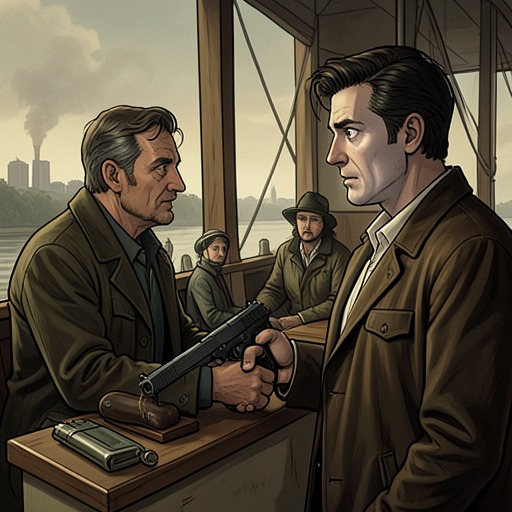
Re-examining the sequence of events, Poirot finds a five-minute interval when Simon was alone in the saloon and the witnesses’ certainty about his movements rested on appearances rather than uninterrupted observation. In Poirot’s account, Simon retrieves Jacqueline’s pistol from beneath a settee, reaches Linnet’s cabin, and shoots her while she sleeps. He leaves a bottle containing red ink by her washstand, then returns with the velvet stole concealed in readiness. He wraps the pistol with the stole and a plain handkerchief, fires into his own leg to sustain the staged account, and throws the weapon into the Nile. The false signs, the planted object, and the disposal of the pistol are parts of one timed operation rather than improvisations after a quarrel.
Investigation and Exposure
At first, Poirot and Colonel Race assume that the killer acted on impulse after overhearing the confrontation between Jacqueline and Simon. That theory makes the shooting, the pistol, and the letter J on the wall seem to point directly to Jacqueline. But the pistol’s removal contradicts the apparent framing: if the killer wanted to incriminate her, leaving the weapon behind would have served that purpose. Poirot recognizes that the mismatch matters more than the theory that initially seemed to explain everything.
The revised explanation is not a crime of sudden opportunity but a plan worked out in advance, including the drugging of Poirot’s wine so that he would be asleep during the crucial events. Simon’s apparently genuine injury, the evidence that he stayed in the saloon, and the witnesses’ account of Jacqueline’s actions all remain real observations; what changes is their interpretation. The scheme succeeds for a time because each observation is made to support a misleading story.
Simon’s final exchange with Jacqueline confirms the collapse of that story. He acknowledges that he lost control and admitted everything, apologizing for having let her down. Jacqueline accepts that they have lost. The confession and her response leave their former shared future reduced to a failed criminal partnership.
Character and Narrative Significance
Simon’s role depends on the distance between appearance and action. His low-key, inarticulate public manner makes him seem less capable of planning than Jacqueline, while the investigation reveals him as the person who physically carries out the murder. Poirot’s account does not cast him as a merely passive instrument: Simon accepts the scheme, uses his apparent injury to mislead the passengers, and acts within the precise interval his and Jacqueline’s arrangements have created.
His story also changes the meaning of the romance that first introduced him. Jacqueline had described their love as absolute and imagined a life built around marriage, employment, and travel. Poirot’s reconstruction shows that their reunion has become inseparable from Linnet’s death and Simon’s attempt to obtain her fortune. The case’s central reversal is therefore not simply that the apparently wounded husband is guilty. It is that the emotional spectacle of jealousy and pursuit has concealed a sustained alliance, with Simon and Jacqueline each helping to manufacture the other’s innocence.