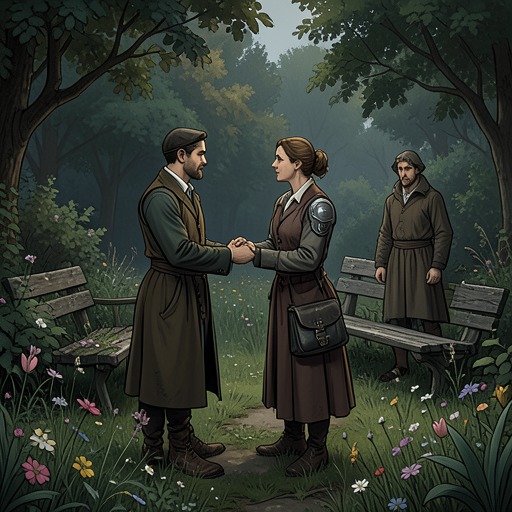
Simon Doyle–Jacqueline de Bellefort
Death on the NileSimon Doyle–Jacqueline de Bellefort is both a love relationship and the concealed partnership behind the murder of Linnet Doyle. Their apparent quarrel, Jacqueline’s pursuit of the newlyweds, and Simon’s public distress all serve as parts of a false story: the two remain lovers while coordinating a plan to remove Linnet and inherit her wealth. Their intimacy gives the conspiracy its motive and its means, but their final actions turn that shared purpose into a fatal bond.
Relationship Beneath the Appearance
The relationship is first obscured by the appearance of a triangle. Jacqueline seems to pursue Simon and Linnet Doyle out of unresolved attachment and hostility, while Simon appears to be the injured husband and Jacqueline the dangerous, remorseful former lover. Even after Linnet’s death, Simon insists that Jacqueline could not have killed her. He allows that her conduct the previous night might look suspicious, but presents it as the consequence of drink and agitation rather than a capacity for murder. His insistence reads as loyalty to an old love; in fact, it helps preserve their shared deception.
Hercule Poirot later recalls hearing Jacqueline say beside the Nile at Aswan that she loved Simon and that he loved her. He had been weighing that declaration against other statements he had heard, and concludes that Jacqueline had come closest to the truth. This retrospective judgment reorders the relationship’s visible history: the apparent break between the former lovers and Simon’s marriage to Linnet were not evidence that his attachment to Jacqueline had ended. Their affection continued behind the spectacle of antagonism.
A Reconciliation That Conceals the Plan
When Jacqueline enters Simon’s cabin, the scene appears to offer a private reconciliation after the previous night’s violence. She tells him she did not kill Linnet and asks whether he can forgive her. Simon treats the incident as an episode of drunkenness and distress, reassures her that she did not seriously harm him, and says doctors will attend to his leg when the party reaches Aswan. Jacqueline kneels beside his bed and sobs; Simon pats her awkwardly. To an observer, the exchange looks like tenderness between people shaken by a crisis.
Poirot leaves them alone, as Simon has wanted. The scene’s emotional display is real enough to be persuasive, but its apparent purpose is false: the pair are not simply comforting one another after a tragic misunderstanding. Their private meeting allows them to maintain the roles that protect them. Jacqueline’s remorse and Simon’s reassurance reinforce the impression that she acted impulsively and that he remains her victim, while their continued closeness is hidden in plain sight.
Two Partners, One Conspiracy
Poirot’s explanation identifies them as complementary planners. Jacqueline supplies the cool, resourceful design; Simon carries it out with speed and timing. Simon’s staged shooting gives him an alibi, while Jacqueline’s insistence that she shot him—and the resulting presence of a hospital nurse with her through the night—makes her appear unable to have killed Linnet. Simon’s injury is not an accidental consequence of an apparent quarrel: the plan requires it to disable him convincingly.
Other details likewise belong to a design rather than a spontaneous act. Simon has red ink and an unmarked handkerchief available; Jacqueline’s kick sends the pistol beneath a settee, where it is out of sight until it can be recovered later. The exaggerated remorse, the selection of Cornelia Robson as a witness, and a sleeping draught intended to keep Poirot from interfering all contribute to the performance. What looks like two people acting separately becomes, in Poirot’s account, a single scheme whose success depends on each partner’s part.
The fabricated hostility between them also turns Jacqueline’s pursuit of the Doyles into cover. Her visible antagonism draws attention toward a plausible suspect and away from the continued alliance between her and Simon. Simon’s apparent rage and his public manner as a devoted husband strengthen that impression, though Poirot recognizes signs that Simon’s performance is overdone. Even a supposed overheard conversation is described as a useful false lead. Their relationship is therefore not merely the motive behind the crime; its staged appearance is one of the conspiracy’s instruments.
Escalation and Exposure
The partnership becomes more dangerous when the plan encounters witnesses. Louise Bourget has seen Simon go to Linnet’s cabin and return, and Poirot concludes that she recognizes enough to seek hush money. Simon asks to see Jacqueline and tells her about this new danger. Jacqueline then kills Louise. The couple’s response shows how their shared aim changes the meaning of their intimacy: the private confidence that once might have belonged to lovers now serves as a channel for criminal instructions and urgent decisions.
Their danger increases again when Mrs. Otterbourne sees Jacqueline enter Louise’s cabin and goes to tell Simon. Simon’s alarm is taken for nervousness, but Poirot later interprets it as an attempt to warn his accomplice. Jacqueline acts immediately, obtaining Andrew Pennington’s revolver and shooting Mrs. Otterbourne. The sequence makes clear that the conspiracy has widened beyond its original target. Each new witness prompts another act, and each act binds the pair more closely to the consequences of the first.
Jacqueline later reflects that she nearly stopped before continuing with the plan. She says she could have told Simon she would not go on, but did not. When she describes Louise’s death, she explains that Simon told her what she had to do and that fear for their safety left her untroubled at the time. She also describes the killing as frighteningly easy. Her account gives the relationship a moral dimension beyond shared affection: love persists, but she has allowed loyalty to Simon and the desire to remain safe with him to become reasons for further violence.
Collapse and Ending
When the conspiracy is exposed, Simon acknowledges that he has ruined their plan and apologizes to Jacqueline for letting her down. She answers that the game is lost. Their exchange preserves the intimacy that has run through the deception: even at the end, Simon addresses her as his partner, and she responds without denying their bond. But the words no longer promise a future together; they recognize defeat.
As Simon is being carried away on a stretcher, Jacqueline takes a concealed pistol from her stocking and shoots him, then turns the weapon on herself. The relationship ends not with a return to ordinary life but with the destruction of both partners. Their deaths complete the reversal at the center of their story: the apparent pursuer and apparent victim were collaborators, and the love they kept hidden had sustained a conspiracy that neither could leave intact.