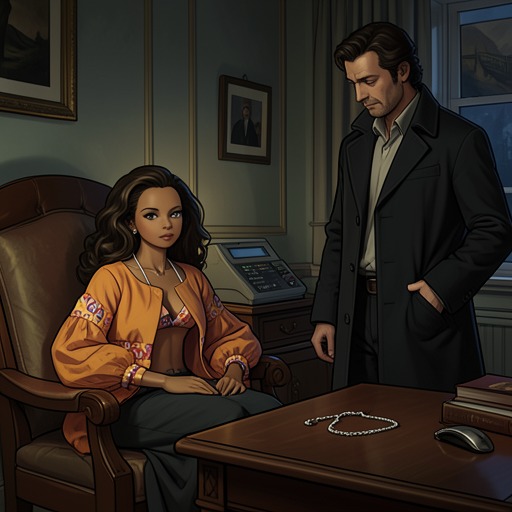
Theft of Linnet Doyle’s pearls
Death on the NileThe Theft of Linnet Doyle’s pearls is a parallel mystery in the investigation aboard the Karnak: after Linnet Doyle’s murder, the pearls are missing from the place where she kept them, and a later return appears to resolve the loss only to reveal a substitution. The changing status of the necklace complicates the evidence and reinforces Hercule Poirot’s need to question an apparently clear account of events.
The disappearance
Poirot asks Louise Bourget whether she knows anything about her mistress’s pearls. Louise recalls that Linnet Doyle wore them the previous night and had placed them on the table beside her bed, as usual. She cannot say whether they were there in the morning: on entering the room, she saw her mistress, cried out, and rushed away. Poirot points out that the pearls were not on the bedside table that morning. Their absence is thus established not by Louise’s inspection, but by Poirot’s attention to what was missing at the scene.
The exchange leaves the precise moment of the pearls’ disappearance unobserved. Louise confirms their last known placement, but her distress at discovering Linnet Doyle prevents her from checking the table afterward. The missing necklace therefore becomes a concrete gap in the sequence of events surrounding the murder, rather than a theft witnessed or explained by the maid.
A return that does not settle the question
Later, Miss Bowers enters the smoking-room and immediately gives Colonel Race a string of pearls from her neat black handbag. Her composed manner contrasts with the sensation her action causes. The return seems to offer a straightforward answer to the disappearance, but it does not establish that these are Linnet Doyle’s original pearls.
Hercule Poirot examines the string, holding it to the light and testing it by touch and taste. He concludes that the pearls are a clever imitation. The apparent recovery therefore deepens the mystery: the necklace handed to Colonel Race is not genuine, and its return does not account for the missing originals. The distinction between a real necklace and a convincing copy becomes central to understanding what has happened to the property.
Place in the investigation
The pearls’ disappearance initially sits alongside other suspicious evidence in Linnet Doyle’s murder. Poirot questions how someone could have retrieved Jacqueline de Bellefort’s pistol, used it to implicate her, and then thrown that very weapon overboard. The choice to remove such damning evidence conflicts with the investigators’ first idea that the murder was a spontaneous act and forces them to reconsider the sequence.
Poirot later acknowledges that he and Colonel Race began with that mistaken assumption. The crime, he explains, was carefully planned and accurately timed; the drugging of his wine was one part of the plan. In that wider investigation, the missing pearls and their imitation return are among the facts that must be assessed without forcing them into an early theory. The evidence here establishes the necklace’s last known place, its absence after the murder, and the inauthenticity of the returned string, but does not identify who removed the original pearls.