Unequal love
Death on the NileUnequal love names the imbalance in which one person gives more affection than the other returns, a pattern first sensed by Jacqueline de Bellefort and later described by Simon Doyle to Hercule Poirot. The phrase Un qui aime et un qui se laisse aimer—one who loves and one who lets themselves be loved—turns their unequal attachment into a compact explanation of both Jacqueline’s fear and Simon’s wish to escape feeling possessed.
The imbalance first appears
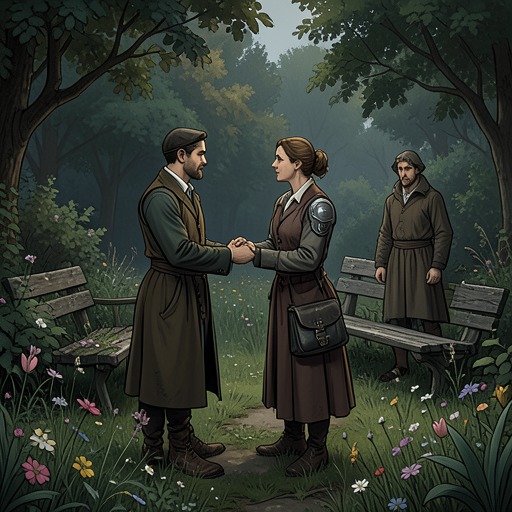
When Simon discusses his prospects with Jacqueline, their future seems to have a practical sequence: he will take a job arranged through Linnet Doyle, they will wait three months to see that he keeps it, and then they will marry and travel to Egypt for their honeymoon. Jacqueline speaks with delight about the Nile, the pyramids, and the sand; Simon says they will see it together. But she abruptly asks whether the experience will mean as much to him as it does to her, and whether he cares as much as she does. Her sudden sharpness and near-fear make the disparity felt before either character names it.
Simon answers that she should not be absurd, and Jacqueline lets the question drop. Poirot, listening, privately recognizes the pattern as Un qui aime et un qui se laisse aimer. His observation does not establish what either person truly feels; it identifies the uncertainty already present in their exchange. Jacqueline’s happiness about their planned life is genuine, but so is her suspicion that she may be more invested in it than Simon is.
Simon’s account of wanting freedom
Later, with Poirot, Simon describes Jacqueline’s continuing presence as a strain on Linnet Doyle’s nerves and says that his old feeling for Jacqueline has vanished. He compares her to the moon obscured when the sun comes out: after meeting Linnet, he says, Jacqueline no longer existed for him. The image makes his emotional change sound complete, but it also reduces Jacqueline to a former presence displaced by a brighter one.
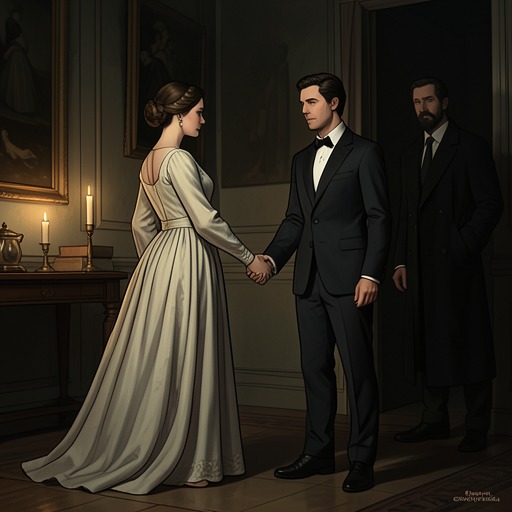
Simon rejects the accusation that he married Linnet for her money. Instead, he offers a different explanation for the broken engagement: Jacqueline had been too fond of him. He says he did not want to feel that a woman cared more for him than he cared for her, or that he was owned body and soul. In his account, her devotion became possessiveness, and his response was to want distance and freedom. Poirot again uses the phrase for the unequal arrangement: Jacqueline loved, while Simon allowed himself to be loved.
Possession, desire, and the limits of his version
Simon’s explanation exposes a tension in the idea of unequal love. He objects to being treated as someone who belongs to Jacqueline, yet says that a man wants to own his woman rather than be owned by her. His language therefore describes more than unequal intensity: it also reveals a struggle over who may claim whom. The same possessive terms that Simon condemns when applied to himself appear, in his account, as an acceptable form of male desire.
The explanation remains Simon’s own account, offered in conversation with Poirot. He presents himself as restless in the engagement, swept off his feet by Linnet’s beauty and by the attention she gave him, and unwilling to be bound by Jacqueline’s stronger attachment. The available scenes establish his interpretation and Jacqueline’s earlier doubt, not an independent measure of either person’s love. Poirot’s repeated phrase holds that gap in view: the relationship may be described as one-sided, but its meaning depends on whose account is being heard.