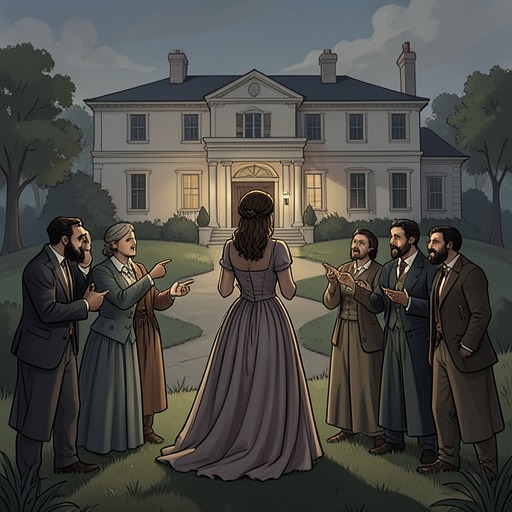
Wode Hall
Death on the NileWode Hall is Linnet Doyle’s country home and a visible expression of her independence: she has acquired, rebuilt, and furnished it with such personal investment that she thinks of it as her own kingdom. Its peaceful beauty first suggests an ideal country estate, but its significance deepens when marriage threatens to make that home seem secondary to an older, grander family seat.
Setting and Appearance
In Linnet Doyle’s bedroom, Joanna Southwood admires the prospect from the window. The view passes over the gardens to open country and the blue shadows of woodland, a scene Linnet herself calls perfect. Wode Hall is presented through this composed, expansive outlook as a place of beauty and ease, not as an oppressive or forbidding house.
Lord Windlesham later sits beneath a cedar tree and looks toward the Hall. Its old-world appearance seems unmarred by its newer buildings and additions, which have been kept out of sight around the corner. In autumn sunshine the house and grounds offer a fair, peaceful prospect; the concealed additions suggest that the estate’s appearance has been deliberately shaped rather than left untouched.
Linnet’s Home and Possession
Wode Hall matters not simply because it is attractive, but because it belongs to Linnet Doyle in a deeply personal sense. She has seen it, acquired it, rebuilt it, and redressed it, lavishing money on the property. Its gardens and altered buildings therefore register her capacity to choose and remake a home, rather than merely inherit a place in an established family order.
The house is described as her kingdom. That image gives her attachment to Wode Hall a force that a comparison of status alone would miss: it is a possession shaped by her own decisions, and a place where she is not merely someone else’s wife or the bearer of a dowry.
Charltonbury and the Threat of Displacement
Wode Hall becomes a point of contrast with Charltonbury, Lord Windlesham’s ancestral family seat, whose lineage reaches back to the Elizabethan era and whose social standing is greater. As Windlesham gazes at Wode Hall, he imagines Linnet as mistress of Charltonbury. His vision turns the quiet estate into the starting point for a possible change in her position: she might marry him and enter a more prestigious household.
From Linnet’s perspective, however, such a marriage could mean giving Wode Hall up. The two country houses would have little reason to be kept together, and Windlesham’s ancestral home would take precedence. The contrast is therefore not simply between a modest house and a more imposing one. Wode Hall is the home Linnet has made her own; at Charltonbury, she imagines herself becoming a countess and consort, losing the distinct independence that her own estate represents.