
The Affair as a Private Refuge
DeceptionThis thread traces how the novelist and the English woman build a hidden intimacy in a borrowed room, make it a refuge from their marriages, and discover that its separation from ordinary life cannot keep it free of consequence.
increasing Bearing strength in each event
 decreasing
Bearing strength in each eventdecreasingA Lovers’ Questionnaire

Intimacy Begins as Inquiry
Questions Before Promises
The relationship opens not with a declaration but with a proposed questionnaire about running away together. The lovers turn the possibility of a shared life into a playful inventory of irritations, money, fidelity, aging, and the lies each might tolerate. Their questions are comic, but they expose the stakes neither can honestly dismiss.
Testing the Imagined Future
The woman asks whether marriage can still be understood as a love affair; the answer suggests that such an illusion may cause trouble. Their exchange creates a form of intimacy based on candid talk, while also making clear that they are not approaching an uncomplicated future together. Even the fantasy of escape arrives already examined for its weaknesses.
The questionnaire establishes the affair’s characteristic double movement: attraction invites them to imagine a life together, and conversation immediately subjects that life to scrutiny. The lovers use wit to approach commitments they cannot yet make, turning emotional risk into a shared game that will recur in different forms.
The Borrowed Room
A Room Apart
Intimacy Under Constraint
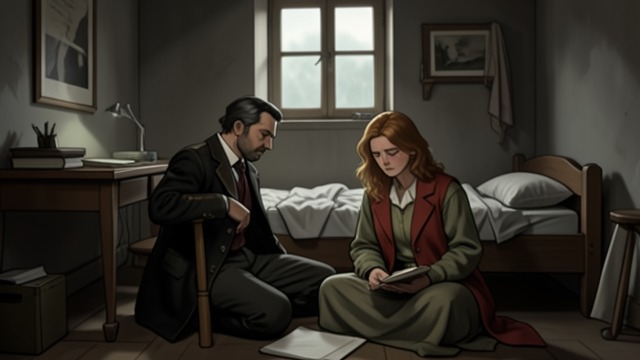
Their affair takes shape in the narrator’s small London writing room, a practical space without a bed and with windows that look onto other homes. The woman describes the room in meticulous detail, turning its desks, papers, books, and ordinary lunch containers into the landscape of their private life. The lack of domestic comfort is not incidental: the room keeps their meetings apart from the homes where their marriages continue.
Listening as Desire
Their closeness depends heavily on speech. The narrator listens as the woman unfolds the distress of her marriage, her work, her children, and her exhaustion; she recognizes that his attention is itself erotic. Their unequal roles—as teller and listener, married woman and writer—make the room feel both intimate and provisional.
The room becomes a refuge precisely because it is not a home. They can create tenderness there without testing it against daily chores, shared finances, or the obligations waiting outside. Yet the room’s makeshift quality also announces the limit of their arrangement: they have a place to meet, but no ordinary shared life in which the relationship can settle.
The Confidante and the Marriage

A Lover Inside a Marriage
Confession as Closeness
The English woman brings the narrator accounts of her husband’s girlfriend, his absences, their arguments, and the sexual distance between them. She is not simply seeking an alternative lover; she is trying to understand why the marriage leaves her lonely and why jealousy persists even when her desire for her husband has faded. The narrator responds as confidant, challenger, and admirer.
Care Without Rescue
He urges her to recognize that she has choices, including leaving, while she repeatedly describes the financial fears, children, and family pressures that make action feel impossible. Her disclosures draw them closer, but they also place him in the difficult position of listening to a life he cannot resolve for her. His attention offers relief without changing the conditions she returns to at home.
Their bond gains emotional weight through the very predicament that keeps it hidden. She can tell him what she struggles to say elsewhere, and he can become important without taking on the ordinary responsibilities of her marriage. The arrangement is sustaining for a time, but it also risks turning her distress into the shared material of their intimacy.
A Love Put on Hold
A Deliberate Separation
The Cost of the Secret
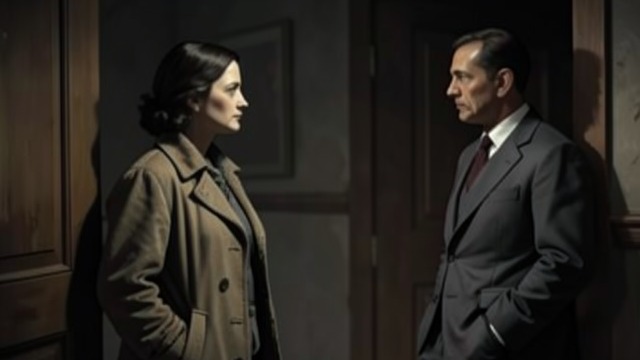
The woman explains that the relationship has become difficult to carry alongside her demand for honesty in her marriage. She does not want the narrator to remain a guilty secret or to be woven into an argument about plain dealing. She also imagines that a period alone might let her become emotionally freer rather than continuing to lean on him.
Affection Without Possession
The narrator accepts that she may need distance, though he says he will miss her. Their parting is tender rather than triumphant: neither claims that the feeling has vanished, and neither offers a practical plan that would turn the affair into a legitimate shared life. A poem about desire and impossibility gives them language for what they cannot sustain.
The separation reveals that their attachment has exceeded its original function as distraction. The woman’s choice is an attempt to regain agency, not proof that the affair meant little; the narrator’s grief likewise cannot erase the reasons she leaves. Their bond persists as something remembered and imagined even while contact is suspended.
The Voice Returns

Reunion Through a Telephone
Recognition and Reproach
Years after their parting, the woman calls after reading the book that has transformed their relationship into literature. She says she has missed the narrator and recognizes her own voice in the character, while also recalling that their relationship was distorted by secrecy and that his writing exposed what he had tried to keep hidden. Affection and anger arrive together, with neither feeling able to cancel the other.
What the Book Cannot Preserve
They speak about the life they shared, the woman’s changed circumstances, and the children she has had since they last met. The narrator remembers loving her intensely, including in imagination when she was absent; she questions whether the remembered woman is truly her or a figure shaped by his writing. Their conversation reopens intimacy while confirming that its past cannot be recovered as it was.
The call does not resolve the conflict between personal attachment and literary appropriation. Instead, the woman acknowledges that the book was tender as well as wounding, and that she still misses talking with him. Their relationship survives as a complicated exchange in which the remembered lover, the written character, and the living woman coexist without becoming identical.
At the opening of their affair
During the early months of their meetings in London
As the woman increasingly discusses her marriage during the affair
After the woman decides she must stop seeing him
Several years after the separation, after the book has appeared
