
Philip Roth’s Notebook and the Limits of Invention
DeceptionThis flow follows Philip Roth as he converts conversations and imagined encounters into a notebook, confronts the harm that writing may cause, and defends fiction's freedom to reshape experience.
increasing Bearing strength in each event
 decreasing
Bearing strength in each eventdecreasingListening as Material
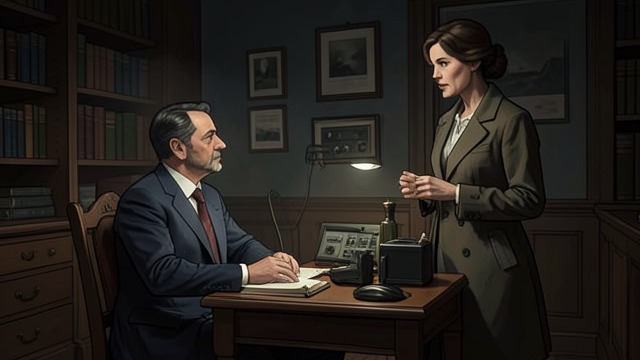
The Writer Who Listens
Attention turned into practice
Philip Roth presents himself as someone drawn to conversation, especially to the intimate stories people tell when trying to understand their lives. The Unnamed English woman notices that his attentive listening has an erotic quality, while he treats the voice and the act of telling as subjects worth studying.
The cost of attention
His interest is not neutral. What she says can become material for his work, making their closeness inseparable from the possibility that he will record, reshape, and preserve it. The room supports both an affair and a writer's habit of turning lived speech into narrative.
A Notebook of Women

An Imagination at Work
Voices gathered and transformed
Philip Roth writes conversations that draw on the Unnamed English woman and on other encounters, including memories of Rosalie Nichols and an invented relationship with a woman from his imagined world. The notebook blurs remembered speech and invention rather than documenting a single, stable affair.
Fiction as a private experiment
He argues that imagining a love affair beyond the boundaries of his novel is part of his work. His notebook therefore becomes both a record of desire and a test of how far a writer can follow an impulse without pretending that the resulting narrative is transparent fact.
The Notebook Is Found
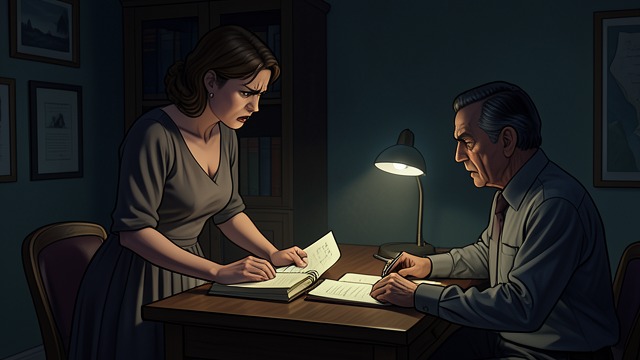
Private Invention Becomes a Domestic Crisis
A reader sees a rival
Philip Roth's wife reads the notebook and interprets its intimate conversations as evidence of a real affair. The imagined woman's knowledge, voice, and apparent closeness persuade her that the manuscript exposes a relationship her husband has concealed.
Fiction does not prevent injury
Philip Roth insists that the notebook combines real conversations, memories, and invention, and that its central affair is imagined. His wife answers that the desire and tenderness exist regardless of whether the woman exists; the creative claim does not erase the hurt his writing has caused.
The Ethics of Exposure

Writing Against Discretion
The writer's defense
Philip Roth rejects the idea that he should censor his work because a reader might identify it with a real person. He calls the notebook an act of imaginative play and argues that the writer cannot control every mistaken or accurate interpretation that readers will make.
The wife's counterclaim
His wife insists that she and the women evoked in the manuscript are human beings, not merely words or material. She asks him to consider how publication could expose and humiliate her, turning the dispute into a conflict between artistic freedom and the obligations created by intimacy.
From Notebook to Book

A Story Leaves the Private Room
The boundary remains unsettled
Philip Roth has not yet decided exactly what the notebook is or how it should be published. He distinguishes the novel, whose protagonist is Nathan Zuckerman, from the notebook, which he calls his own imaginative account, but acknowledges that the two forms may be brought together.
Consequences beyond intention
The later book makes the Unnamed English woman recognize elements of herself, even though Philip Roth maintains that the story is also invented. Publication carries the private experiment into public life, where writer, former lover, and reader no longer have equal control over what the narrative means.
During the affair in the Narrator's London writing room
During the later years of the affair
After his wife reads the notebook
During the argument over whether the notebook should be published
After the notebook argument and before the later reunion call
