“A Walk in the Woods”
Defending Jacob“A Walk in the Woods” is a fictionalized account of Ben Rifkin’s murder that Andrew Barber finds among the saved favorite stories of Job, a Cutting Room account identified with Jacob Barber. Its resemblance to the real crime makes it disturbing to Andrew, but the evidence does not establish Jacob as its author or show that the story contains information unavailable to the public. The work therefore becomes both an object of suspicion and a measure of the limits of what Andrew, as a father and a lawyer, can claim to know.
Discovery and Digital Context
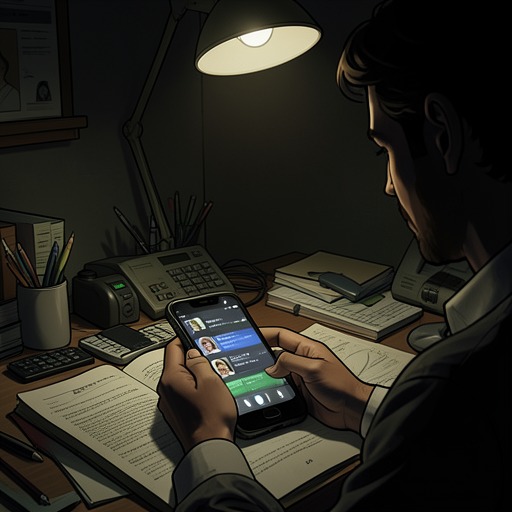
Andrew finds the story while searching Jacob’s password-protected iPod Touch. Jacob had given his parents the four-digit password as a condition of keeping the device, but the Cutting Room is not among the handful of obvious sites bookmarked in its browser. Andrew locates the message board through a Google search. Its format is plain text: visitors post stories for others to read, with no images or video, and the stripped-down browser does not reveal which stories Jacob read or how long he spent on the site.
The account page offers a more specific connection. Jacob’s screen name, Job, appears at the top, and clicking it leads Andrew to a list of a dozen favorite stories. “A Walk in the Woods” is first. The entry is dated April 19, more than three months earlier, while both its author and uploader fields are blank. The list establishes that the story was saved as a favorite under Job’s account; it does not identify who wrote it.
Story and Correspondence to the Murder
The story follows a character named Jason Fears, who carries a knife into the woods. Its long, elaborate prose presents a lurid account that closely corresponds to the murder of Ben Rifkin in Cold Spring Park. The fictional names and geography are altered: Cold Spring Park becomes Rock River Park, Newton becomes Brooktown, and Ben Rifkin becomes Brent Mallis, portrayed as a bully. These substitutions obscure the real-world references only lightly; Andrew recognizes the narrative as a barely fictionalized version of the killing.
The story’s similarities do not, by themselves, show that its writer knew private details. Andrew notes that one line attributed to the victim, “Stop, you’re hurting me,” had already been widely reported in newspapers. Other details, including the story’s account of what was said in the woods and its description of the killing, are unwitnessed or cannot be confirmed by investigators. The text may have been assembled from newspaper clippings and imagination. Its apparent specificity thus remains difficult to distinguish from reconstruction based on public reporting.
Authorship and Evidentiary Limits
Andrew assumes that Jacob wrote the story, but recognizes that the page supplies no proof. Nothing in the story gives away its author’s identity. Its adolescent-sounding voice and Jacob’s familiarity with the Cutting Room’s genre make the attribution seem possible to Andrew; the story also demonstrates at least a passing knowledge of Cold Spring Park. Yet these impressions support suspicion, not certainty. The narrowest conclusion Andrew can defend is that Jacob read the story, and even that does not establish involvement in the murder.
That distinction is consequential because the story is neither a confession nor a verified disclosure of nonpublic information. Andrew tests it against what was already known from the news and against details that no investigator could independently confirm. The story’s resemblance to the murder intensifies its emotional force without resolving its evidentiary value. In this way, it gives form to the difference between a narrative that feels incriminating and evidence that can prove authorship, access, or guilt.
Andrew’s Response and the Story’s Significance
Andrew continues to argue the defense case to himself: Jacob might have written or read the story without being guilty, and a teenager under the pressure of the approaching trial could do something foolish without understanding its consequences. But the line about Ben’s plea stays with him. Andrew says that the lawyer in him can recognize the absence of proof while the father in him feels wounded. His continued love and belief in Jacob do not erase the pain; nor does that pain amount to a new fact about the murder.
After rereading the story, Andrew clears it from the browser’s memory and returns the iPod to Jacob’s bureau. He initially intends not to mention what he found to Jacob or Laurie. But the device itself now seems dangerous to him: he worries that digital records may persist despite deletion and that the iPod gives Jacob access to the Internet beyond the controls of the family computers. The story’s discovery therefore changes Andrew’s view of the iPod from an ordinary personal device into a possible source of exposure, while leaving the central question of authorship unanswered. “A Walk in the Woods” matters not because it settles Jacob’s guilt, but because its unsettling proximity to the murder forces Andrew to confront how little the artifact can settle.