1961
Defending Jacob1961 is the year Andrew Barber last saw his father, Bloody Billy Barber, in a New Haven jail. The visit became the fixed point of a childhood shaped by a murder Andrew could not yet understand, and a memory he later tried to reduce to a handful of uncertain fragments. When the past returns to the present, the date marks not just a last encounter but the start of a divergence in two lives and of a family story Andrew had spent decades telling himself was no longer his.
The last meeting
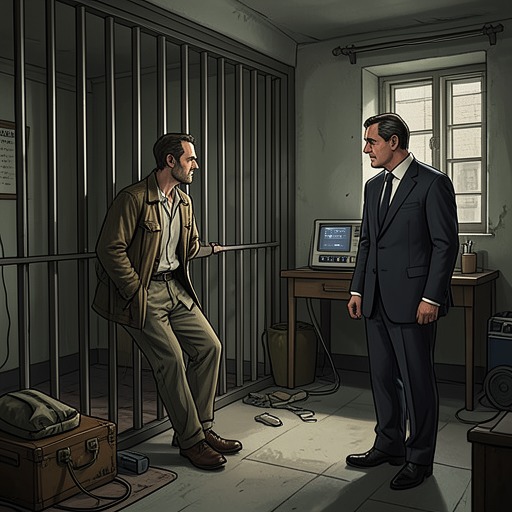
Andrew remembers being five when his mother took him to visit his twenty-six-year-old father at the Whalley Avenue jail. In the crowded visiting room, Billy coaxed him closer and took hold of his arm; the encounter stayed with Andrew as a physical memory even as almost everything else about his father faded. The visit was their last. Andrew says that beyond scraps—a face and a curved, pearl-handled knife Billy carried at his belt—he cannot reliably remember him, and suspects that years of recollection may have embellished even those remnants.
The circumstances surrounding Billy were frighteningly incomplete to the child. Andrew knew his father had done something terrible, but no adult explained precisely what had happened. He understood only that it involved a girl, an empty boarded-up row house on Congress Avenue, and the knife. The adults’ silence left him with the word murder before he could grasp its full weight.
A childhood shaped by absence
Andrew describes the summer of 1961 as the end of his childhood. Understanding murder, in his account, was not a matter of learning a definition: he had to carry the word in secret and revisit it over time. As his memories of Billy dwindled, Andrew stopped thinking about his father and lived as though he had been born without one. The date thus begins an extended process of erasure, not a clean break: Billy recedes from conscious memory, while the family history remains a burden Andrew has not yet learned how to name.
That self-erasure later shaped Andrew’s marriage to Laurie. For decades, he told her that he did not know who his father was, presenting himself as essentially fatherless. He explains that this was not simply a deliberate falsehood: by the time he met Laurie, he had come to experience Billy as a remote figure who had little to do with his identity. His account of 1961 therefore reaches forward into adult life, showing how a childhood loss can become a sustaining personal story—and how that story can conceal the biological relationship it seems to deny.
The memory returns
When Andrew visits Billy years later at Northern Correctional Institution, the words my father bring a thrill and send his mind back to their last meeting in the Whalley Avenue jail. He identifies that visit as the moment of divergence from which the separate, branching courses of their lives began. The return does not restore a complete memory or undo the years of estrangement; it makes the old encounter newly consequential by placing it inside Andrew’s present effort to confront his family’s history.
The recurrence of 1961 gives the date a double function: it is both a biographical marker and a narrative hinge. Andrew’s memory is explicitly incomplete, and he questions its reliability, yet its fragments—the jail, the visit, the knife, the word murder—continue to organize his understanding of who he is and what he has kept from Laurie. The past returns not as a settled explanation but as a problem Andrew must face again.
Momentous days and what follows
The book also places 1961 within a broader meditation on time and retrospective storytelling. Andrew reflects that people organize long lives around a small number of Big Days, while most of the thirty or thirty-five thousand days in a lifetime pass as ordinary, repetitive days and are forgotten. The last meeting with Billy is one such defining day in Andrew’s personal history: its importance becomes legible through what follows, including his father’s disappearance from memory and the later return of the family past.
This arithmetic of memory contrasts with the continuing accumulation of ordinary time. After Jacob’s exoneration, another Big Day, daily life continues without restoring the family’s former sense of normality. The book’s account of 1961 therefore resonates beyond Andrew’s childhood: a consequential day may divide a life into before and after, but it cannot make everything that comes afterward disappear. The remembered date holds the wound in view while acknowledging the years of everyday life that gather around it.