Andrew Barber's disclosure of his family history to Laurie
Defending JacobAndrew Barber's disclosure of his family history to Laurie is a late-night confession that turns a private family secret into a question about trust, identity, and what Andrew's history might mean for Jacob. He recounts the violence in his ancestry and argues that it does not define him; Laurie’s response makes clear that the harm lies not only in the history itself but in his having withheld it from the person he married and raised a child with.
The moment of disclosure
The conversation comes after a punishing day, but Andrew is still awake at two in the morning, slumped in the living room and unable to get himself to bed. Laurie comes downstairs barefoot, in pajama bottoms and a threadbare turquoise T-shirt, and urges him to come to bed because nothing more can be done that night. Instead, he asks her to sit and says there is something he has to tell her, something that will soon come out. When she asks whether it is about Jacob, Andrew says it is about himself.
The delay and the hour matter: Andrew has carried the story for thirty-four years, yet tells it in five or ten minutes, after the day’s pressures have left him stranded on the couch. His announcement turns the conversation from the immediate case to the history he has kept apart from their shared life. He presents the telling as necessary before that history becomes public, but also as a way to relieve a burden he has borne alone.
The family history he recounts
Andrew describes a sequence of violent episodes in the Barber family. He names James Burkett as the first “bloody Barber,” a figure who came east from the frontier, and recalls that his grandfather, Rusty Barber, was a war hero who later killed a man in a fight over a traffic accident in Lowell, Massachusetts. He then tells Laurie about his father, Bloody Billy Barber, whose violent past involved a young girl and a knife in an abandoned building.
Andrew’s account moves across generations, but he does not claim that the events are identical or explain them through a single cause. What connects them in the scene is his recognition that he comes from this family history, and his insistence that inheritance is not the same as identity. Having finished the brief account, he says that this is what he comes from; he has kept the facts private for decades because he believed they did not determine who he was.
Laurie’s response and the breach of trust
Laurie listens with a blank, disappointed expression and asks why Andrew never told her. He answers that the history did not matter and that he is not like the men who came before him. Laurie’s objection is not simply that the family has a violent past: she says Andrew should have trusted her to understand, and that she had a right to know whom she was marrying and having a child with. Andrew counters that she did know him because she married him, and that the history has nothing to do with their life together. Their disagreement is therefore about what knowledge marriage requires, as much as about whether the past defines the present.
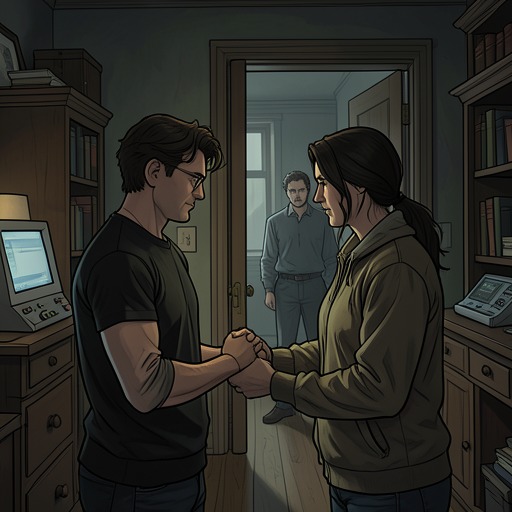
For a moment, Andrew believes they might survive the argument and move on. He kneels in front of Laurie, rests his arms on her lap, and asks her to believe that he is not his father or grandfather. Laurie says she does believe him, though uncertainly, and that she is too tired to continue. Andrew presses her to look at him and remember the person she has known since they were seventeen. But he also recognizes that he has asked her to absorb a family secret in the middle of the night, following one of the worst days of her life, partly to ease his own mind.
A marriage recast by memory
The confession prompts Andrew to reconsider the story he has told himself about his marriage. He remembers Laurie as a young woman he met at seventeen, and describes their life together, their family, and their home as gifts she gave him. For thirty-four years, he says, the spell of that idealized memory lasted. Now, at fifty-one, he sees Laurie not as the shining girl preserved in his recollection, but as a woman exhausted by the present crisis. The change in his perception does not erase his love for her; it exposes how memory can hold a person in an earlier image even as a shared life becomes more difficult.
The scene also makes the secret’s timing consequential. Andrew frames the confession as disclosure before the story comes out, but Laurie experiences it as information withheld from her throughout the marriage. His appeal—that he remains the same person she has known—cannot settle the question she raises: whether she had a right to know the family history before they built a life and had Jacob together.
Consequences within the family crisis
The disclosure resonates beyond this one exchange because Jacob’s case has made violence within the Barber family newly difficult to regard as distant history. Later, Laurie wonders whether she and Andrew made mistakes raising Jacob, and Andrew rejects the suggestion that his childhood behavior signaled anything serious. During the trial, Laurie sits alone in the courtroom, separated from the support Andrew thinks her parents could offer. After hearing Dr. Vogel’s diagnosis, she asks Andrew what they should do if Jacob is guilty; his attempt to comfort her only leads her to withdraw further. The family secret thus sits alongside, rather than resolves, the parents’ conflicting fears about their son.
Laurie’s later question sharpens the stakes: if Jacob is acquitted and commits another act of violence, she asks, would they bear responsibility? Andrew tells her to stop thinking that way and postpones the conversation, while Laurie insists they need to be honest with each other. The exchange echoes the earlier confession: what Andrew has treated as history he could keep to himself, Laurie treats as knowledge a family may need in order to face uncertainty responsibly.
The marriage does not return to its earlier sense of certainty. Andrew’s disclosure briefly allows him to ask Laurie for reassurance that he is separate from the violence in his ancestry, but it also reveals the cost of having left her outside that history. The scene’s lasting tension is not a verdict about whether blood determines character. It is the unresolved distance between Andrew’s claim that the past has nothing to do with them and Laurie’s insistence that, because they are parents and partners, they must be able to speak honestly about what they do not know.