Andrew Barber–Dan Rifkin relationship
Defending JacobAndrew Barber–Dan Rifkin relationship joins two men whose roles make them dependent on one another and whose losses pull them apart: Andrew is the prosecutor handling the case, while Dan is the father of the murdered Ben Rifkin. At first Dan turns to Andrew for both practical reassurance and an answer to the question of why his son died. As the investigation and trial continue, his need for certainty becomes an accusation that Andrew has failed him. The relationship does not resolve when the charges are dismissed; instead, it ends in a violent confrontation that shows how little the legal outcome can do to repair grief or restore trust.
Professional duty and a private appeal
Dan asks Andrew for news, but his questions quickly reach beyond evidence and procedure. He wants to understand why someone would kill Ben, and later asks what grieving parents do to survive, whether there is a pattern among those who recover, and what becomes of those who do not. Andrew answers by pointing to families, support groups, and victim advocates, while recognizing that Dan’s distress is not something he can solve through prosecution alone.
Dan also places hope in the case reaching an end. He tells Andrew that uncertainty is draining and that resolution, with the person responsible locked away, would help him and his family find closure. He insists that he is not trying to pressure Andrew and says he has faith in him. The appeal nevertheless binds personal hope to professional duty: Dan expects a completed prosecution to make emotional recovery possible, while Andrew can offer only a legal process whose outcome is not yet settled.
Grief becomes distrust
At Cold Spring Park, Dan’s sorrow is made visible in the contrast between his small, solitary figure and the empty playing fields. He describes the rest of the world as actors carrying on as though nothing has happened, while he alone knows that everything has changed. Andrew listens, but the scene also exposes his own conflicted response: he wants to help Dan and, at the same time, wants to get away from him.
The meeting turns into a confrontation over Andrew’s handling of the investigation. Dan says he wants another district attorney and challenges Andrew for not pressing Ben’s classmates, including Jacob. When Andrew reaches toward him, Dan raises an arm to ward him off and accuses Andrew of lying to him. He connects his anger to the helplessness of not having been with Ben in the moments before his death: he had been present for his son’s birth and milestones, but not when Ben needed help. He tells Andrew that he no longer cares what becomes of him and orders him to call his office. Andrew does so, and his supervisor tells him to come in. Dan’s grief has thus crossed into a demand that Andrew lose his place on the case.
A loss that neither family can bridge
The relationship is shaped not only by the two men’s conversations but by the divided families around them. When Andrew, Laurie, and Jacob encounter Dan and Joan at a market, the simple arithmetic of the group becomes painfully charged: one family has its son present, while the other has lost theirs. The moment makes the Barbers’ continued family life feel, from the Rifkins’ position, like an affront, without requiring either household to say so aloud.
At trial, the conflict is recast as competing explanations of Ben’s death. Neal Logiudice presents the case as a story in which a boy with a lethal temper was pushed until he snapped, and treats Ben’s teasing as an ordinary schoolyard provocation. Andrew’s narration recognizes that the prosecutor is constructing a persuasive story for the jury, while also questioning the gap between that story and what is actually known about motive. The courtroom’s demand for a coherent account cannot erase Dan’s earlier insistence on knowing why, nor can Andrew’s professional role guarantee that the answer will satisfy the father who has entrusted him with the case.
Legal closure and the surviving rupture
When Leonard Patz confesses, the Barbers experience the revelation as proof of Jacob’s innocence, and the government files a nolle prosequi dropping the charges before the judge takes the bench. The judge formally tells Jacob he is free. For Andrew and his family, the dismissal is a rescue; it is not a shared restoration of trust between the two families. The legal outcome answers the question of whether Jacob will still be prosecuted, but does not undo the Rifkins’ bereavement or establish that Dan can accept the Barbers’ relief.
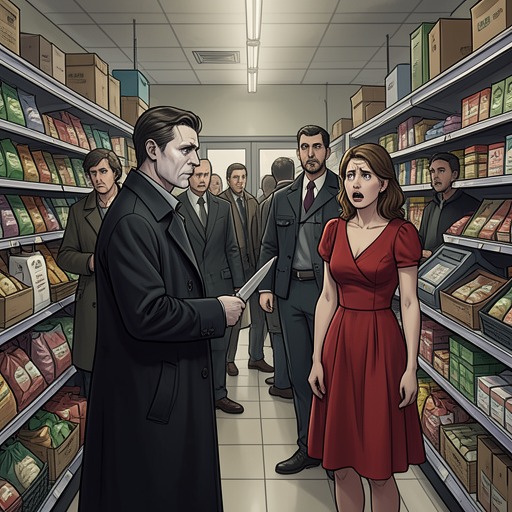
The rupture becomes explicit when Dan approaches the Barbers in a parking garage after the dismissal. Andrew and Laurie initially turn toward him expecting a difficult but friendly encounter. Dan instead takes a kitchen steak knife from his coat. Before he reaches them, Father O’Leary restrains him and knocks the knife from his hand. The attempted attack makes the relationship’s final reversal stark: the bereaved father who once looked to Andrew for protection and closure becomes a direct danger to the family whose son has been cleared. The case is over, but the pain and hostility generated around it are not.