Andrew Barber–Jacob Barber relationship
Defending JacobThe Andrew Barber–Jacob Barber relationship is a bond of fierce paternal attachment and declared trust, placed under extraordinary pressure when Jacob is accused of murdering Ben Rifkin. Andy’s instinct is to protect his son; the crisis makes that protection concrete, from searching Jacob’s room before police arrive to telling him he believes him. Yet the relationship is not presented as simple certainty. Andy knows Jacob as a beloved child and, increasingly, as a person whose private knowledge and inner life he cannot fully reach. The case tests not only whether Andy can defend Jacob, but whether fatherly faith can survive the possibility that a parent’s understanding is incomplete.
Origins of the Bond
Andy’s commitment to fatherhood is rooted in his own childhood. His father was absent, and Andy barely knew him; he resolved that his children would never experience fatherlessness. An old bedtime exchange with Jacob—Andy asking who loved him, and Jacob answering that Daddy did—had been part of their nightly routine when Jacob was very young. Andy understood that the reassurance was as much for himself as for his son: Jacob did not doubt that his father would be there, while Andy carried the memory of a father who had not been.
The approaching end of everyday fatherhood already haunts Andy before the crisis fully unfolds. He imagines Jacob leaving for college, their contact dwindling to visits on holidays and summer weekends, and wonders what he would be if he were no longer Jacob’s father in daily life. The thought gives their later separation a painful double meaning. Andy fears not only the immediate danger of losing his son to the case, but the ordinary future in which a child grows away from a parent.
That protectiveness also sharpens Andy’s awareness of the difference between Jacob’s survival and Ben’s death. Remembering that Ben lies in a refrigerated drawer while Jacob sleeps safely at home, Andy admits to himself that he is grateful the dead boy is not his own. He recognizes the shame in the thought, but cannot pretend it is absent. His parental love is not abstract fairness: it is an intimate, partial attachment, formed around the child he has promised himself to protect.
Suspicion and Protection
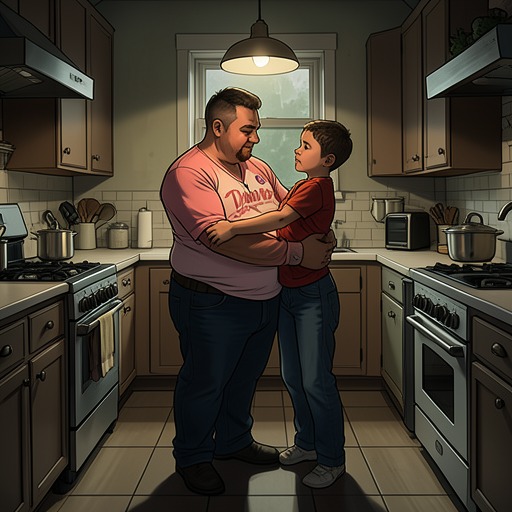
The discovery of a knife in Jacob’s possession forces Andy to put that attachment into action. When Jacob comes home from school, Andy and Laurie listen to his movements through the house before calling him into the kitchen. The folded knife lies on the table between them, stripped of its menace in appearance but charged with what it might mean. Andy asks Jacob whether it is the knife police are looking for and whether he knows anything about Ben’s death. Jacob denies it and offers no objection to testing the knife. Andy says he believes him, then refuses to return the knife.
Andy’s faith does not mean he believes he understands everything. He later distinguishes his suspicion that Jacob knows more than he has said from a belief that Jacob committed murder. As a former prosecutor, Andy finds himself experiencing events in two roles at once: pursuing the truth and fearing what the truth might be as a father. The uncertainty makes him read ordinary details twice, and he does not disclose the full extent of that unsettled suspicion when questioned by the grand jury.
When Andy learns that police are about to search the family home, he goes into Jacob’s room first and turns over drawers, closet contents, and laundry in a desperate search for anything incriminating that might be taken or misread. He finds only familiar teenage belongings: dirty clothes, enormous sneakers, schoolbooks, gaming magazines, and electronic charging cables. Andy justifies his intervention by pointing to the fallibility of witnesses, memories, police judgment, and criminal verdicts. He insists that protecting Jacob from a mistaken result is not the same as believing him guilty. The episode reveals the cost of his faith: Andy’s defense of his son draws him toward conduct that compromises his own role in the justice system.
Father and Son Under Arrest
After Jacob is arrested, the familiar father-son relationship is suddenly confined to a brief visit in a windowless room at the Newton Police Station. Jacob has not been able to make bail. According to the police report, he submitted to handcuffs without complaint, told the officer he was the person they were looking for, and denied killing Ben. When confronted with the fingerprint on the body, he said he had found Ben already lying there, tried to lift him to help, and then ran when he realized he was dead. Andy cannot be sure whether Jacob’s statement was impulsive or calculated; he does know it was the only statement Jacob gave police.
After that explanation, Jacob repeats one request: “I want my dad.” The appeal reduces the distance between the accused teenager and the father who has tried to keep him safe. In the visiting room, Jacob asks what he is supposed to do. Andy answers that they will fight the case at every step, while Jacob presses him for the immediate next step rather than a general promise. When Jacob apologizes and swears he did not kill Ben, Andy answers, “I believe you.” The words give Jacob a clear assurance at a moment when the authorities and much of the surrounding world have turned suspicion into his defining identity.
Andy’s own memories of comforting Jacob as a small child recur against the changed reality of adolescence and arrest. Before the case, Jacob had grown surly and withdrawn, sometimes seeming like a stranger in the house; Andy had accepted Laurie’s view that he was trying on different personas as he left childhood behind. The father’s familiar knowledge of a son’s habits therefore coexists with an acknowledged gap. The case magnifies a separation already present in ordinary growing up: a boy may remain deeply loved while becoming less legible to his parents.
The Other Family and the Limits of Belief
The bond is set against Dan and Joan Rifkin’s bereavement. Andy remembers Dan crossing the broad, empty fields at Cold Spring Park during the search, a small figure with his head bowed and hands in his coat pockets, blown off course by the wind. Andy’s picture of the grieving father is inseparable from the knowledge that he himself still has a living son. Later, when the Barbers encounter the Rifkins at a market, the families’ unequal numbers become stark: three Barbers, two Rifkins; one son present, the other gone. Joan’s anger and the awkward silence make Jacob’s survival feel, to the grieving parents, almost like an affront. The relationship between Andy and Jacob thus exists inside a conflict between two families whose pain is real but cannot be made equal by the legal case.
Early in the story, Dan asks Andy why the killer acted and what helps bereaved parents endure. He also hopes that resolving the case and putting the responsible person away will give his family closure. Andy wants to help Dan, yet admits to feeling both compassion and a wish to escape the encounter. This tension matters to Andy’s bond with Jacob: his professional responsibility to seek answers and his personal need to keep his son safe occupy the same person, but they do not always pull in the same direction.
The distance between Andy and Laurie adds another pressure to the father-son relationship. During the trial, Laurie sits alone in the courtroom, separated from other people by a visible zone of space. The night before, she asks Andy what they should do if Jacob is guilty; his attempt to comfort her physically only makes her withdraw to the edge of the bed. Later she asks whether they might be wrong and whether they would bear responsibility if Jacob were released and killed again. Andy tells her to stop thinking that way, but her question exposes the difference between his sustaining certainty and her fear. Their disagreement concerns the same son, yet Andy’s promise to believe and protect him does not settle the moral uncertainty she experiences.
Release and the Unfinished Bond
When Leonard Patz’s confession becomes known, Andy and Laurie wake Jacob to tell him the news. Andy experiences the confession and the state’s decision to drop the case as more than a not-guilty verdict: to him, it feels as if Jacob has been proven innocent. The judge announces that Jacob is a free man after the prosecution files a nolle prosequi, and father and son embrace. The moment appears to vindicate Andy’s insistence that Jacob did not do it, but legal release cannot restore the family’s former life or answer every question the trial raised.
Soon after the dismissal, the Barbers encounter Dan Rifkin again. He silently draws an ordinary kitchen knife from his coat, one Andy recognizes as the same Wüsthof Classic steak knife used in his own household. Before Dan can reach the family, Father O’Leary knocks the knife from his hand and restrains him. The scene turns the earlier contrast between the two families into a direct physical threat: even after Jacob is legally free, grief and hostility have not disappeared. Andy’s protective bond with Jacob remains exposed to consequences the verdict cannot control.
The novel’s closing reflection distinguishes a handful of momentous “Big Days” from the tens of thousands of ordinary days that make up a life. Jacob’s exoneration is one such Big Day, but the little days continue; the family does not return to normal, and Andy takes over grocery shopping because Laurie fears encountering the Rifkins again. That aftermath gives the father-son relationship no clean resolution. Andy’s promise to protect Jacob has been tested by arrest, trial, and a threat with a kitchen knife; his faith has prevailed as a commitment, but the family remains marked by what happened. The bond endures not as proof that a father can know everything about his child, but as the persistent work of standing beside him amid uncertainty and its lasting consequences.