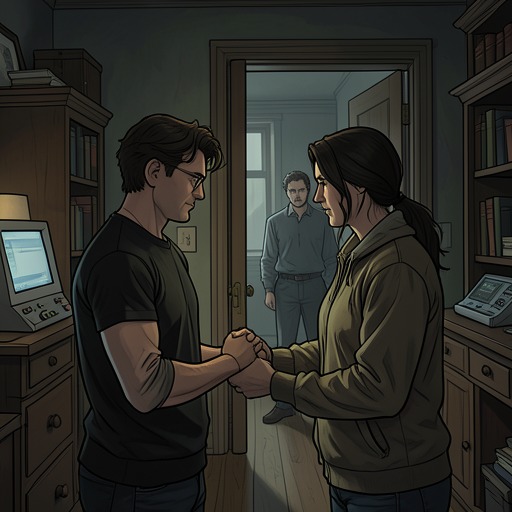
Andrew Barber–Laurie relationship
Defending JacobAndrew Barber and Laurie’s marriage is presented as a long, intimate partnership whose shared history offers real comfort but cannot protect it from the pressures of the case against their son, Jacob. Andrew’s delayed disclosure of his family’s violent past turns their private history into a source of mistrust, while Laurie’s growing uncertainty about Jacob makes loyalty itself a contested question. Their relationship survives, but the novel leaves it altered by secrets, grief, and the knowledge that legal resolution cannot restore the life they had before.
A marriage built on shared history
Andrew remembers a relationship that began when he and Laurie were seventeen and students in college. At fifty-one, their love has become quieter: they drift through daily life together, yet a word, gesture, or tone can call up the history they share. Thinking of Laurie as the young woman he first loved still gives him a thrill, like a pilot light that has never gone out. Their familiar teasing and easy affection are evidence of a durable bond, not proof that it is untouched by change.
That history informs Andrew’s sense of what Laurie has given him. He recalls becoming, through loving her, a different person, and regards their family, home, and life together as gifts. He describes the spell of their shared life as lasting thirty-four years. But his recollection also contains a turning point: in the middle of the family crisis, he suddenly sees Laurie not as the shining girl preserved in memory, but as a tired, vulnerable woman. The change is in his perception as well as in their circumstances; the past remains precious, but it can no longer stand in for the person beside him.
The family secret and the breach of trust
Andrew summons Laurie to talk after Jacob’s case has intensified the significance of family history. He tells her what he knows of his bloodline: James Burkett, remembered as the first violent Barber; his grandfather Rusty, who killed a man in a fight over a traffic accident in Lowell, Massachusetts; and his father, William Barber, known as Bloody Billy, whose history included a violent episode involving a young girl and a knife. Andrew says the account takes only minutes to tell, although he has carried the burden of it for thirty-four years. He insists that this history is not who he is and does not define their family.
Laurie’s response is not immediate acceptance. She is disappointed by both the history and Andrew’s decision not to tell her. She says she had a right to know who she was marrying and having a child with; Andrew answers that she knew him and that the past has nothing to do with their life together. His defense exposes the very difference between them: he treats the family history as irrelevant to his identity, while Laurie sees the concealment as a denial of her ability to judge what mattered to her own life.
Andrew asks Laurie to believe that he is not his father or grandfather. For a moment, he thinks they might still survive the disclosure and move on. Laurie says she does believe him, though uncertainly, and also says that it is late and she is too tired to continue. Andrew then recognizes the timing of his confession as selfish: he has brought it to her in the middle of the night, after a devastating day, partly to ease his own mind. Their history of intimacy has not disappeared, but the disclosure has changed what trust requires of them.
Parenting under the pressure of the case
As the case continues, Laurie looks back on their early parenthood and wonders whether they made mistakes. She recalls that they had tried to be responsible, waited until they were older, worked hard, and provided for Jacob, yet now doubts whether those efforts meant they were ready. She considers whether Jacob might have needed medication or counseling. Andrew resists turning the past into an accusation against them, describing Jacob as a rough and boisterous young child whose falls and mishaps were ordinary and whose behavior eventually stopped. He tells Laurie there was nothing for them to feel guilty about.
Their disagreement is not simply a contest between a parent who believes and one who doubts. Laurie says she is not trying to make their son’s defense a loyalty test; she is trying to face the possibility that they misunderstood his needs. Andrew’s insistence that they did nothing wrong protects their shared identity as responsible parents, but it also closes off questions Laurie believes they must consider. The case strains their marriage by forcing them to reconsider not only Jacob, but the story they have told themselves about raising him.
The danger of that uncertainty becomes explicit during the trial. Laurie asks what would happen if Jacob were acquitted and then committed another crime, and whether they would bear responsibility. Andrew tells her she is exhausted and should stop thinking that way. She rejects that dismissal and insists that they need to be honest with each other. Her fear does not settle the question of Jacob’s guilt; it shows how far the case has carried doubt into the marriage, where Andrew wants to contain it and Laurie wants it faced.
Isolation, relief, and what remains
During the trial, Laurie sits alone on the courtroom’s front bench. The family has no friends in Newton, and she refuses Andrew’s suggestion that her parents sit with her. He interprets her isolation as a way of bearing the cost of marrying into his family. At home, the distance is more intimate: after an upsetting diagnosis from Dr. Vogel, Laurie asks what they should do if Jacob is guilty. Andrew can offer only that they must wait for the jury. When he tries to comfort her in bed, she moves away and remains awake. The familiar ease of their marriage has given way to a touch that cannot reassure her.
When the case is dropped, Laurie and Andrew share an intense, immediate relief. They wake Jacob with the news, embrace him, and wait for the dismissal before allowing themselves fully to celebrate. Andrew experiences the result as more than an ordinary acquittal, since Jacob’s release follows Leonard Patz’s confession; he describes the family’s sense of rescue as miraculous. Yet this moment does not erase the Rifkins’ loss or repair the Barbers’ isolation. At the courthouse, the family is legally released from the prosecution, not restored to the relationships and ordinary public life they had before.
The limit becomes plain when the families encounter one another after Jacob’s release. At the market, Andrew sees the Rifkins’ presence as a painful arithmetic: Jacob is still there, while their son is gone. Later, Dan Rifkin approaches the Barbers with a kitchen knife, and Father O’Leary intervenes before he reaches them. These encounters keep the families’ grief and fear in the same frame. The charges against Jacob may be dropped, but neither that decision nor the Barbers’ relief can resolve the Rifkins’ bereavement or make the families’ proximity harmless.
A marriage after the case
The novel’s account of life after Jacob’s exoneration stresses that the family does not return to normal. Andrew takes over grocery shopping because Laurie does not want to risk meeting the Rifkins again. The household settles into a sparse routine, avoiding restaurants and other public places where they feel watched. The case has ended in court, but its consequences continue to set the terms of the couple’s daily life.
Their marriage is therefore both a source of resilience and one of the places where the damage becomes visible. Shared memories sustain Andrew’s love for Laurie; the secret he withheld and their disagreement over Jacob make those memories insufficient to guarantee mutual understanding. Laurie’s questions require a kind of honesty Andrew initially tries to postpone, while Andrew’s devotion to his family is tested by the possibility that love cannot settle questions of truth or responsibility. Their relationship endures beyond the prosecution, but the story offers no simple return to the old ease: the ordinary days continue, carrying what the case has left unresolved.