Andrew Barber–William “Billy” Barber relationship
Defending JacobAndrew Barber’s relationship with his father, William “Billy” Barber, is shaped less by an ongoing bond than by a rupture Andrew works to make permanent. He remembers Billy in fragments, carries the knowledge of a terrible crime into adulthood, and builds his identity around refusing to inherit or disclose the family’s violent past. That self-imposed distance becomes harder to sustain when Jacob faces a murder charge: Andrew’s effort to protect his son draws him back toward the father he had spent decades trying not to be.
Childhood and the break
Andrew’s memories of Billy are sparse and uncertain. He recalls his father’s hands, a prison tattoo, and a pearl-handled knife that Billy carried at the small of his back. Andrew acknowledges that years of recollection may have embellished even these details. The last time he saw Billy was in 1961, when Andrew was five and Billy was twenty-six.
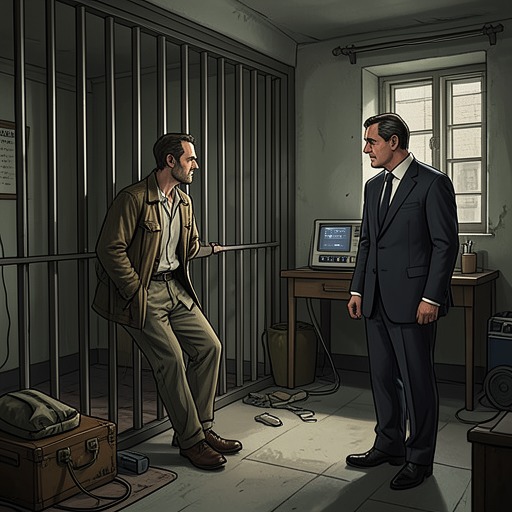
One memory remains especially vivid: a visit to Billy in the Whalley Avenue jail in New Haven. In the visiting room, Billy called the shy child closer and gripped his upper arm to draw him forward. Andrew remembers the encounter as a source of fear as well as physical closeness: the child had to be careful around his father, and the adult narrator still recalls the force of Billy’s hold.
Andrew knew Billy had done something terrible, though adults would not tell him exactly what. He understood that it involved a girl, an abandoned row house on Congress Avenue, and the pearl-handled knife. The word murder entered Andrew’s childhood without a full explanation; its meaning became something he had to carry and gradually comprehend on his own. The knowledge turned the father-son relationship into a secret wound rather than a source of guidance or security.
Estrangement as self-protection
As Andrew grew older, his recollections of Billy dwindled to fragments. By about ten, he had little memory of his father beyond those stray images; later, he stopped thinking about him. He describes living as though he had no father, an arrangement he did not question because he believed nothing good could come from revisiting the relationship.
That estrangement also shaped Andrew’s understanding of family history. He sees violence running through the Barber line and resolves to contain it within himself rather than pass it on to Jacob. His strategy is not to investigate or analyze the past, but to refuse knowledge of it and to sever himself, as far as he can, from the family that came before. In this sense, distance from Billy is both an emotional fact and a deliberate parental project: Andrew believes that suppressing the history will stop it from reaching his son.
The secret inside Andrew’s marriage
When Andrew meets Laurie, he tells her that he never knew his father and describes himself as the child of a short, unhappy affair. He does not tell her that Billy was a murderer. Andrew insists that this account was, in his own mind, close to the truth: after years of living as fatherless, he no longer experienced himself as Billy’s son except in biological terms. He also recognizes that the concealment persisted because he and Laurie were happy and because the matter did not arise in ordinary conversation.
The silence lasts for decades. When Jacob’s case makes Andrew’s family background newly consequential, he calls Laurie to talk about what is coming to light and tells her the history he had withheld. He recounts the family’s violent past, including Billy’s crime, in a conversation that takes only minutes after thirty-four years of keeping it buried. Andrew briefly expects the revelation to seem less burdensome once spoken aloud. Laurie instead asks why he never trusted her with it, exposing the cost of a secret Andrew had come to regard as irrelevant.
Andrew answers that the history was never who he was and that he is not like the men who came before him. His claim expresses his long effort to separate identity from biological inheritance, but the timing complicates it: the secret emerges precisely when he is confronting what can be known about Jacob and what a parent might pass down. The disclosure does not restore a relationship with Billy; it forces Andrew to acknowledge how thoroughly that absent relationship has shaped his marriage and fatherhood.
Fatherhood, inheritance, and unresolved distance
Andrew’s account of his father takes place within a larger attempt to protect Jacob. He has imagined himself as the point where the family’s violence stops, absorbing the past rather than transmitting it. The revelation to Laurie makes that protective intention visible while also showing its limitation: Andrew can withhold the story, but he cannot make the lineage disappear simply by refusing to speak of it.
The novel sets Andrew’s chosen fatherlessness against the fact that he has become a father himself. He says that adults eventually cease being their parents’ children and become their own children’s parents. For Andrew, that shift was a way to make Billy’s history feel remote and to center his life on Laurie and Jacob. Yet the crisis surrounding Jacob reopens the question of what inheritance means. Andrew’s insistence that he is not like Billy stands alongside his fear that violence has run through the family for generations, leaving the relationship between biology, memory, and moral responsibility unsettled.
Billy remains absent from Andrew’s adult life in the evidence presented here; there is no reconciliation or renewed conversation between them. His lasting presence is instead carried by the jail visit, the knife, the crime Andrew learned to name, and the secret he kept from Laurie. The father-son relationship is therefore a continuing bond made out of estrangement: Andrew’s effort to disown Billy becomes one of the central ways Billy’s influence persists, shaping Andrew’s self-understanding and his determination to protect Jacob from the past.