Andy’s bereavement after Jacob’s death
Defending JacobAndy’s bereavement after Jacob’s death begins with the news itself and persists as a daily return to what he could not witness. When Paul Duffy tells Andy that Laurie and Jacob have been in a crash and Jacob is dead, Andy’s knees buckle and Duffy has to hold him up and guide him to a chair. Later, as a witness before a grand jury, Andy faces the question of what happened to his son while carrying a private grief that no account of the crash can resolve.
The News and the Body’s Response
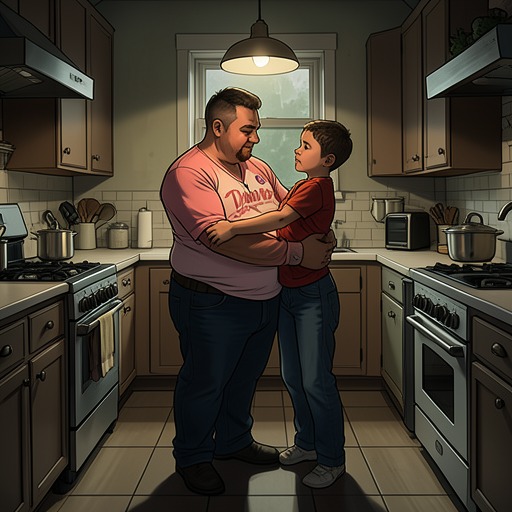
Paul Duffy arrives at Andy’s home around nine in the morning and asks to come inside. Andy refuses to wait for a conversation in the living room, asking Duffy to say whatever it is at the door. Duffy reports that Laurie and Jacob were in the car on the turnpike when it left the road: Jacob is dead, and Laurie is badly hurt but expected to survive. The distinction between those outcomes arrives all at once. Andy begins to fall, and Duffy catches him, supports him, and helps him into a chair.
Duffy also tells Andy that no other cars were involved. Witnesses saw the vehicle head directly toward a bridge abutment, without braking or steering away, and accelerate toward the collision. The account reaches Andy through other people’s observations; it does not make him an eyewitness. Later, Neal Logiudice presses the grand jury to consider Laurie’s actions as murder and asks Andy to tell the truth about what happened to Jacob. Andy does not respond. The silence follows the report of the death into the formal setting where it is being interpreted as evidence and potential criminal conduct.
Grief Under Question
The grand-jury examination places Andy between two demands: Logiudice’s insistence on an answer and the fact that Andy was not in the car. When asked what happened to Jacob, he offers no account. The silence is not presented as a resolution of the question. Instead, it leaves the legal demand unanswered at precisely the point where the family’s loss and the possibility of indicting Laurie meet.
The narrative gives Andy’s later account a different kind of testimony. He says that he imagines Jacob’s final moments over and over, relives them every day, and dreams about them when he sleeps. He knows he was not there, but cannot keep his mind from seeing what he did not see. Bereavement thus takes the form of a recurring imagined scene: the absence of firsthand knowledge does not prevent the mind from returning to the death, and the return does not supply certainty.
The Last Ride as an Imagined Scene
In Andy’s reconstruction, less than a minute remains in Jacob’s life. Jacob is stretched out in the minivan’s middle row, where he routinely sat even when he and Laurie were alone. He is not wearing his seat belt, something he was often careless about; usually Laurie would have told him to put it on, but that morning she does not. The detail is ordinary and specific, and its ordinary quality sharpens the weight Andy gives it afterward.
The ride is also framed by the distance between mother and son. Since the family returned from Jamaica a few weeks earlier, Laurie has been quiet and withdrawn. Jacob gives her space; Andy’s retrospective account says Jacob must have understood that Laurie had lost trust in him, though not love. Mother and son exchange a few strained words on Route 128, then fall silent as the minivan merges onto the turnpike and heads west. This remembered quiet does not explain the crash, but it places Jacob’s death within an already damaged family relationship and makes the final ride part of Andy’s effort to understand what cannot be undone.
A Death That Does Not End
The book sets Andy’s private repetition against its account of how people shape a life into a story. It describes a lifetime as tens of thousands of mostly ordinary, forgettable days punctuated by a small number of Big Days, the momentous occasions people preserve when they look back. Jacob’s exoneration is one such day, but the days afterward continue; the end of one decisive event is not the end of living with its consequences. For Andy, Jacob’s death is another Big Day whose force persists inside the otherwise continuing stretch of time.
His grief also recalls an earlier question from Dan Rifkin, who asks why the person responsible for a killing would do it and later asks what helps bereaved parents survive, and what becomes of those who never recover. At Cold Spring Park, Andy remembers Dan as a small, bowed figure crossing the empty green fields, buffeted off course by the wind. The image belongs to Dan’s loss, not Andy’s, but it makes visible a parallel the novel sustains: a parent’s bereavement is not settled by procedural language or by a story’s apparent ending. Andy’s repeated imagining, his silence before the grand jury, and the narrative’s return to ordinary days all keep Jacob’s absence present without claiming that the mystery of the death, or its grief, has been resolved.