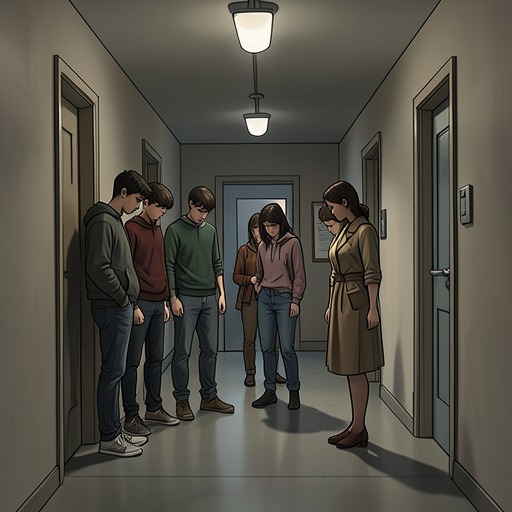
Collective silence during interviews with McCormick students
Defending JacobThe collective silence during interviews with McCormick students marks a turning point in the investigation of Ben Rifkin’s murder. What begins as a carefully restricted effort to gather tips becomes a pattern of denials that makes the investigators suspect the students know more than they are saying; the resulting uncertainty later feeds a public stigma that survives the trial’s abrupt end.
Setting and Conditions
The interviews began after school, following a day of class meetings and grief counseling. Plainclothes detectives from the state police Crime Prevention and Control unit went from classroom to classroom, inviting students to share information, anonymously if they wished. The children responded with dull stares. The school was a grades-six-through-eight middle school, its plain rectangular building lined with layers of teal paint. Laurie had attended it decades earlier and found that it seemed nearly unchanged, except that the halls appeared smaller to her.
The interviews were contentious before they began. The principal initially resisted investigators entering the school to speak freely with students, and the school board and mayor intervened with Lynn Canavan to slow the process. The eventual agreement allowed interviews on school grounds but limited access to students outside Ben Rifkin’s homeroom unless investigators had a specific reason to believe they might know something. Students could have a parent or lawyer present and could stop an interview at any time. The narrator accepted these protections as appropriate, while noting that negotiations had cost time.
At two o’clock, Andrew Barber and Paul Duffy took over the principal’s office to interview the highest-priority witnesses: Ben’s close friends, students who walked through Cold Spring Park, and students who had specifically asked to speak with investigators. Two dozen interviews were scheduled for the pair, while other detectives interviewed students simultaneously. The investigators expected most conversations to be brief and unproductive; instead, the early interviews changed their sense of the case.
Denials and the Investigators’ Reassessment
After only three or four interviews, Andrew and Paul felt that the students were stonewalling them. At first they interpreted the shrugs, wandering eyes, and evasive filler words as ordinary adolescent behavior. Both men were fathers and knew that teenagers often use such mannerisms to keep adults at a distance. What unsettled them was the scope of the denials: students claimed not merely to know nothing about the murder, but not to know Ben at all.
That account contradicted what investigators already knew about Ben’s friendships. The interviews made him sound as if he had no friends, only acquaintances, and as if no one had spoken to him or knew who had. Andrew regarded the apparent disavowal by Ben’s friends as a betrayal. Some students, in his view, made their lies conspicuous by delivering them with excessive confidence; others became visibly tentative. Their behavior did not provide a reliable test of truth, but its inconsistencies heightened the investigators’ concern.
As Andrew and Paul challenged the more obvious falsehoods, the pace of the interviews slowed. Paul joked that the students were acting like a group bound by a code of silence. The remark gave comic form to a darker inference: the investigators had previously considered and discounted the possibility of student involvement because they had found no evidence, apparent motive, or obvious suspect among the pupils. Now the denials themselves led them to think that the students knew something. The interviews did not establish who knew what, or whether every student was concealing information; they changed the investigators’ working assumptions without resolving the mystery.
From Interview Room to Public Judgment
The suspicion generated by the interviews belongs to a wider pattern in which incomplete information is treated as confirmation. When Jacob was charged, newspaper coverage transformed the accusation into a public identity: one headline emphasized that a district attorney’s teenage son had been charged in the Newton killing, while a tabloid cover labeled him a monster. The family’s ability to control its public image seemed negligible beside the reach of that coverage.
The hostility became tangible at the Barber family home, where graffiti on the front of the house called the family murderers and said that they were hated. The accusation did not establish guilt, but it made the community’s judgment visible in the family’s everyday surroundings. The gap between legal process and public certainty echoed the earlier gap between what the students said and what Andrew and Paul believed they knew.
Aftermath and Continuing Stigma
Even after the case ended, the town’s judgments did not simply disappear. Neighbors regarded Jacob as neither guilty nor entirely innocent, citing the knife, his violent fantasies, and his family background as reasons for unease. Some also found the trial’s abrupt end suspicious. The possibility that Jacob had not murdered Ben did not persuade people to welcome him into their children’s lives; uncertainty itself became a reason to avoid him.
The family therefore did not send Jacob back to school in Newton. He continued homeschooling with Mrs. McGowan, who had tutored him after his indictment and suspension. She came to the house each morning, while Laurie also took an active role in his lessons. Jacob said he did not miss school or friends and appeared content with the more solitary arrangement. His composure, which Andrew found admirable, could also seem eerie to classmates and neighbors already disposed to distrust him.
The sequence gives the student interviews significance beyond their immediate investigative value. The students’ denials open a new possibility for the investigators but do not answer the central question; later, public accusation and neighborhood suspicion likewise harden without producing certainty. The result is a lasting separation between what the legal case can establish and what a community chooses to believe.