Discovery and destruction of Jacob’s iPod
Defending JacobAndrew Barber’s discovery of a story about Ben Rifkin on Jacob Barber’s iPod turns a piece of private adolescent writing into a danger Andrew cannot resolve: the story may have been Jacob’s, but the evidence does not establish its authorship. Acting at once as Jacob’s lawyer and father, Andrew argues away its implications while feeling the first bodily force of doubt; he then destroys the device, hoping to contain both its digital traces and its continued access to the Internet.
The iPod and the search
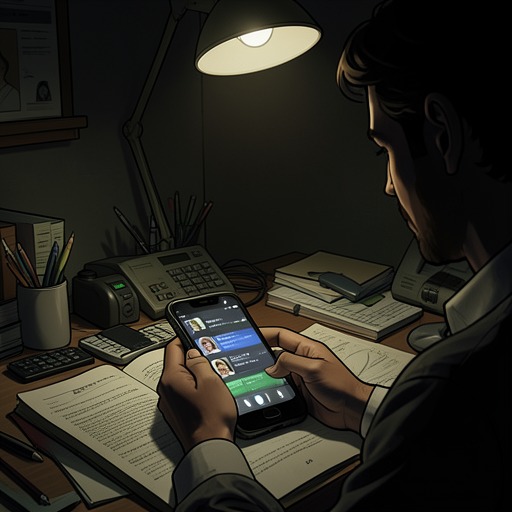
After leaving Derek Yoo, Andrew drives slowly through the town center, conscious in retrospect that he was prolonging an ordinary moment before what came next. At home he goes upstairs to Jacob’s room. Jacob’s iPod Touch is on the bureau. Because Jacob had given his parents its four-digit password as a condition of keeping it, Andrew can unlock it and inspect the browser.
Jacob’s bookmarks include familiar destinations such as Facebook and Gmail, along with blogs about technology, video games, and music. The site Andrew is worried about, the Cutting Room, is not among them; he has to find it through a Google search. The message board contains text-only stories, including violent fantasies and accounts of torture. The limited browser does not show which stories Jacob read or how long he spent there, but the site identifies him as a member under the screen name Job. Membership establishes that Jacob had access to the board, not what he did with it.
The saved story and the unresolved authorship
Andrew opens Job’s favorites and finds a dozen saved stories. The first is “A Walk in the Woods,” dated April 19, more than three months earlier. Its author and uploader fields are blank. In a long, florid narrative, a character named Jason Fears takes a knife into the woods; the story then recasts the setting and people associated with Ben Rifkin’s murder. Cold Spring Park becomes Rock River Park, Newton becomes Brooktown, and Ben is rendered as Brent Mallis, a bullying antagonist.
The resemblance alarms Andrew, but it does not settle the central question. He assumes Jacob wrote the story, while recognizing that nothing in it identifies its author. Its adolescent voice and its apparent familiarity with Cold Spring Park make the possibility feel plausible to him; they do not prove it. The only firm conclusion he can draw is that Jacob had read the story. The text likewise offers no certain indication that its writer knew information unavailable to the public: details that might seem incriminating had been reported, while other elements could not be confirmed by investigators.
The father’s counterargument
Andrew immediately resumes the habits of a defense lawyer, minimizing what he has found and assembling reasons not to treat it as proof. The story is not a confession, he tells himself; it may have drawn on newspaper accounts and imagination. Even if Jacob wrote it, Andrew reasons, it could be reckless teenage behavior rather than evidence of guilt. He also places it in the context of Jacob’s isolation at home, the pressure surrounding the approaching trial, and the boy’s earlier posting of a Psycho image on Facebook.
Those arguments do not restore his earlier certainty. The story’s words echo in Andrew’s mind, and he describes the effect as a physical injury. He continues to believe in Jacob, continues to love him, and acknowledges that he has no real proof; at the same time, the father in him feels wounded in a way the lawyer’s reasoning cannot cancel. The scene’s turn is not a new evidentiary conclusion but a fracture between what Andrew can argue and what he can feel.
Destruction and consequence
Andrew reads the story again, clears it from the browser’s memory, and returns the iPod to Jacob’s bureau. His first impulse is to say nothing to Jacob or Laurie Barber. He changes course because he fears the device could become evidence if the district attorney’s office found it, and because deleting a page from the iPod cannot erase the records left by Internet activity on servers or computers. The device also gives Jacob private access to the Web that Andrew cannot monitor as easily as the family computers.
Andrew thinks of the small, phone-like iPod as a leak: a vulnerability both because its digital traces may persist and because Jacob can use it beyond his parents’ supervision. He takes it to his basement worktable, places it glass-side up, and smashes it with a hammer. The action removes the device from Jacob’s use, but it cannot answer who wrote the story or erase what Andrew has read. Its decisive consequence is therefore as much personal as practical: Andrew destroys a possible source of exposure while leaving the uncertainty, and the strain between his legal defense and his paternal fear, intact.