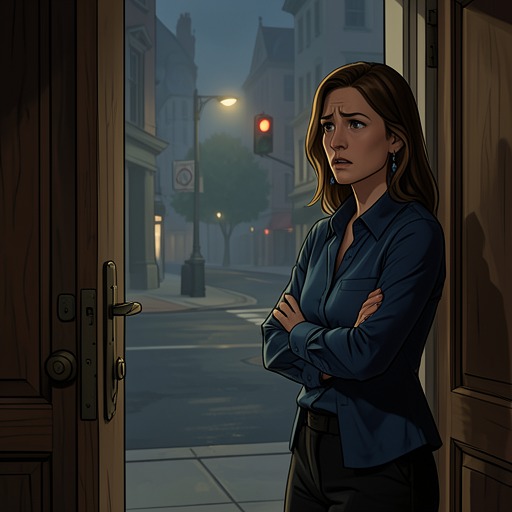
Hope Connors’s disappearance and death
Defending JacobHope Connors’s disappearance and death shatter the Barbers’ brief return to family happiness at Waves, the resort where she and Jacob begin a relationship. She vanishes during an afternoon when her absence initially seems ordinary; seven weeks later, her body is found on a distant shore. The account never settles whether she drowned accidentally or was killed, and the uncertainty acquires force from the family’s earlier experience of Jacob’s murder case: suspicion, media attention, and disputed evidence gather around him again, without resolving what happened.
A brief romance at Waves
The episode begins inside the holiday’s apparent reprieve. The Barbers have settled into the beach-and-pool rhythm at Waves, with buffet meals, evening entertainment, and the resort’s insistence on exuberant fun. Jacob spends much of his time with Hope, increasingly leaving his parents’ company to be alone with her. For the first time in a long while, he seems happy in someone else’s presence.
That happiness rests on a concealed identity. Jacob tells Hope his name is Jacob Gold, using Laurie’s maiden name, and she does not know about the case. Andrew and Laurie learn of the false surname only later. At the time, they wonder whether Hope has somehow missed the extensive attention surrounding Jacob or knows about it and is drawn to the notoriety; they avoid asking her directly because they fear spoiling what appears to be the first good thing in Jacob’s life for a long while.
The family’s glimpses of the couple are small and tentative. Even when Hope and Jacob come over to greet them at the pool, the young people then sit a little apart. Once, the parents see them holding hands furtively on neighboring chaise lounges. Andrew remembers Hope as courteous and warm, with blond hair and a soft Virginia accent, and emphasizes that she seemed comfortable in her own body. Her presence brightens Jacob. The name Hope, Andrew reflects, gives her sudden entrance an almost fairy-tale symmetry; he jokes to Laurie that at last they have hope.
The disappearance
As evening approaches, Hope’s mother telephones their room to ask whether Hope is with Jacob; she has not heard from her all afternoon. Andrew cannot recall exactly when he later learned that Hope had vanished, but he remembers the call and its initially reassuring context. Jacob shrugs when asked. There is no cell-phone reception at the resort, and the teenagers have often been temporarily out of contact. The resort is fenced and regarded as safe. Andrew and Hope’s mother both assume she may have gone exploring or lost track of time, and Andrew tells her not to worry because Hope will probably return shortly.
She does not. In the grand-jury account, Andrew gives the disappearance its bluntest form: Hope never came back. That sentence retrospectively overturns the casual explanation that had seemed reasonable at the time. What began as a familiar vacation uncertainty becomes an absence with no immediate answer, and the apparent security of the fenced resort offers no explanation for where Hope went or what happened to her.
The narrative sets this rupture against the Barbers’ carefully recovered routines. They had begun watching the sunset as a family, dragging three beach chairs to the water’s edge and sitting with their feet in the water. Hope joined them once, sitting beside Laurie; usually the ritual belonged to the three Barbers. Andrew later pictures them there as a happy, apparently ordinary family and wants to freeze the story at that image. Hope’s disappearance breaks into this remembered tableau from the next stage of the testimony, converting the holiday’s dreamlike ease into a memory marked by what was still unknown.
Discovery and disputed cause of death
Hope’s body is not found until seven weeks after her disappearance. It washes ashore several miles from the resort. Andrew’s understanding is that she drowned, but he is careful in his testimony about the limits of what he knows: the body had been in the water for a long time, had deteriorated, and, as he understood it, had been fed on by marine life. He was not privy to the investigation, and he says the remains yielded little evidence.
The cause of death is therefore presented through competing claims rather than a settled reconstruction. Andrew maintains that the evidence supports only that Hope went swimming and drowned. The prosecutor counters that there is evidence her windpipe was crushed before she entered the water, a detail that raises the possibility of homicide. Andrew rejects that inference, arguing that the condition of the body did not support it and that the investigation in the resort’s location was compromised by intense media and public pressure. He describes the local police investigation as improperly conducted; his criticism does not, however, establish what happened to Hope.
The testimony preserves the gap between a possible sign of violence and proof of a killing. Asked whether the case is considered an unsolved homicide, Andrew says he does not know and disputes that the evidence warrants the label. The exchange leaves the death unresolved: drowning is Andrew’s account of what the evidence suggests, while the alleged injury to Hope’s windpipe remains an opposing interpretation voiced in questioning.
Jacob under renewed suspicion
The prosecutor draws a connection between Hope’s case and Jacob’s earlier prosecution, calling him an exceptionally unlucky boy after describing a murder and what the prosecutor characterizes as a botched investigation. Andrew challenges whether the remark is even a question. The parallel is consequential precisely because it is not a resolution: it brings Jacob’s name into another case involving a young woman’s death while leaving the evidence and responsibility unsettled.
By the time of the grand-jury testimony, Jacob’s name has been widely linked to Hope’s case in tabloids and on websites Andrew calls sleazy. He dismisses those outlets as willing to say anything for money and argues that there is no profit in claiming Jacob was innocent. The testimony thus places the family’s private uncertainty inside a public narrative that treats association as insinuation. The earlier murder case has not simply ended with Jacob’s exoneration; his name remains available to media speculation when Hope disappears and dies.
Memory, grief, and the unfinished ending
The book’s treatment of the event is shaped by hindsight. The resort episodes are remembered as a short-lived interval in which Jacob has a girlfriend, the parents begin repairing their marriage, and the family can sit together at sunset. Andrew’s wish to hold that scene still is answered by the testimony’s abrupt sequence: a girl disappears; weeks later, her body is found; the evidence is disputed. The shift from intimate family recollection to formal questioning makes the vanished person both a presence in the remembered holiday and the center of a case the family cannot explain.
The contrast also echoes Dan Rifkin’s earlier struggle to understand why someone would commit a murder and his plea for answers beyond evidence and court procedure. He asks what enables some bereaved parents to carry on, and what happens to those who never recover. In another recollection, Andrew sees Dan alone in a vast, empty field at Cold Spring Park, a small figure with his head bowed and his hands pushed into his coat pockets, buffeted off course by the wind. That image belongs to the aftermath of Ben Rifkin’s death, not Hope’s, but it gives the book’s later treatment of loss a continuing human context: official answers and the passage of time do not automatically quiet grief.
Andrew’s broader reflection on life after Jacob’s exoneration likewise resists a clean ending. He describes life as a long succession of ordinary days, punctuated by a few momentous ones, and observes that people shape those days into tidy stories even though the end is never simply the end. Hope’s disappearance and death sharpen that idea. The Barbers’ remembered vacation cannot remain a sealed happy episode, and the testimony cannot convert uncertainty into closure. Hope is gone, the circumstances of her death remain contested, and Jacob’s association with the case renews the shadow of suspicion around a family that had only briefly imagined it might be living an ordinary life.