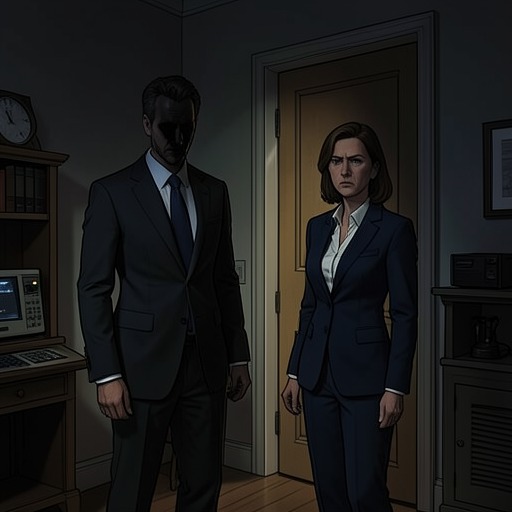
Interrogation of Leonard Patz
Defending JacobThe Interrogation of Leonard Patz is a brief but consequential episode in which Andrew Barber’s search for a suspect narrows onto a man whose record and admission of being in Cold Spring Park make him seem plausible, but do not establish that he killed Ben Rifkin. Andrew presses the detectives to keep questioning Patz until his lawyer intervenes. The interview shows how urgency and professional instinct can turn circumstantial details into a prosecutorial story—and how the need for a story can outrun what the evidence actually proves.
Background and suspicion
Andrew’s attention is drawn to Patz when Paul Duffy brings him a Board of Probation record. It lists several allegations and charges involving indecent conduct, including an accusation concerning a minor that remains pending. The record makes Patz an alarming figure in the neighborhood, but the details do not connect him to Ben’s death. Duffy says Patz is twenty-six and lives near the park, in the Windsor condominium complex. A mug shot gives Andrew a face to consider alongside the record.
Andrew feels from this first encounter that Patz might be the person responsible. Yet the narration qualifies the intuition at once: Andrew is desperate for a suspect and knows that he wants to have this feeling because he needs to produce something. He distrusts his own suspicion without dismissing it. His account of expertise as an instinct formed through accumulated cases, mistakes, and technical knowledge explains why he is unwilling to ignore that gut feeling; it also reveals why the feeling is not self-validating. Duffy identifies a central weakness in the lead: Patz’s record contains no history of violence or weapons.
The interview and its limits
By the afternoon, detectives have Patz in an interview room at the Newton Police Station. A camera, concealed in a schoolhouse clock, records him with his consent after detectives inform him that recording is required. His image appears on a small screen in the detective bureau, where Newton and CPAC detectives watch from outside. The setup makes the questioning a performance observed by an audience, although the detectives initially see little to respond to.
Patz says that he walks in the park every morning, but insists that he was nowhere near the place where Ben was killed. He says he does not take that route, did not see or hear anything, and did not know Ben. As he speaks, he counts these denials on his fingers. Andrew’s reply is not that the denials have been disproved; instead, he treats Patz’s presence in the park as a reason to keep pressing him.
Andrew argues that Patz is their only real suspect: a child has been killed, Patz is attracted to boys, he knows the park, walks there routinely, and is physically capable of overpowering the victim. From these details Andrew constructs what he calls motive, means, and opportunity. His logic moves from a record about sexual offenses to a suspected motive, then from familiarity with the park to opportunity. The interview does not supply independent confirmation of that chain. Patz’s admission establishes that he was in the park, while his denials leave the crucial connection to Ben unresolved.
Andrew is especially impatient because Patz’s lawyer is about to end the questioning. He tells Duffy to go back in and obtain a confession that he could take to the grand jury that afternoon. The urgency makes the interview’s purpose plain: Andrew wants more than clarification; he wants an admission capable of carrying the case forward. But the pressure cannot itself fill the evidentiary gaps, and the scene records no confession.
Counsel ends the questioning
Jonathan Klein arrives in the detective bureau carrying a battered lawyer’s bag. He is described as slight and slightly stooped, with long white hair and a white goatee; his quiet greeting to Andrew is followed by a handshake marked by genuine warmth. Andrew respects Klein as intelligent, legally knowledgeable, and unusually honest. Their personal regard contrasts with the adversarial work underway: Klein is there to represent Patz, while Andrew wants the suspect to keep talking.
Andrew asks whether Klein will let his client continue. Klein declines, telling Andrew that he trusts him too much for that. The exchange draws the interrogation to a close: Patz’s questioning ends when counsel intervenes, not when the detectives resolve whether he was involved. The distinction matters. The episode gives the investigation a suspect and a set of suspicions, but not the confession Andrew sought or an established account of Patz’s role in the killing.
From investigation to courtroom story
The trial later makes clear how sharply the case against Jacob Barber depends on narrative construction. Neal Logiudice describes Ben as a fourteen-year-old found dead in Cold Spring Park, then presents the killing as the culmination of a boy’s temper suddenly breaking. His argument turns bullying and Jacob’s alleged anger into a simple causal account, repeating the idea that the defendant “snapped.” The narrative makes the prosecution’s task legible to the jury, but the narrator characterizes Logiudice’s technique as stronger than the certainty of his explanation.
The opening statement also presents Ben as a regular teenager rather than a saint: someone who teased Jacob, but whose ordinary flaws cannot make him responsible for his own death. Logiudice contrasts Ben’s popularity and confidence with Jacob’s supposed loneliness and outsider status, then proposes that Jacob carried a knife and an idea into the park before some later provocation supplied the trigger. Yet the account of the trial emphasizes that Logiudice cannot establish what that trigger was. He offers possibilities, including insults or bullying, and concedes that the answer may never be known.
That courtroom uncertainty throws the Patz interrogation into relief. In both episodes, the search for a motive presses investigators and advocates to arrange fragments into a coherent story. Andrew’s suspicion rests on Patz’s record, his routine presence in the park, and his admission that he was there that morning; Logiudice’s theory of Jacob rests on a proposed temper, bullying, and a conjectured trigger. Neither the urgency of an investigation nor the persuasive force of a trial theme turns an inference into a demonstrated fact. The interrogation’s decisive outcome is therefore limited but revealing: the questioning stops, the lead remains unresolved, and the story of the crime continues to be contested.