Jacob Barber's murder trial
Defending JacobJacob Barber's murder trial, formally Commonwealth v. Jacob Michael Barber, is the public contest over whether Jacob killed Ben Rifkin and the novel’s concentrated demonstration of how a criminal case becomes a story. Its stakes are not limited to the verdict: the prosecution and defense offer incompatible explanations, while Andrew Barber’s retrospective narration exposes how a search for certainty can shape the interpretation of incomplete evidence. The courtroom asks who committed the crime; the narrative also asks how anyone can claim to know.
Identity and Setting
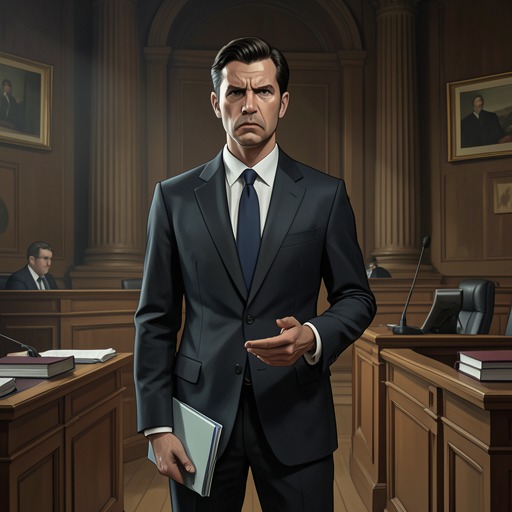
The trial opens in the Massachusetts courtroom as a single count of first-degree murder against Jacob Michael Barber. Judge French presides; Jonathan Klein represents the defense, and Assistant District Attorney Neal Logiudice appears for the Commonwealth. Andrew, Jacob’s father and a former prosecutor, attends with Laurie. Their presence places the family inside the public machinery of the case while leaving them, as Andrew describes it, expected to watch in silence.
The opening is delayed while the courtroom’s television camera feed is arranged and the unusually large jury pool is assembled. The postponement gives the anticipated proceeding an unceremonious start: the family waits in the gallery, Jonathan reads a newspaper, and the court’s routine preparations continue before the case is called. Once Judge French takes the bench, the clerk identifies the matter as Commonwealth v. Jacob Michael Barber, a single count of murder in the first degree. The formal announcement briefly makes each participant visible as a role in the case—judge, lawyers, defendant, family—before the trial begins to assign them meanings.
Competing Stories of the Case
Logiudice’s opening argument organizes the prosecution around the phrase “The defendant snapped.” He describes Ben’s death in Cold Spring Park and frames the killing as the sudden release of Jacob’s allegedly lethal temper after ordinary school teasing. The argument turns a complex case into a memorable causal sequence: a boy is pushed, reaches a limit, and acts. Logiudice emphasizes that Ben was not a saint, but argues that he was an ordinary fourteen-year-old with a life ahead of him; he contrasts Ben’s popularity with Jacob’s supposed isolation and presents the contrast as part of the motive.
The prosecution’s account also acknowledges a gap. Logiudice cannot establish exactly what triggered the killing, and his alternatives—an insult, a threat, or some form of bullying—remain possibilities rather than a known cause. Andrew recognizes that jurors nevertheless want a reason that makes the crime intelligible. In his account, motive may not be a formal element of the charge, but the jury’s demand for a causal explanation gives it practical force. Logiudice’s resort to theories and probabilities, including genetic explanations, shows the strain between the certainty of the prosecution’s theme and the uncertainty of the evidence it can offer for the trigger.
Jonathan counters with a direct assertion of Jacob’s innocence. He acknowledges the enormity of Ben’s death and the human desire to see justice done, then warns that grief and anger can direct that desire toward the wrong person. His opening refuses the prosecution’s story rather than supplying, in this moment, a comparably developed alternative account. The contrast is one of rhetorical method as well as conclusion: Logiudice gives the jury a compact explanation to carry into deliberations, while Jonathan asks it to resist the pressure to make a tragedy feel resolved by assigning guilt.
Andrew’s account of advocacy makes that contrast part of the trial’s larger significance. He argues that jurors want a story answering the question of what the case is about, not only abstract reminders about the burden of proof. Earlier, he had considered offering Leonard Patz as an alternative suspect and narrative, believing that the jurors would want to know who committed the crime if Jacob did not. Andrew says he believed Patz was responsible and that the counter-narrative was true; he also admits that, as Jacob’s father, his conviction was entangled with his loyalty to his son. His retrospective qualification makes his certainty itself part of the evidence to be considered, rather than a neutral resolution of the case.
Evidence, Procedure, and Scientific Claims
The trial places behavioral genetics before the court as a disputed form of evidence. Jonathan files a motion in limine seeking to exclude scientific evidence based on an alleged genetic predisposition to violence. Judge French initially appears inclined to grant it, but clarifies that he has not excluded the evidence outright: the prosecution must give notice, and the court will hold an admissibility hearing before it is offered to the jury. The ruling therefore sets a procedural condition rather than settling the scientific question. Logiudice’s argument that the field has advanced and is mature enough for admission does not, at this point, establish that the jury will hear it.
The limits of evidence recur in Andrew’s account of investigative reasoning. Under questioning by Logiudice, he describes how investigators can form a theory, select a suspect, and then search the available data for support, ceasing to notice facts that point elsewhere. He connects this danger to the treatment of Leonard Patz: when Logiudice names Patz as an example, Andrew agrees. The exchange makes the trial’s argument about competing stories self-implicating. The defense’s alternative account may challenge a premature focus on Jacob, but Andrew’s own determination that Patz did it also risks turning an interpretation into a conclusion before all the evidence is available.
A piece of writing becomes a particularly consequential part of the prosecution’s case. Andrew testifies that the story associated with Jacob described the angle of the knife wounds in a way he believed was not public knowledge and difficult to infer. He regarded its detail as effectively a written confession and believed it supplied probable cause to arrest Jacob. He also says the police did not arrest him immediately because they still wanted to locate the knife and search for other evidence in the house. The episode links narrative form to legal action: a story is treated not merely as expression but as evidence whose specific detail changes the investigators’ assessment of the case.
Dispute Over the Trial and Its Aftermath
On the fifth day of trial, Judge French denies the defense motion for a mistrial after the jury has heard a reference to Jacob’s grandfather. He records the objection and preserves the issue for appeal, says that he has given the jury a curative instruction, and cautions Logiudice not to mention the matter again. The ruling keeps the trial moving while leaving the objection formally alive. Andrew observes that mistrials are rare and considers the judge’s reluctance to end the proceeding, as well as the possibility that Logiudice understood how unlikely a mistrial would be; he marks the latter as an unkind interpretation rather than established fact.
The trial’s scenes are framed through Andrew’s testimony and recollection, a structure that gives the courtroom both documentary texture and an interested witness. The book places grand-jury questions, trial exchanges, procedural rulings, and Andrew’s commentary beside one another. That arrangement lets the reader hear the formal language of the case while also seeing how Andrew interprets the people and tactics around him. His explicit recognition that he may be arguing his own case as a father complicates the authority of his account without rendering it useless: his perspective is both a record of the proceedings and one of the narratives under examination.
At the trial’s opening, the prosecution’s memorable theme promises a simple explanation, but the testimony and procedure keep exposing uncertainty: the trigger is unknown, the genetic claim is disputed, an alternative suspect remains in Andrew’s mind, and the defense challenges the evidence and the fairness of what reaches the jury. The trial therefore functions as more than a contest between guilty and innocent. It stages the tension between the legal demand for a finding and the human demand for a story, while showing how neither a compelling theme nor a plausible counter-narrative can by itself make incomplete evidence complete.