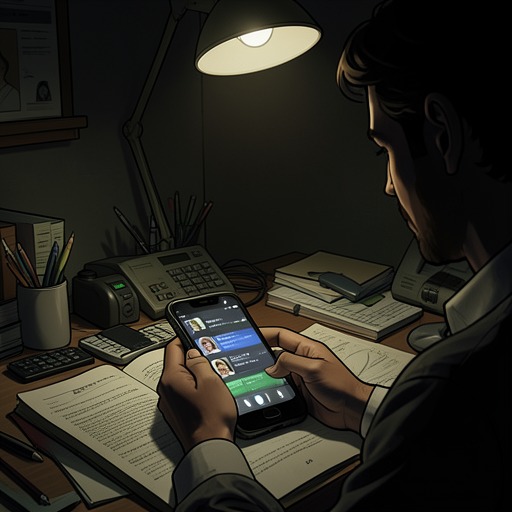
Jacob posts a Norman Bates composite photo
Defending JacobJacob posts a Norman Bates composite photo is a small online act that acquires outsized weight in the Barber family’s life under prosecution. In mid-August, Jacob placed his own face on the knife-wielding figure from Psycho and captioned the image “What people think of me.” To Jacob it was a joke; to Andrew Barber, it was a durable digital record that prosecutors might turn into a portrait of guilt.
Background: A monitored online life
After Facebook froze Jacob’s original account, probably in response to a subpoena seeking his posts, he opened a new account under the name “Marvin Glasscock” and began adding people from his inner circle. Andrew and Laurie Barber agreed to limits: Jacob could not change the password, write about the case, or post photos and video. Andrew nevertheless checked the account each morning, aware that the case had made every online exchange potentially consequential.
The account also existed against the background of Jacob’s growing isolation. Before Ben Rifkin’s murder, his Facebook network had numbered 474, mostly classmates; afterward, only four people remained connected to the new account, including Derek Yoo. In person, Jacob had been suspended from school and received no calls or visits. The contrast between a shrinking real-world circle and a small online one helps explain why Laurie defended his need for contact even as Andrew worried about what the account could expose.
The image and Andrew’s reaction
Early one Sunday morning, Andrew found the composite on Jacob’s Facebook page. The image used Anthony Perkins’s silhouette from the shower scene in Psycho, with Jacob’s face—taken from what appeared to be a party photograph—substituted for the figure’s. Jacob was grinning in the source image. Friends responded with jokes and approval, treating the post as an amusing piece of online performance rather than a statement about the murder.
Andrew did not delete it at once. He carried the laptop upstairs and confronted Jacob while he was still asleep. When Jacob said it was a joke and asked whether they could delete it, Andrew focused on the gap between deleting a post and erasing its record. He feared that Neal Logiudice could obtain the material through a subpoena and present the picture to a jury as consciousness of guilt: not proof of what Jacob had done, but an image jurors might remember and use to move their judgment against him.
Family conflict and repair
The confrontation turns on competing understandings of the same image. Jacob treats it as humor and asks to remove it; Andrew sees a possible exhibit in a murder trial, one that could be detached from its playful context and made to support a prosecution narrative. His anger rises beyond the question of the post itself, and Laurie challenges his reaction. The exchange makes the family’s predicament concrete: Jacob’s ordinary attempts to joke and connect online have to be judged against the legal risk of every recorded gesture.
After Laurie leaves, Andrew apologizes for yelling. Jacob’s sniff gives Andrew no clear indication whether he is close to tears or angry. Andrew remembers Jacob as a baby and recognizes the sleeping child and the teenager as the same person, a moment that redirects his attention from managing evidence to protecting his son. He sits beside Jacob, touches his shoulder, and says he is trying to look out for him. Jacob tells him there is nothing wrong with him and that he already knows what they will do to him; Andrew answers that he knows. Jacob then falls asleep.
Digital records and public interpretation
The episode extends the book’s concern with the internet as both social refuge and evidentiary archive. Andrew had earlier read students’ online conversations with the intention of seeking a subpoena to preserve Facebook records. The posts feel intimate to the young people writing them, but their written form leaves a transcript that investigators and prosecutors can retrieve. The Psycho image sharpens that tension: a joke made for a small online audience can outlast its immediate context and be recast by the legal system.
The image’s meaning is not settled by the post itself. Jacob calls it a joke, and his friends respond playfully; Andrew imagines how the prosecution could make it signify something darker. The narrative thus distinguishes the act from the interpretation that may attach to it, while showing why the distinction offers little comfort to a defendant’s family. In a case already shaped by public suspicion, the possibility that a jury might remember the image is itself consequential, even before it is known whether prosecutors will use it.