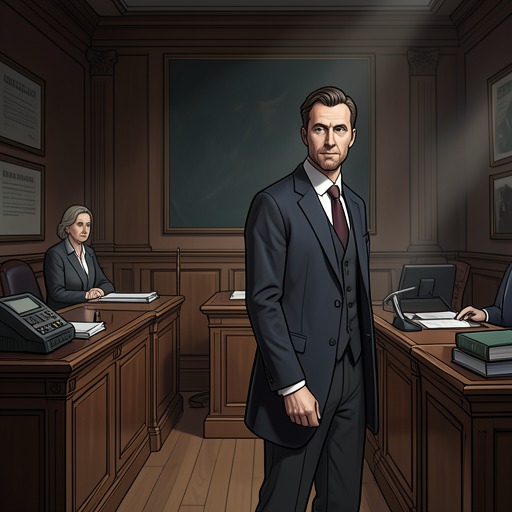
Jacob's defense psychiatric evaluation interview
Defending JacobJacob's defense psychiatric evaluation interview brings the Barber family to McLean Hospital, where defense psychiatrist Dr. Elizabeth Vogel asks about Jacob's childhood and behavior. The meetings are intended to assess competency and criminal responsibility, but they also become a test of what the family can acknowledge: Laurie recounts troubling patterns, Andrew tries to defend his son from their implications, and Vogel insists that the assessment requires candor rather than advocacy. The interview does not resolve whether Jacob killed Ben Rifkin; it makes the family’s competing understandings of him part of the case itself.
Purpose and Setting
The evaluation begins as a standard defense procedure proposed by Jacob’s lawyer, Jonathan Klein: a competency and criminal responsibility assessment. Andrew learns that the selected psychiatrist is also an authority on genetic inheritance and behavior, and worries that the defense may have to address the contested idea of a “murder gene.” He regards such evidence as scientifically immature and fears that it could become propensity reasoning: an argument that Jacob was disposed to violence and therefore committed this crime. Klein’s preparation thus opens a subject Andrew would rather keep outside the case.
The meetings take place in a bare, sparsely furnished room on the campus of McLean Hospital, where Dr. Elizabeth Vogel practices. The plain setting offers little of the comfort Laurie hopes to find in the psychiatrist. Vogel, who also teaches and researches at Harvard Medical School, does not simply listen passively; she leans forward and presses for frank answers. Her manner makes the interview less a reassuring consultation than a structured effort to obtain a fuller account of Jacob.
Laurie’s Recollections
Laurie describes noticing Jacob’s moods when he was very young. As a baby, she says, she could recognize from the sound of his crawling that he was entering a frightening mood. During such episodes, he would come down the hall on all fours, throw things, and scream. Laurie says she could not stop the outbursts, and would put him in his crib or playpen and step away until he calmed down.
She dates the beginning of other children being hurt around Jacob to when he was two. Laurie does not describe him simply as mean; she says he seemed unable to imagine how other children would feel if he pushed them down and was hard to control. At the time, she and Andrew treated the behavior as a phase that many boys passed through. Laurie had asked Jacob’s pediatrician for help and was told not to worry, that he was still very young and would outgrow it. The reassurance left her feeling that her concern might be excessive, even as she remained horrified when other children were hurt.
Laurie says the situation improved in some respects: other children were no longer getting hurt around Jacob. But she adds that he continued to misbehave, especially by stealing. She remembers him taking things from stores, a CVS, the library, and her purse, and says that talking to him did not change the behavior. These recollections complicate a simple account of an entirely untroubled childhood without establishing that any childhood behavior caused the murder.
Conflict Within the Family
The interview makes Laurie’s willingness to speak and Andrew’s resistance to her disclosures collide. Andrew objects that she is being unfair to Jacob, while Laurie insists that she is telling the truth. Her account threatens the defense’s cleanest emotional claim—that the family can confidently separate an ordinary childhood from the accusation now confronting them. Andrew hears the conversation as treating Jacob as someone who must answer for something; Laurie appears determined not to let his objections silence her.
Vogel asks Laurie directly whether she doubts Jacob’s innocence. Laurie answers no, but Vogel observes that her descriptions sound as though she may have doubts. The question does not produce an admission of guilt. Instead, it exposes a distinction the family struggles to maintain: concern about Jacob’s past is not itself proof that he committed the crime, yet the pressure to defend him makes even an account of childhood behavior feel dangerous.
Andrew eventually interrupts the direction of the discussion. He insists that Jacob had nothing to do with Ben Rifkin’s death and objects to treating him as a freak or monster. He calls Jacob an ordinary boy with flaws, and frames the injuries from early childhood as rough play that ended before kindergarten. His defense is both a statement of belief and an effort to prevent the interview from turning personal history into a theory of criminal responsibility.
Confidentiality and the Unresolved Record
Vogel tells the family that she has been hired by the defense, works for them, and is on Jacob’s side. She explains that she will submit her report to Klein, after which the family can decide what to do with it, and says their conversation is confidential. She asks them not to hide information or defend Jacob in the room; her stated aim is to learn the truth about him. Andrew remains uneasy with the premise that anyone can confidently claim to know that truth.
That unease gives the evaluation its lasting significance. The family has invited an expert to assess Jacob, but the resulting account cannot be kept neatly separate from the legal battle: childhood behavior may be interpreted as relevant to a psychiatric evaluation, or recast as a prosecution narrative about violent disposition. The interviews therefore reveal both the need for a fuller record and the danger of making that record do more than it can prove. The questions sharpen the conflict between protection and candor, but the evidence presented here supplies no definitive verdict about Jacob’s innocence or guilt.