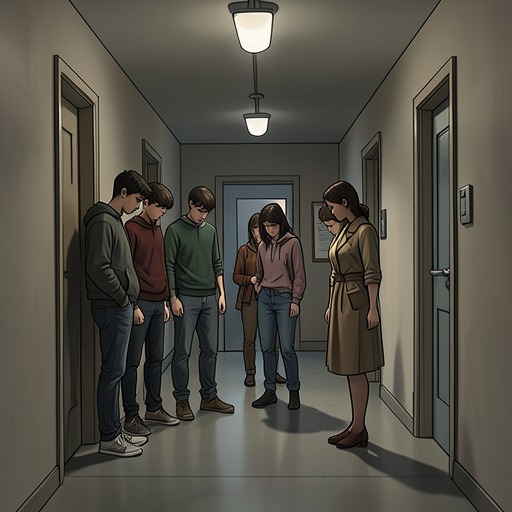
Jacob’s home education and social withdrawal
Defending JacobJacob’s home education and social withdrawal are the lasting social consequences of his prosecution: even after the case is dismissed, the stigma surrounding him keeps him out of school and narrows his life to lessons at home. The arrangement offers a workable daily structure, but it does not restore his place among other children; Jacob himself seems increasingly at ease with solitude, while his family remains marked by the case.
From suspension to continued homeschooling
When Jacob was indicted, he was suspended from school, and the town arranged a home tutor, Mrs. McGowan. After the charges were dropped, the family rehired her rather than sending him back. Neighbors remained suspicious of Jacob because of the knife, his violent fantasies, and the family history associated with him; even people who believed he might not have killed Ben Rifkin did not necessarily regard him as innocent or want their children around him. The sudden end of the trial also struck some as questionable. In that climate, his continued presence in town made him a pariah, and returning to school did not seem viable.
The arrangement had an institutional constraint as well as a social cause. The family had been told that Newton would not cover homeschooling under a special-education plan until they had exhausted other options. That requirement later led to a few school interviews, despite the family’s expectation that Jacob would be homeschooled through the rest of high school. The interviews therefore became a formal hurdle: Jacob had to seek admission to schools the family believed would be unwilling to take the legal risk or public attention associated with him.
The household classroom
Mrs. McGowan became the household’s only regular visitor and, in practice, one of the few outsiders who saw the family’s daily life. She arrived each morning at nine and worked with Jacob at the kitchen table, reviewing his lessons and insisting that he complete his homework. Her blunt reminder that no one would feel sorry for him made clear that the instruction was not simply protective or indulgent; she expected him to keep working despite his circumstances.
Laurie also took an active role in Jacob’s education. Andrew, who had not previously seen her teach, found her patient and kind with their son and thought that she should return to teaching. The lessons thus became a sustained family routine as well as a substitute for school: Mrs. McGowan supplied regular instruction, while Laurie’s participation brought her own teaching ability into the home.
Solitude and the rejected return
As the weeks passed, Jacob said that he did not miss school or his friends. He valued homeschooling for its academic content, while preferring to avoid the complications of other students: girls, sex, sports, bullies, peer pressure, and cliques. The account presents his isolation not only as something imposed on him by the town, but also as a life he appeared to accept, even prefer. When the family discussed moving, Jacob supported the idea most enthusiastically and favored going as far away as possible.
The school interviews arranged to satisfy the town’s requirement sharpened the cost of that isolation. Jacob experienced them as repeated opportunities to be rejected, and believed the schools were granting interviews merely to see what he looked like. He was sullen about the prospect of another interview at a private school in Natick. In the minivan on the way there, he asked Laurie to turn on the radio; she briefly put on WBUR, then turned it off. The ordinary news served only to remind them that the wider world continued without regard for their private ordeal.
A legal release without social restoration
The dismissal of the case brought the Barbers intense relief, and they understood it as more than a jury’s failure to convict. Yet legal freedom did not undo the local judgment. Neighbors continued to regard Jacob as troubling, and the trial’s abrupt end gave some further reason for suspicion. The contrast is central to his post-case life: the prosecution ends, but the social consequences remain, shaping the family’s decision to keep him at home and his own increasing retreat from school and peers.
By the time another school interview was arranged, the family still expected homeschooling to continue. Jacob’s apparent calm and comfort in solitude could be read as resilience, but it also made his exclusion easier to sustain: he did not visibly break down or demand a return to ordinary school life. The home classroom accommodates his education, while leaving unresolved whether the community will ever accept him again.