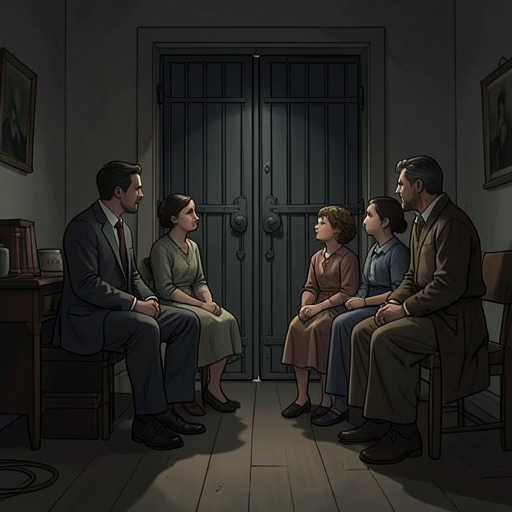
Jacob’s social isolation after his arrest
Defending JacobJacob’s social isolation after his arrest reaches beyond suspension from school: friends stop calling or visiting, and classmates who accept his Facebook account largely refuse to acknowledge him in person. The contrast between a shrinking real-world circle and a monitored online one makes isolation a practical condition of the family’s life and a source of anxiety about what the digital record may reveal.
Withdrawal from Ordinary Contact
Jacob is wary when Laurie answers the family’s ringing phone. He already understands that the calls are not for him, and he has little habit of using the telephone. He considers it intrusive, awkward, archaic, and inefficient; texting and Facebook feel more comfortable because they are less intimate. His preference for typing rather than talking is not simply a matter of taste in communication. By this point, his friends have dropped him, and the phone no longer offers an ordinary route back into their company.
The family’s efforts to maintain a normal dinner routine sit uneasily beside this withdrawal. Laurie hurries to answer before the answering machine can pick up, while Andrew recognizes that she wants to preserve normalcy and holds back his instinct to warn her. The phone becomes a small but telling test of whether the family can behave as it did before Jacob’s arrest, even as Jacob’s social world has already changed.
A Reduced Online Circle
Facebook freezes Jacob’s original account, probably because a subpoena compels the production of his past posts. He opens another account under the name Marvin Glasscock and starts friending members of his inner circle again. Laurie defends his access to this online life: she argues that Jacob is alone and needs people, and that online contact is a necessary part of how young people socialize. Andrew objects, but they agree to limits: Jacob must not change the password, post about the case, or share photos and video. Their compromise preserves some contact while leaving his parents able to monitor and edit his activity.
The scale of the change is stark. Before the murder, Jacob’s Facebook network included 474 people, mostly classmates; afterward, only four accept the new account, one of them Derek Yoo. Those few online connections do not translate into ordinary companionship. Jacob has no in-person friends, and nobody calls or visits him. He has been suspended, and the town will have to provide a tutor at home when September comes; Laurie spends weeks negotiating with the school department over the amount of tutoring he is entitled to receive. The gap between online acceptance and face-to-face avoidance gives his isolation a social, institutional, and domestic dimension.
Connection Under Surveillance
The family’s limits on the new account lead to a cat-and-mouse arrangement. Jacob tries to joke about his situation in language vague enough to escape his father’s censorship, while Andrew checks the account every morning after opening Gmail. His routine moves from Facebook to a Google search for Jacob’s name before he turns to other parts of the Internet. The monitoring is an extension of parental vigilance, but it also makes the family’s remaining channel of contact feel conditional and supervised.
Andrew sees a deeper danger in the format itself. Facebook activity creates a stored record; unlike a phone call, written exchanges leave a transcript. He regards the Web as a powerful tool for prosecution, capable of preserving even private or unspoken aspects of people’s lives. The medium that lets Jacob maintain a handful of connections also exposes those connections to scrutiny, making online contact both a fragile substitute for friendship and another source of legal risk.
Isolation Beyond the Case
The book later places Jacob’s release within a broader account of life after the case’s decisive events. The family does not return to normal, and its routine remains barren: the Barbers go out little, avoid public places where they feel watched, and spend much of their time at home. Laurie avoids the market because she fears encountering the Rifkins, while Andrew takes over the grocery shopping. This later pattern does not erase Jacob’s earlier social isolation; it shows how the rupture extends into the family’s shared life.
The narrative’s distinction between Big Days and the many ordinary days that follow underscores why release cannot simply restore the life that came before. Exoneration is momentous, but the little days continue in a changed routine, without the old meaning of normal. Jacob’s isolation is therefore not only a temporary loss of classmates and familiar contact: it belongs to a larger aftermath in which legal vindication and social repair prove to be different things.