James O’Leary
Defending JacobJames O’Leary, usually called Father O’Leary, is a sixty-four-year-old former gangster who now works as a fixer. His decisive appearance comes when he prevents Dan Rifkin from attacking the Barber family with a kitchen knife. Later, Andrew Barber concludes that O’Leary had also helped secure Leonard Patz’s confession through intimidation. He embodies the story’s uneasy distinction between being protected and being delivered justice: his intervention shields the family, but the means Andrew suspects are themselves coercive and unlawful.
Identity and Background
Father O’Leary’s history reaches back roughly fifty years. He was once a violent enforcer, described to Andrew as a leg-breaker, and federal authorities charged him with a RICO conspiracy in the 1980s alongside other men; he beat that case. By the time Andrew learns about him, O’Leary is considered too old for his former role as muscle. His work has narrowed to fixing problems for hire, including collections, evictions, and silencing people. The description makes age a change in method rather than a departure from the world of force: he no longer serves as a leg-breaker, but his reputation still rests on making trouble disappear.
The name Father O’Leary carries a misleadingly benign sound. Andrew’s friend Paul Duffy jokes about calling him a grandfather, but the account immediately establishes that O’Leary is no harmless elder. His nickname and advanced age sit beside a criminal record associated with weapons, drugs, and violence. The contrast helps explain why his arrival can seem at once reassuring and alarming: he is a figure of protection precisely because he has a history of operating beyond ordinary legal boundaries.
The Fixer’s Work
Andrew first learns of O’Leary through a police friend, who describes him as an old enforcer still working as a fixer. When Andrew asks what a fixer does, the answer is that he makes problems go away. That phrase becomes the key to Andrew’s later suspicion. It does not establish what O’Leary did in every instance, but it gives Andrew a framework for connecting the older man to events that official channels have not resolved.
The book does not present O’Leary’s business as public service or lawful investigation. His small-time work is transactional: he hires himself out to handle problems. That description links his past and present without claiming that every job involves violence. It also places him outside the institutions that dominate the case. Prosecutors, police, and defense lawyers work through rules and evidence; O’Leary’s stated trade is to make an obstacle disappear.
Intervention at the Garage
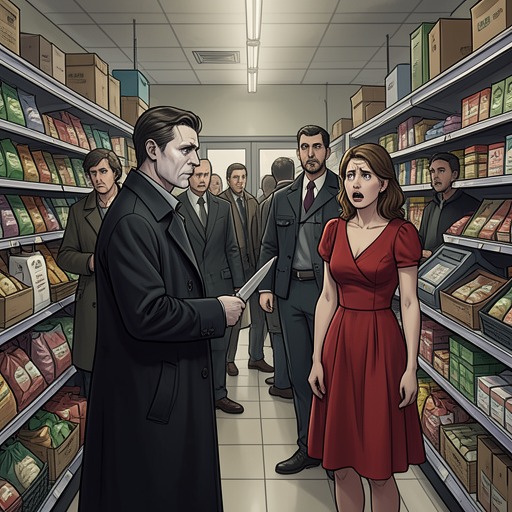
After the trial, the Barber family encounters Dan Rifkin in a parking garage. The family has turned toward him expecting a painful but civil reunion; instead, his expression is hard, and he takes a kitchen knife from his coat. Andrew recognizes it as a Wüsthof Classic steak knife from the same set kept in the Barber home. Before Dan reaches them, Father O’Leary intervenes, restraining him and disarming him in a matter of seconds. The attack does not proceed, and the family is left trying to understand who has just protected them.
The details make O’Leary’s intervention intimate as well as startling: the weapon is an ordinary household knife, recognizable to Andrew because it resembles one of the knives in his own kitchen. O’Leary handles Dan with professional ease, and his brief command to him is, “Easy there, champ.” The encounter turns a familiar domestic object into a threat, then into evidence of how close the family came to another confrontation. O’Leary’s presence prevents the immediate danger, but it also raises a question the family cannot answer from the scene alone: why was he there, and what obligations or earlier arrangements connect him to them?
Suspected Role in Patz’s Confession
Andrew later confronts his father, Bloody Billy Barber, with the theory that O’Leary was called in to deal with the case’s central problem. Andrew recalls what he heard about O’Leary’s work and reasons that his father reached out to an old associate to make the problem go away. Billy does not confirm the accusation. Andrew nevertheless believes that both men understand what happened: he imagines O’Leary frightening Leonard Patz and making him sign a confession after a particularly difficult day for Jacob in court.
This account remains Andrew’s inference, not a confession by O’Leary or a verified account of what took place. Its significance lies partly in that uncertainty. Patz’s confession appears to resolve the threat to Jacob, but Andrew suspects that the resolution was engineered through intimidation rather than established by reliable investigation. When Andrew asks his father what he has done to Jacob, Billy answers that he saved his life. O’Leary is not shown explaining or defending his own conduct; his role is reconstructed through Andrew’s questioning and Billy’s terse response.
Protection and Moral Cost
O’Leary’s actions connect two different moments of danger: the suspected coercion of Patz, which could have removed the threat of conviction for Jacob, and the direct intervention that stops Dan from attacking the family. In each case, protection is associated with a man whose methods do not belong to the courtroom. The contrast does not make O’Leary a substitute for justice. Instead, it exposes the moral cost of a family’s reliance on force when formal proceedings and social acceptance have failed to make it feel safe.
His role also sharpens the book’s distinction between legal outcomes and lived consequences. The case against Jacob is dismissed, but the family remains socially isolated and vulnerable to hostility. O’Leary’s intervention keeps Dan’s knife from reaching them; Andrew’s suspicion that the same fixer helped produce Patz’s confession offers a possible explanation for why Jacob survived the trial. Yet both forms of protection leave the Barbers with an unresolved burden: safety may have been secured, but the truth about how it was secured remains uncertain.