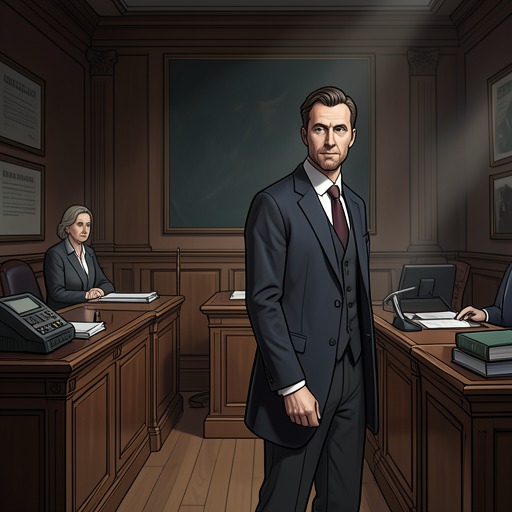
Jonathan Klein questions Jacob
Defending JacobJonathan Klein questions Jacob Barber in a defense meeting about the events surrounding Ben Rifkin’s death. The interview turns Jacob’s account into a test of credibility: Klein probes what Jacob noticed, what he did afterward, and how his explanation might sound under cross-examination. The exchange unsettles Jacob and Laurie, and helps establish the defense’s practical dilemma: Jacob should not testify, but merely attacking the prosecution’s case may not be enough.
Purpose and Setting
The episode appears under the chapter heading “Questioning” and centers on Klein’s interview with Jacob about the knife and the discovery of Ben’s body. The meeting is not presented as a hostile police interrogation; Klein asks in a measured, curious manner, while steadily examining details that could trouble a jury. His role is both supportive and adversarial in a limited sense: he represents Jacob, but cannot simply accept an account that may fail under courtroom scrutiny.
The interview takes place with Laurie present. She remains silent through much of the questioning, then intervenes when Klein’s method begins to distress Jacob. Her intervention changes the tone of the meeting, but not its underlying purpose: the defense must assess the story as jurors and the prosecutor may hear it, rather than only as Jacob remembers or intends it.
The Account Under Examination
Klein asks whether Ben’s body was on the path Jacob usually took through the park, and whether Jacob saw or heard anything before finding him. Jacob says he had not thought about the path in that way and recalls simply walking until he saw Ben lying there. Klein then focuses on Jacob’s failure to use the cell phone in his pocket to call emergency services. The question draws attention to a gap between the gravity of the situation and Jacob’s reported response.
Klein also tests what Jacob noticed at the scene. He points to the blood trail down the hill and asks whether Jacob saw it. Jacob says he did not, explaining that he was frightened and internally panicking, though he did not show that reaction when Derek Yoo encountered him a few minutes later. Klein gathers these details into a single challenge: Jacob says he was overwhelmed, saw no blood, and did not understand what had happened, even though the circumstances described in the interview make those claims difficult to accept at face value.
The questioning becomes more personal when Jacob tells Klein that the lawyer’s phrasing makes it sound as if Jacob is lying. Jacob insists that the account is his own, while objecting that Klein has distorted its details. In particular, he rejects the picture Klein has constructed of Ben lying entirely facedown amid an overwhelming amount of blood. The scene thus distinguishes between Jacob’s insistence on truthfulness and the precision, coherence, and plausibility that a courtroom will demand from his story.
The Limits of Testimony
Klein warns Jacob that an account that sounded convincing when rehearsed alone may sound different under cross-examination. He contrasts the present interview with the more aggressive questioning he expects from Neal Logiudice, the prosecutor. The warning is tactical rather than a declaration that Jacob is lying: Klein says his responsibility is to prepare the defense, not to act as Jacob’s parent, and he tests the account before the prosecution can do so.
The exchange over the thumbprint sharpens the problem. Klein asks the jury’s question in effect: how could Jacob place a thumbprint inside Ben’s sweatshirt, beneath the body, and then withdraw his arm without visible blood on it? Jacob responds that Klein has got the details wrong, but continues to maintain that the story is true. The interview therefore leaves a central difficulty unresolved: Jacob’s confidence in his account does not itself resolve the apparent mismatch between its details and the evidence Klein describes.
When Jacob asks how he will testify at trial, his father, Andrew Barber, tells him he will not take the stand. Klein agrees that this is wise. Jacob immediately asks what his defense will be, and Klein explains that the defense has no burden to prove anything; its task is to challenge the prosecution’s case at every turn. Andrew, however, doubts that this alone will suffice, given the thumbprint and the witness who places a knife in Jacob’s hand.
Alternative Theory and Consequence
Andrew proposes that the jury should hear about Leonard Patz and calls him the real killer. Klein’s response is practical: the defense must establish how it can prove that claim. Andrew suggests hiring a detective to investigate. The proposal follows directly from the interview’s impasse. Jacob’s testimony appears too vulnerable to cross-examination, and a purely negative defense seems inadequate to Andrew, so the conversation turns toward an alternative suspect and the need for evidence to support that theory.
The encounter does not produce a new, settled account of Ben’s death. Instead, it clarifies the choices and risks facing the defense: Jacob’s story must withstand hostile scrutiny, he is advised not to testify, and the defense must decide whether to rely on weaknesses in the prosecution’s case or investigate a positive alternative. Laurie’s request that Klein stop shows the personal cost of that preparation, while Jacob’s continued insistence that he is telling the truth leaves the factual conflict open rather than resolving it.