Laurie’s psychological and physical decline
Defending JacobLaurie’s psychological and physical decline is one of the less visible but consequential injuries of Jacob’s prosecution. It unfolds not as a single crisis but as a gradual alteration in the woman Andrew remembers: exhaustion and weight loss give way to diminished concentration, fading optimism, and withdrawal, while her husband mistakes endurance for recovery and postpones their emotional reckoning until an imagined “After.”
The First Signs of Change
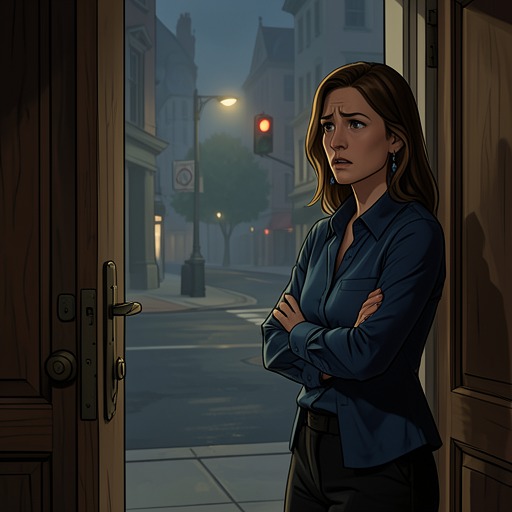
After Jacob’s arraignment, Laurie left the courthouse with Andrew and Jacob through a crowd of increasingly aggressive reporters. By the time they reached the family home, she looked wrung out; her hair was beginning to lose its order in the humidity, her face was drawn, and the weight she had steadily lost since the catastrophe had made her heart-shaped face gaunt. At the sight of graffiti on the front of the house calling Jacob a murderer, she gasped and covered her mouth. The family’s return home thus brought no refuge from the case: public hostility had reached their door, and Laurie had to encounter it while already depleted.
That afternoon, the family met with Jacob’s lawyers to discuss the case. Laurie came prepared to take notes, asking for a legal pad and sitting with the same industrious attention Andrew associated with her earlier life. Yet the effort to remain organized and clearheaded existed alongside what he describes as a shock-hammered look in her eyes. Her determination to think her way through the crisis was not proof that she was untouched by it. Andrew understood that her ability to keep working could make the damage harder to notice, even as he recognized that she was paying a severe price.
The Person Andrew Remembers
Andrew measures Laurie’s decline against her former habits and presence. She once read constantly, even holding a book while brushing her teeth; now she no longer picked up books, lacking both the concentration and the interest. Before, she focused so intently on the person speaking that the listener felt captivating. Now her eyes wandered, and she seemed less present. Her clothes, hair, and makeup became mismatched and careless, while the youthful eagerness that had made her shine began to fade.
The contrast is especially meaningful because Andrew’s account stresses that Laurie had always been more than the composed, familiar image he had of her. Recalling their college years, he remembers her neat, carefully organized notes and her different academic interests. Those memories lead him to recognize that she was as complex and inwardly unknowable as he was. In the present crisis, however, he does not turn that recognition into sustained attention. He can see that she has changed, but he does not yet understand what she is experiencing as Jacob’s mother.
Andrew’s Misjudgment and Laurie’s Isolation
By the last week of August, Andrew describes the whole family as heat-crazy and himself as coming apart. He admits that he had become self-absorbed, entangling his own guilt with Jacob’s and concentrating on keeping up appearances. Rather than invite Laurie to speak openly, he discouraged frank emotional conversation. He soon stopped noticing her as a person in her own right and never asked what it was like for the mother of a son accused of murder.
Andrew believed that the sensible course was to withstand the trial, keep Jacob safe, and repair the family’s emotional damage later. He imagines “After” as a place to which he can get his family across, where the postponed problems will finally be addressed. The plan makes the case’s resolution seem like a prerequisite for caring for Laurie, rather than a moment whose strain is already affecting her. His retrospective account directly rejects that assumption: there was no guarantee that the harm could simply be dealt with once the legal crisis ended.
He recalls that Laurie had once loved him when he came to her damaged, but that when she herself was damaged, he did not help. He noticed her graying, increasingly disordered hair and the lines in her face, her weight loss until her hip bones protruded, and the fact that she spoke less and less when they were together. Even with those signs before him, he kept choosing to save Jacob first and attend to Laurie later. He explains that he had become practiced at containing dangerous emotions and was overwhelmed by the endless summer, but refuses to let those explanations excuse his behavior: he calls himself a fool.
The Case’s Uneasy Promise of Relief
Earlier, Dan Rifkin had told Andrew that the unresolved case was draining and that knowing the accused man had been locked away would help him and his family find closure. Andrew had agreed that resolution could help parents. Laurie’s experience makes the limits of that promised relief plain: the legal process imposed strain not only on the bereaved Rifkins but also on the family living under accusation, publicity, and hostility. Their suffering is not interchangeable, but the case’s demand for a decisive outcome cannot itself restore what it has damaged within either household.
When the prosecution dropped the charges against Jacob, Andrew and Laurie experienced the decision as a miracle and believed the episode might be erased. The intensity of their relief shows how much of their lives had been organized around the possibility of Jacob’s conviction. Yet the end of the prosecution is not presented as a cure for Laurie’s decline. Andrew’s earlier admission remains: he had overlooked her while telling himself that healing could wait until the case was over. The contrast between the sudden legal reversal and the gradual damage to their marriage gives “After” its painful ambiguity: the case can end, but the family’s emotional consequences do not thereby disappear.