Legal Dichotomies and Moral Complexity
Defending JacobLegal Dichotomies and Moral Complexity is the tension between law’s need to sort people and acts into opposing categories and a family’s experience of loss, uncertainty, and divided loyalties. The novel repeatedly stages that tension through the case against Jacob Barber and its aftermath: a verdict or dismissal can alter legal status, but neither necessarily answers what happened or repairs the damage among the people left behind.
The demand for a legible case
The prosecution turns a death into a story designed for a jury. Neal Logiudice describes a fourteen-year-old boy found dead in Cold Spring Park, then offers a causal script: Jacob Barber had a lethal temper, was pushed by ordinary teasing, and finally “snapped.” The account gives the jury an intelligible sequence and a phrase to carry into deliberations. The narrator recognizes the craft of this strategy even as he rejects its certainty: Logiudice’s story supplies the apparent explanation that the evidence itself does not settle.
That gap becomes most visible in the question of motive. Logiudice acknowledges that the trigger may never be known and proposes possibilities about what Ben Rifkin might have said or done. The narrator notes that the prosecution can offer theories, guesses, probabilities, and “murder genes,” but no firm answer to how a boy with no known history of violence could commit such an act. The case therefore exposes a pressure built into legal storytelling: jurors want a reason, while the available facts may not provide one. A coherent account can persuade without converting uncertainty into knowledge.
The prosecution’s treatment of Ben Rifkin likewise resists a simple moral division. Logiudice tells jurors that Ben was not a saint and may have teased Jacob, but insists that an imperfect fourteen-year-old should not be reduced to his flaws. The dead boy’s ordinary imperfections do not make his killing acceptable; nor do they complete the account of Jacob’s responsibility. The argument asks the jury to hold sympathy for the victim together with a description of the defendant as an outsider, while still pressing toward one decisive judgment.
Procedure, authority, and competing duties
The novel’s institutional scenes show that legal judgment depends on boundaries between roles as well as on competing interpretations of events. When Lynn Canavan says she is uncomfortable with Andrew Barber handling a case involving a school attended by his son, the concern is not a finding about his conduct but the appearance of a conflict. The scene makes professional impartiality a matter of public trust: Andrew’s responsibilities as a prosecutor and as Jacob’s father cannot be cleanly separated by intention alone.
Other exchanges mark the limits of professional authority. Dr. Elizabeth Vogel tells Andrew that she was hired by the defense, works for the defense, and will report to Jonathan Klein; the family can decide whether to use her findings, and the conversation is confidential. Her assurance creates a protected space for candor, but it does not itself resolve what the facts mean. Jonathan Klein, whom Andrew respects for his intelligence, honesty, and wisdom, embodies another kind of legal expertise: not a promise of certainty, but a disciplined capacity to work within the law without pretending that advocacy and truth are identical.
The investigation’s delays at McCormick School reveal a further boundary dispute. Parents raised concerns about interviews with students, whether lawyers should be present, access to lockers without a warrant, the use of school premises, and which pupils could be interviewed. These restrictions complicate the gathering of evidence, but they also register that children and their families are not merely resources for a case. Procedure protects interests while limiting investigators’ reach; its costs and protections cannot be collapsed into a single measure of efficiency.
Grief beyond the verdict
For Dan Rifkin, the case is not an abstract contest over proof. He tells Andrew that uncertainty is draining and that resolution, the apprehension of the person responsible, and a sense of closure might help him and his wife. His repeated qualification that he does not mean to pressure Andrew underscores how grief and trust coexist: he needs the prosecutor to act, and he is trying to preserve faith in him while asking for an end to uncertainty.
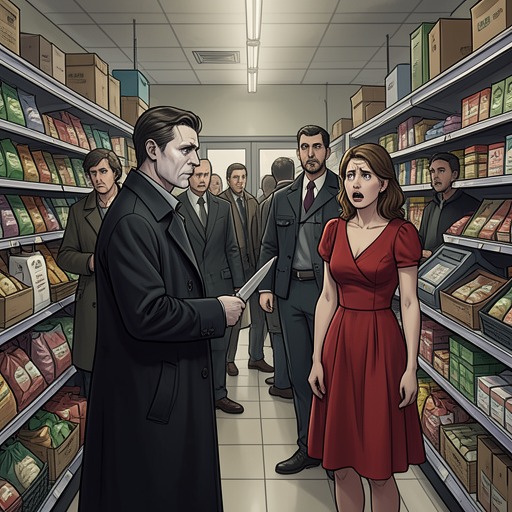
The encounter between the Barber and Rifkin families at a market makes the asymmetry of their losses visible without turning either family into a legal argument. There are three Barbers and two Rifkins; one son is present and the other is gone. Joan Rifkin’s visible offense at the Barbers’ presence gives the scene its moral force. Jacob’s continued existence can appear profane to parents whose son has died, even though his survival is not itself proof of guilt. The legal distinction between accused and victim cannot make the families’ shared public world emotionally neutral.
Dismissal and what remains
When Leonard Patz’s confession becomes known, the Barbers experience the news as more than a possible acquittal. Andrew says they saw it as Jacob having been proven innocent, rather than merely not proven guilty, and describes the feeling as a miracle. Yet their joy remains qualified until the case is officially dismissed; they still fear that Logiudice might continue the prosecution. The distinction between evidence that changes a family’s understanding and a formal legal act remains consequential: the charges end only when the prosecutor files a nolle prosequi, after which the judge tells Jacob he is free.
Legal release does not restore the world that existed before the case. As the Barbers leave, Dan Rifkin approaches with a kitchen knife, and James “Father” O’Leary stops him before he reaches them. The episode brings private grief and danger into the space of the courthouse aftermath; the state’s decision to drop charges cannot by itself reconcile the victim’s family with the accused family or guarantee their safety. The ordinary knife also links the threat to household life rather than to an abstract legal symbol, while O’Leary’s intervention prevents the confrontation from becoming another irreversible loss.
The later grand-jury questioning of Andrew makes the unresolved moral burden explicit. Neal asks why Andrew will not help investigate Laurie and says that what she did was his family. Andrew refuses speeches and demands proper questions; when Logiudice says Laurie should be indicted, Andrew again declines to engage on those terms. The conflict is at once procedural and personal: the prosecutor seeks testimony, while the witness is a husband and father being asked to help define responsibility inside his own family.
Logiudice tells Andrew that Laurie accelerated toward a bridge abutment and calls her actions murder. Andrew does not respond to that accusation. When Logiudice asks what happened to Jacob and says the matter can still come out right, Andrew answers, “Can it?” The question leaves the legal and moral accounts unreconciled. The novel’s governing distinction is not that law has no value, but that its binary classifications—guilty or innocent, criminal or victim—cannot encompass every wound or make every consequence right. A legal decision can close a prosecution; it cannot, on its own, produce shared truth, absolution, or repair.