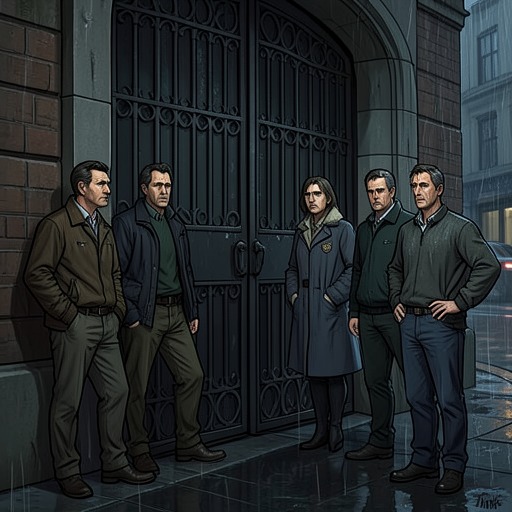
Leonard Patz
Defending JacobLeonard Patz is a convicted sex offender who lives near Cold Spring Park and becomes the alternative suspect Andrew Barber pursues in the murder of Ben Rifkin. Andrew’s conviction that Patz, not Jacob Barber, killed Ben drives a lonely counter-investigation that clashes with the prosecution’s case; Patz’s eventual confession appears to vindicate Andrew, while leaving the larger question of what the confession can settle shadowed by the damage already done.
Identity and Background
A Board of Probation record gives Patz a history of offenses and charges involving indecent assault and battery, including offenses against minors; one charge was dismissed and another was pending. Paul Duffy tells Andrew that Patz is twenty-six and lives near the park in the Windsor Apartments. The record makes him a known sexual offender, and his residence near the park where Ben was killed gives the lead immediate investigative relevance. At the same time, the record is not proof that Patz committed this particular crime.
Patz’s connection to a fourteen-year-old boy provides a further, troubling point of comparison: Duffy tells Andrew that Patz had grabbed a boy’s package in a public library, and that the boy was the same age as Ben. Andrew treats the incident as a start, not a conclusion. That distinction soon narrows as he builds a case in his own mind from Patz’s history, location, and apparent access to the park.
Andrew’s Pursuit
When detectives interview Patz at the Newton Police Station, he sits still in the interview room while detectives watch his image on a screen outside. The recording camera is concealed in a schoolhouse clock, though detectives are required to tell Patz it is present and obtain his consent to record. Andrew urges the investigators to continue questioning him: Patz, he argues, knows the park and its morning routine, has acknowledged being there that morning, and is physically capable of overpowering the victim. In Andrew’s view, motive, means, and opportunity align; he wants a confession before Patz’s lawyer ends the interview.
Andrew’s certainty grows beyond the interview. While keeping to his running routine after Jacob’s indictment, he runs through Cold Spring Park and arrives at the Windsor Apartments with the growing conviction that Patz is responsible. He finds Patz’s plum-colored Ford Probe in the parking lot and recognizes it from information Duffy had gathered. The car and Patz’s known connection to the neighborhood become part of Andrew’s private pattern of suspicion, though neither establishes guilt.
Andrew later follows Patz for weeks, morning and evening, observing his trips to Dunkin’ Donuts and his work at Staples. He also sees him spend time near Cold Spring Park, eat at a McDonald’s drive-through in Brighton, and go to a movie alone. Patz’s observed routine yields no especially suspicious act, and Andrew knows that Matt Magrath’s account would not persuade a jury without harder evidence. Yet the absence of a new incriminating incident does not loosen his belief. Instead, the ordinary dullness of Patz’s life frustrates Andrew, and the possibility that Jacob might be sacrificed while Patz escapes becomes an obsession.
The Lead and the Trial
Matt Magrath gives Andrew a crucial account of Patz’s motive for ending their association: Patz had become interested in another boy who walked through the park in the morning near his apartment. When Andrew asks who the boy was, Matt identifies the child who was killed. Matt also tells Andrew that Patz had been shaking him down for money. The information gives Andrew a narrative connecting Patz to Ben, but Andrew recognizes that Matt’s word alone would be difficult to use in court.
At Jacob’s trial, the defense brings Patz’s history and Andrew’s advocacy into view. A witness confirms Patz had a record for offenses involving young boys, and the questioning emphasizes that investigators initially had no obvious suspect and that a known offender living beside the park was relevant information. Another account establishes that Andrew wanted to pursue Patz and that there was circumstantial indication of possible involvement. The trial thus exposes a consequential divide: Andrew saw Patz as a lead demanding investigation, while the case against Jacob proceeded without resolving that alternative to Andrew’s satisfaction.
Andrew’s belief is also revealed in his own testimony. When asked who Patz was, he blurts out that Patz was the man who did it. The statement is a declaration of Andrew’s certainty, not independent proof. Its force comes from the contrast between the confidence with which he names Patz and the unresolved status of the evidence in court.
Confession and Aftermath
After Patz receives a subpoena, he dies by suicide and leaves a full confession. Jonathan Klein reports that the authorities have confirmed the handwriting and that the note is genuine. Patz’s confession identifies him as Ben’s killer, appearing to answer the question Andrew had pursued throughout the investigation. Its arrival comes after Andrew has spent weeks following Patz and after the alternative-suspect theory has surfaced in Jacob’s trial; the confession radically changes the case’s meaning without undoing those earlier events.
The confession does not restore the Barber family’s standing in Newton. After the case ends, neighbors remain unsettled by Jacob’s knife, violent fantasies, and family history, and some regard the abrupt end of the trial as suspicious. Jacob remains a pariah, despite his release, and the family continues his education at home rather than sending him back to school. Patz’s confession therefore provides a decisive answer about the crime within the story, but it does not reverse the social consequences of suspicion or make the damage to the Barber family disappear.
Narrative Significance
Patz functions both as a concrete investigative lead and as the focus of Andrew’s need to resist the prosecution’s account of his son. The evidence that makes Patz relevant is specific—his record, his proximity to the park, and Matt’s account—but Andrew’s certainty outruns what he can establish in court. His prolonged surveillance yields mostly ordinary routines, making the later confession a sharp reversal: the man Andrew could not prove responsible is ultimately identified by his own written confession.
That reversal gives Patz’s role a lasting ambiguity of consequence rather than of identity. His confession appears to confirm Andrew’s judgment, but it cannot return Jacob’s lost time, restore the family’s welcome in town, or erase the suspicions attached to them. Patz becomes the belated answer to the murder and, at the same time, a measure of how little a factual resolution can repair once a family has been publicly marked.