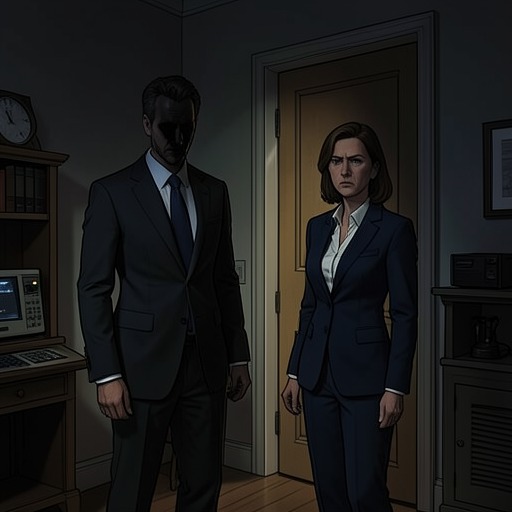
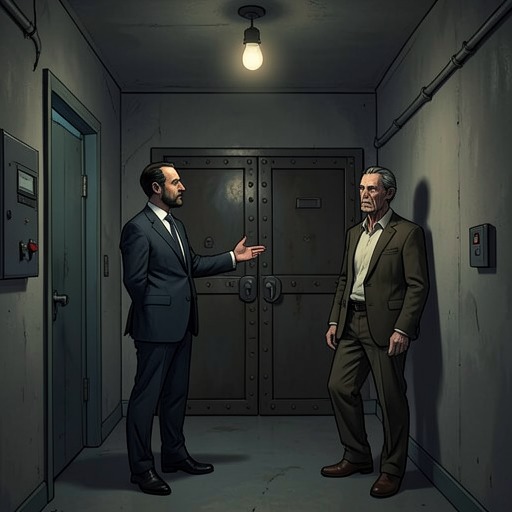
Matt Magrath tells Andy about the leads concerning Patz
Defending JacobMatt Magrath’s disclosure to Andy Barber turns a dubious accusation into a possible lead in Ben Rifkin’s murder investigation. Matt admits that he lied about an alleged incident at a library, then describes his dealings with Leonard Patz, identifies Patz’s interest in another boy who walked through Cold Spring Park, and says he saw Patz carrying a knife. The information points toward Patz, but arrives through a witness whose own dishonesty makes the truth difficult to establish.
The Interview and Its Reversal
Andy visits the Magraths’ apartment looking for Matthew. The encounter develops into a private interview, and Matt eventually tells him that Jacob Barber did not kill Ben: Patz did. The declaration catches Andy physically off guard; his heart begins to pound as he waits for Matt to explain.
Matt initially frames Patz as a friend and acknowledges that he had reported him for an alleged indecent assault. But he then retracts the accusation: Patz never committed the act Matt had reported. The reversal does not simply clear Patz of that specific allegation; it reveals that Matt fabricated it, making his account both more consequential and less readily credible.
Matt’s Account of Patz
Matt says that Patz approached him at McDonald’s and offered to buy him food. Matt accepted, and Patz later invited him to his apartment to watch a movie. Matt describes recognizing Patz’s interest and negotiating for money. He says the arrangement occurred five times over a period of a few weeks, and that Patz said he could not afford to continue paying.
According to Matt, the relationship ended when Patz said he was interested in another boy: a child who walked through the park near his apartment in the morning. When Andy asks who the boy was, Matt identifies him as the child who had been killed. The detail gives Andy a specific connection between Patz and Ben, rather than merely an allegation that Patz was dangerous or dishonest.
Matt also says that Patz carried a knife when he thought he might meet people. He characterizes it as a fighting knife rather than a kitchen knife and says he saw Patz with it on the day they met. The account is not proof that this was the murder weapon or that Patz used it against Ben. It nevertheless supplies Andy with a significant investigative lead: Patz had a knife, and, in Matt’s telling, had spoken of the boy who walked near his apartment.
Why Matt Had Kept Silent
Andy asks why Matt did not come forward after learning that a child had been murdered. Matt explains that his own conduct had trapped him. He was on probation, had taken money from Patz, and had lied about the supposed library assault; telling the truth about Patz would also have exposed his own actions and false report.
Matt further says that he expected investigators to reject his story because he had already lied. His reasoning is borne out by the evident weakness of his position: he is an admitted liar, and his account places him in circumstances he could not easily disclose without incriminating himself. Andy recognizes the central difficulty. Matt may be telling the truth about Patz now, but the earlier lie gives a jury an obvious reason to doubt him.
The Lead and Its Limits
The disclosure shifts Andy’s attention toward Patz by linking him to Ben’s route through Cold Spring Park and by providing a witness account of Patz possessing a fighting knife. It also complicates that lead at its source. Matt’s admission that the library story was fabricated means the new account cannot be treated as uncomplicated corroboration; the same history that explains his silence also undermines his reliability.
The scene’s force lies in that contradiction. Matt offers the kind of specific information that could redirect an investigation, yet the information comes from someone whose previous lie threatens to make the truth unusable. His statement gives Andy a reason to pursue Patz, not a resolution of the case: the accusation remains testimony from a compromised witness, and its value depends on whether it can be supported beyond Matt’s word.