McCormick School
Defending JacobMcCormick School is the middle school attended by Jacob Barber and Benjamin Rifkin, and it becomes a crucial setting in the investigation after Rifkin is murdered. Its reopening only five days after the killing brings the case back into the ordinary rhythms of school life, while disputes over access to students delay investigators and complicate their search for information. The school’s classrooms and interviews reveal not only what investigators are trying to learn, but the limits placed on them and the collective silence they encounter.
Identity and Setting
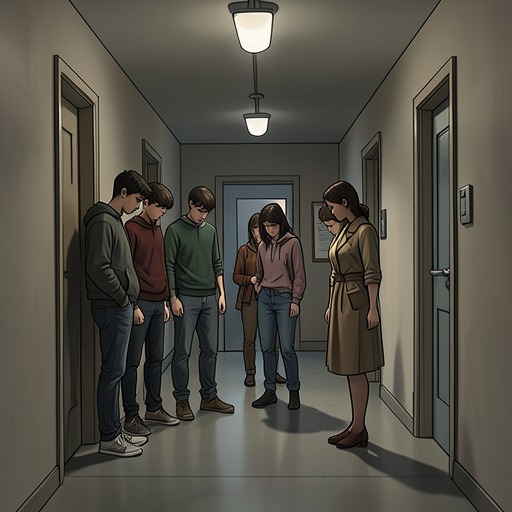
The McCormick is a middle school serving grades six through eight. Its plain rectangular sections and walls layered with teal paint form an unremarkable institutional backdrop, one Laurie recognizes from her own childhood: she grew up in Newton and attended the school in the 1970s. The building has changed little, she says, though walking its halls gives her the impression that it has shrunk. That continuity links the school Laurie remembers to the one Jacob now attends, even as a murder transforms its familiar corridors into a site of grief and investigation.
Jacob and Rifkin are classmates, but Jacob says he barely knew him. Rifkin is described as a smart but unstudious eighth-grader, handsome and conspicuous, interested in sports but more drawn to skateboarding and skiing. Jacob says Rifkin had his own group of friends and that other students noticed him more after his death than they had before. The contrast between their limited acquaintance and the school’s subsequent attention to Rifkin underscores how quickly a familiar student becomes the focus of communal mourning and inquiry.
Reopening After the Murder
The school reopens five days after the murder. For the Barber household, that return to routine does not feel routine: the family follows its usual morning sequence of showers, coffee, bagels, and checking online news, but everyone is tense. They are up by 6:30 and nevertheless dawdle until they are running late. The detail makes the reopening’s effect concrete: ordinary school time resumes, but the family’s movements have become hesitant and unsettled.
Laurie is especially nervous. Her distress is connected both to Jacob’s vulnerability and to the murder’s arrival in her own life. Although she has spent years near the work of a prosecutor, the violence remains difficult for her to absorb. For Andrew Barber, by contrast, years of handling cases have made violence part of a familiar progression toward files, exhibits, and testimony. The difference in their responses gives the school reopening a double meaning: it marks the community’s return to its schedule, but not a return to emotional security.
Rules for Interviewing Students
Investigators cannot simply enter the school and question students at will. The principal initially refuses to let them come in and speak to any child they choose. Parents, school officials, the school board, and the mayor intervene in discussions with Lynn Canavan, and the eventual agreement allows interviews on school grounds only under restrictions. Students outside Rifkin’s homeroom are off limits unless investigators have a specific reason to think they know something. Any student may have a parent or lawyer present and may end an interview at any time.
Andrew considers most of these protections appropriate, while also recognizing that negotiations cost time. The disagreement is therefore not simply between investigative urgency and obstruction: the rules acknowledge students’ rights and vulnerability, but they also slow the effort to gather evidence. The dispute resurfaces at trial when testimony explains that investigators had not yet interviewed classmates because there had been delay over access to the school, the conditions for interviewing children, whether a warrant was needed to enter the building or lockers, and which students could be questioned.
Interviews and Collective Silence
After school, CPAC detectives move from classroom to classroom, inviting students to share information, including anonymously. The children have already endured class meetings and grief counseling, and they respond with dull stares. At 2 p.m., Andrew and Paul Duffy take over the principal’s office to interview their highest-priority witnesses: Rifkin’s close friends, students who walked to school through Cold Spring Park, and students who had asked to speak with investigators. Two dozen interviews are scheduled for them, alongside interviews by other detectives.
The investigators expect most conversations to be brief, but after only three or four, Andrew and Duffy sense that the students are withholding more than ordinary adolescent evasiveness. At first, shrugs, wandering eyes, and vague answers seem like familiar teenage behavior. Then students go further, denying that they knew Rifkin at all. Investigators already know many of the supposed strangers were his friends. The denials turn the interviews into evidence of a wider silence: Rifkin’s classmates appear unwilling to acknowledge their ties to him, and Andrew sees their disavowal as a betrayal of the boy who has just died.
At trial, the school interviews also shape the account of Rifkin’s social world. The prosecution acknowledges that he teased Jacob and that school could be difficult, while arguing that such behavior did not make Rifkin uniquely cruel or diminish his life. The defense-side questions about the delay in interviewing classmates, meanwhile, preserve the procedural controversy in the record. McCormick thus matters not merely as the place where the boys attended school, but as the institution through which grief, peer relations, investigative access, and the search for a reliable account of the murder collide.