Mindfuck
Defending JacobMindfuck names a form of torment built on misleading someone or withholding a fact that would change how events are understood. The term enters the investigation through Andrew Barber’s account of Jacob’s slang, then grows into a wider interpretive frame: the Rifkin case feels like a deliberate deception, while the adults’ efforts to learn what happened repeatedly run up against silence and denial.
Meaning and First Use
Andrew explains that Jacob and his friends use the word for a person being tormented through misdirection, often because an essential fact is kept from them. He gives two examples: a girl pretending to like a boy, and a film whose late revelation alters the meaning of what came before. Jacob calls films such as The Sixth Sense and The Usual Suspects mindfuck movies. The examples make the term as much about information and timing as about a lie: the target is made to interpret events without knowing what would clarify them.
Andrew applies the word to the atmosphere surrounding the murder investigation. After five days, the case seems unnaturally quiet: the investigators have possibilities but no clear signal, and no indication of who killed Benjamin Rifkin or why. Andrew’s sense that a secret is being kept turns the lack of answers into something that feels intentional. He imagines someone watching the investigators misunderstand the case, though the passage presents this as his suspicion, not as established fact.
The Investigation and Its Silences
The term’s force comes from the gap between ordinary investigative uncertainty and the particular silence Andrew describes. He expects a murder investigation to generate noise—suspects, theories, witnesses, and competing explanations. Instead, the lack of leads makes him feel manipulated. His analogy converts an absence of information into a possible act of control, revealing how quickly an investigator’s desire for an explanation can shape the story he tells himself.
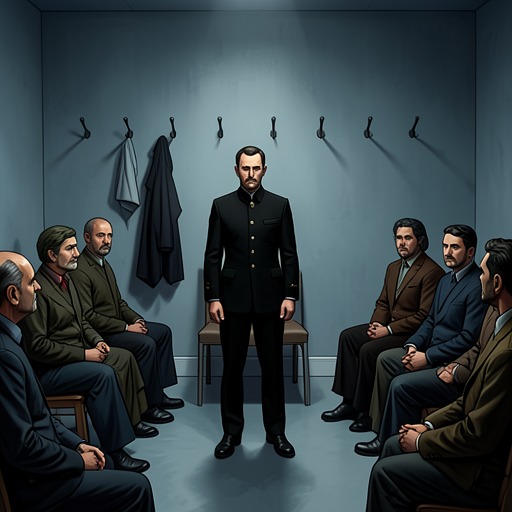
The same tension appears when Andrew and Paul Duffy interview students at the McCormick School. After only a few interviews, they suspect that students are coordinating their evasions: some deny even knowing Benjamin, although the investigators already know who his friends were. Andrew experiences the denials as a betrayal of the dead boy. Yet the scene does not establish that every child knows what happened or that one shared secret explains their behavior. The suspicion of a concealed truth is part of the investigators’ perspective, and the expression helps convey how that perspective hardens under pressure.
Knowledge, Denial, and Interpretation
Later, Andrew asks Sarah Groehl whether she thinks Jacob is innocent, but when he suggests that her earlier words imply as much, she replies, “I never said that.” Her answer makes the distinction between what someone may believe and what they are willing to state explicit. The exchange does not settle Sarah’s knowledge or her view of the case; it shows how Andrew tries to interpret a guarded response and how she refuses the meaning he assigns to it.
The expression also resonates with Andrew’s pursuit of Leonard Patz. By August, Andrew has followed Patz for weeks and regards information from Matt Magrath as compelling, while recognizing that it will not persuade a jury without stronger evidence. Patz’s ordinary routines yield nothing notably suspicious, but Andrew’s certainty remains intact. In this context, the language of deception describes Andrew’s felt experience rather than proof that Patz is hiding something: the absence of confirmation becomes another reason for suspicion instead of a reason to reconsider it.
Narrative Significance
As a recurring interpretive idea, Mindfuck draws attention to the novel’s uncertainty about what silence means. A missing fact might be deliberately withheld, as in Jacob’s examples, but silence can also invite an observer to supply a story of concealment. The word captures the investigators’ anxiety and the difficulty of separating evidence from inference; it does not, by itself, reveal who knows the truth or what that truth is.
That ambiguity gives the expression its particular force. It begins as teenage slang, becomes Andrew’s name for the case’s disorienting quiet, and then illuminates exchanges in which knowledge is suspected but not openly confirmed. The narrative’s central tension lies in that unresolved distance between a secret one imagines and a fact one can establish.