New Haven, Connecticut
Defending JacobNew Haven, Connecticut, is where five-year-old Andrew Barber visited his father in the Whalley Avenue jail in the summer of 1961. The city is remembered less as a broad setting than as the site of a formative encounter: a crowded visiting room, a father’s grip on a child’s arm, and the first knowledge of murder, left unexplained by the adults around him.
The jail visit
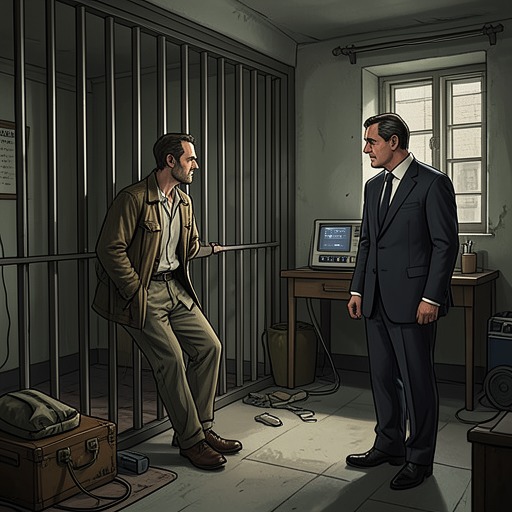
Andrew recalls sitting with his mother at a pitted wooden table in the jail’s crowded visiting room. The prisoners’ boxy dungarees and pajama tops struck him as resembling the flat, square-shaped men he and his friends drew as children. His father had to coax him closer, then clamped a fist around his upper arm and pulled him forward, twisting it with a force Andrew would remember years later. In the account, New Haven is anchored by this physical contact: the visit is both an attempt at reunion and an encounter in which the child has to be careful around his father.
A childhood shaped by silence
Andrew knew that his father had done something terrible, but no adult told him exactly what. The fragments he retained linked the crime to a girl, an empty boarded-up row house on Congress Avenue, and a pearl-handled knife. The adults’ silence around the knife made the object a charged trace of an event Andrew could not yet understand. He learned the word murder that summer, but describes understanding it as something that came only through years of carrying the knowledge and turning it over in secret.
The place in Andrew’s later memory
The jail visit was the last time Andrew saw his father. He says that even his few surviving recollections may have been embellished over the years; by about age ten, the man had dwindled in his memory to scattered pieces, and Andrew eventually stopped thinking of him. He came to live as if he had no father, a self-understanding that shaped what he later told Laurie: that he had never known who his father was. New Haven thus marks both a specific childhood encounter and the beginning of a long erasure, in which a remembered grip and an unspoken crime persist after the father himself has nearly vanished from Andrew’s account of his life.