Newton, Massachusetts
Defending JacobNewton, Massachusetts is the wealthy suburb where the murder of a child turns a local criminal case into a public rupture. The town’s schools, parks, neighborhood routines, and faith in family life form the setting for the investigation, but they also become part of what the crime unsettles: Newton’s image as a place where children can be raised safely.
A Suburban Self-Image
Newton is described as a wealthy town, and the victim’s family is wealthy as well. That combination helped make the case appear likely to attract media attention from the outset. In its first hours, the investigation did not yet have a settled account of what had happened; the killing could even resemble a schoolhouse attack. The uncertainty gave the case an urgency beyond the immediate need to identify what had occurred and ensure that the early work was done properly.
The town’s shock is bound up with its sense of itself. Newton was not accustomed to violent crime, and residents tended to associate it with news coverage of cities and poorer communities. A child’s murder therefore seemed not merely an individual tragedy but a violation of the distinction on which the suburb’s confidence rested. The crime exposed the limits of an imagined geography in which violence belonged somewhere else.
That self-image had been expressed in Newton Centre through the motto “A Community of Families, A Family of Communities,” and residents often described Newton as “a good place to raise kids.” The phrase had practical and emotional force: the town was full of test-preparation centers, tutors, karate schools, and youth sports, while many parents had left city life and accepted the expense and monotony of the suburbs in return for the promise of a protected childhood. The murder struck at the justification for that choice.
Grief Made Public
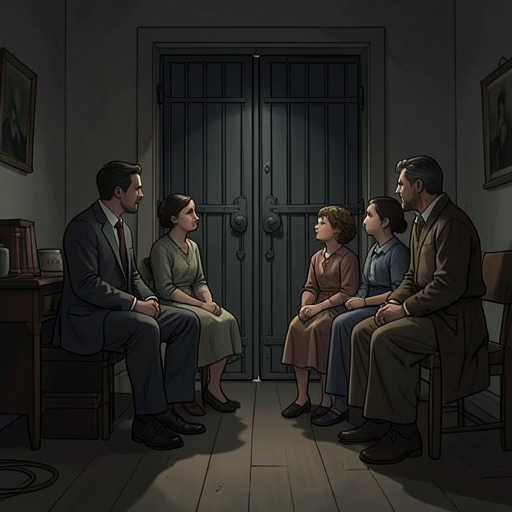
Four days after the murder, the Rifkins opened their home for shiva, the Jewish period of mourning. The gathering filled the house and drew people from across town. Its scale made private grief difficult: even the pauses and lowered voices of the mourners seemed to move as one, while the crowd could briefly take on the awkward feel of a social gathering. Newton’s response to the death was communal, but that visibility also meant the bereaved family could not mourn in isolation.
The town’s attention extended to the investigation. People recognized Andrew Barber as the person handling the case and were curious about suspects and clues, though they did not press him for details at the shiva. For the moment, the facts of the inquiry receded beside the basic knowledge that a child had been killed. In this way, Newton’s collective reaction moved between public fascination with the case and the more immediate recognition of loss.
Schools, Parks, and the Investigation
The case quickly changed the ordinary appearance of local life. When Andrew Barber and Jacob went to school, traffic, television news vans, police barriers, and officers at the entrance turned the morning arrival into a conspicuous security scene. Parents escorted children to the door or watched from the sidewalk; students carried their heavy packs through the police-controlled approaches. The school, ordinarily part of the town’s everyday family routine, had become a place watched by media and law enforcement.
Cold Spring Park, another ordinary public space, became central to the investigation because the victim’s body had been found there. During testimony, the first responding Newton detective described the park’s layout: a parking lot off Beacon Street, tennis courts and playing fields beyond it, and woods with trails farther back. Police vehicles filled the lot and lined the street when he arrived. The park had been sealed and searched in the first hours, but investigators found no weapon. Several footprints were located, none near the body and none ultimately matched to a suspect; in a public park, the sheer number of possible traces complicated their significance.
The local investigation also depended on cooperation with the school, which was delayed by parental concerns about interviewing students, the possible need for lawyers, access to lockers without a warrant, the appropriateness of using the school building, and which pupils could be interviewed. The questions show how the murder brought criminal investigation into direct contact with the community’s responsibilities toward its children. School procedures and parental protections became part of the case’s practical course, not merely background to it.
Community Under Pressure
Newton’s neighborhoods are presented as close enough for familiar faces to recur even though the town itself is not small. The jogger who discovered the body was someone Andrew Barber recognized from everyday places such as the market, Starbucks, or the dry cleaner; they apparently also ran in Cold Spring Park around the time of the murder. Such familiarity connects the investigation to ordinary local life, while the crime makes those routines newly charged with consequence.
That closeness does not mean the town can offer a single, uncomplicated response. At the shiva, mourners gathered around the Rifkin family, while the presence of a child from the Barber family among the dead boy’s peers made the social atmosphere more difficult. At school, parents and police shared responsibility for children’s safety while negotiating the limits of interviews and searches. Newton’s identity as a community built around families thus becomes both a source of solidarity and a point of pressure: the murder draws its residents together, but also makes their assumptions, loyalties, and protective instincts part of the story.
Narrative Significance
Newton is more than a backdrop for the murder investigation. Its prosperity and child-centered civic image help explain why the case attracts attention, while its schools, park, and homes make visible how violence enters spaces understood as ordinary and safe. The distance residents once placed between their town and violent crime collapses when the victim is one of their children.
The town’s response also gives the investigation a public dimension. Grief is witnessed, school access becomes contested, and the murder’s presence follows families into routine places and routines. Newton’s promise of safety is not shown to have been a guarantee; it is a community ideal, tested by an event that its residents cannot keep private or assign to somewhere else.