Northern Correctional Institution
Defending JacobNorthern Correctional Institution is a maximum-security prison in Somers, Connecticut, where Andrew Barber visits his father, William “Billy” Barber, while seeking a DNA sample relevant to Jacob’s defense. The prison’s no-contact rules shape both encounters: thick glass separates father and son, and even the collection of a cheek swab must be mediated by a guard. Its sealed, nearly colorless visiting booths give physical form to the estrangement and uncertainty that the visits bring into view.
Setting and Visiting Conditions
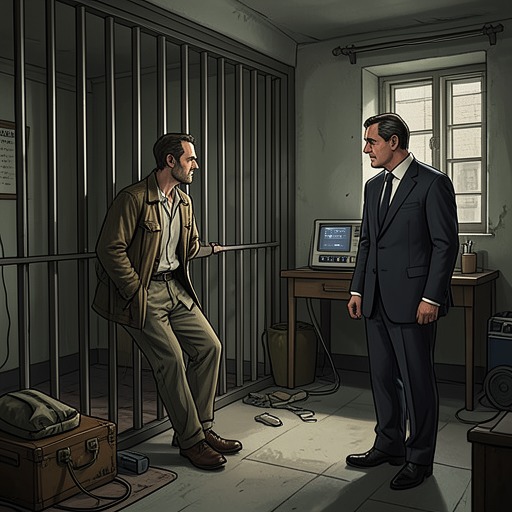
Northern is described as a level-five maximum-security facility permitting only no-contact visits. Andrew’s visiting booth is a sealed white compartment about five feet wide and eight feet deep, with a windowed door behind him, a plate-glass window in front, and a beige phone on the wall. A white counter offers a place to rest his arms. The space is intended to keep prisoners contained, but Andrew experiences it as confining him as well.
The visible surroundings reinforce that impression. From the booth, Andrew sees unbroken white plaster and gray concrete, with blank walls and surfaces throughout the institution. He notes that the facility was completed in 1995 and supposes that its lack of color may be part of a deliberate penal strategy. In a place designed to separate people, even the architecture seems to deny ordinary signs of comfort or individuality.
Andrew’s First Visit with His Father
When Billy appears behind the glass, his hands cuffed at his waist and his hair ash gray, Andrew is surprised by the strength of his own reaction. He has not seen his father for roughly forty-five years, since childhood, and considers Billy a stranger; nevertheless, the sight of him leaves Andrew frozen. The barrier makes Andrew feel safer because Billy cannot reach him, yet Andrew also interprets the encounter through the image of a zoo visitor facing a leopard: the person protected by a barrier is aware of the animal’s greater strength and feels a complicated shame alongside security.
Andrew breaks eye contact, and Billy sits down. A guard remains several feet behind him, while father and son pick up their phones to speak through the glass. The encounter reaches back beyond the immediate visit: Andrew associates seeing his father with their last meeting, in 1961, at the Whalley Avenue jail, and describes that separation as the point from which their two lives diverged. The present-day prison thus becomes a setting in which a long-avoided family relationship returns as a concrete, uneasy presence.
The DNA Request and Its Limits
Andrew’s purpose is practical as well as personal. He brings a sterile swab and plastic envelope, explaining that he needs a sample from Billy for DNA testing. He has already concluded that Billy should not come near the witness stand, describing him as a poor liar. Although Billy offers to help get his grandson acquitted, Andrew’s decision to seek a sample does not amount to trusting him as a witness.
The prison’s no-contact policy complicates the collection. Andrew cannot personally swab Billy’s mouth, which he considers the best way to preserve a clean chain of custody: if the swab remained in his possession, he could testify that the sample was genuine. After negotiation and a call to the deputy warden, he is allowed to hand the kit to a guard, who passes it to Billy. Andrew then explains the procedure over the telephone and watches Billy carry it out, including labeling and signing the container. The institution’s rules turn a small forensic task into a carefully supervised exchange, preserving separation even while allowing the investigation to proceed.
A Later Return and Narrative Significance
Andrew visits again at Northern, where the same sealed booth, glass window, and background noise of nearby conversations, distant shouts, and prison announcements frame another exchange with Billy. This time, Billy arrives chained at the waist and ankles, escorted by two guards. They seat him without touching him, remove the handcuffs, and withdraw from the window’s view. The additional restraints make the prison’s control visible, while Billy’s manner—chin forward and a sneer—contrasts with the restrictions placed on his movement.
Billy greets Andrew as “Junior!” with a tone of apparent welcome, and Andrew immediately asks why he did it. The question signals that this later visit carries a different urgency from the earlier effort to secure DNA: Andrew confronts his father directly. Northern therefore serves not merely as a backdrop for reconciliation or evidence gathering but as the controlled boundary within which Andrew’s family history and his defense of Jacob meet. The glass permits conversation without contact; the rules enable a sample to pass while keeping father and son apart.