Parental Loyalty to Children and the Truth
Defending JacobParental Loyalty to Children and the Truth is the conflict between standing by Jacob and facing the possibility that he may have killed Ben Rifkin. It shapes Andrew and Laurie’s marriage throughout the case: Andrew makes loyalty a duty, while Laurie presses him to distinguish the jury’s verdict from the truth and to consider what parenthood demands if Jacob is guilty. The charges are ultimately dropped after Leonard Patz confesses, but neither the dismissal nor Andrew’s public defense of his son provides a final answer to the family’s moral questions.
Loyalty as a Parental Duty
When Dan Rifkin tells Andrew that resolution and the prospect of seeing the person responsible put away would help his family, Andrew assures him that people will think what they think and that he cannot worry about appearances. Yet he recognizes the contradiction in himself: he wants to help Dan and also wants to get away from him. The Rifkins’ need for closure sits uneasily beside Andrew’s duty to defend Jacob, whose continued presence, in the Rifkins’ view, makes the loss of their own son impossible to set aside.
That tension becomes especially stark when the Barbers encounter Dan and Joan Rifkin at a market. The two families stand facing one another—three people on one side, two on the other—and Andrew registers the painful arithmetic: Jacob is alive, while the Rifkins’ son is gone. Nobody needs to state the disparity aloud. The Barbers’ family loyalty cannot undo the Rifkins’ bereavement, and the Rifkins’ grief cannot by itself determine whether Jacob is guilty. The encounter gives the question of truth a human cost on both sides of the case.
Laurie Challenges Andrew’s Certainty
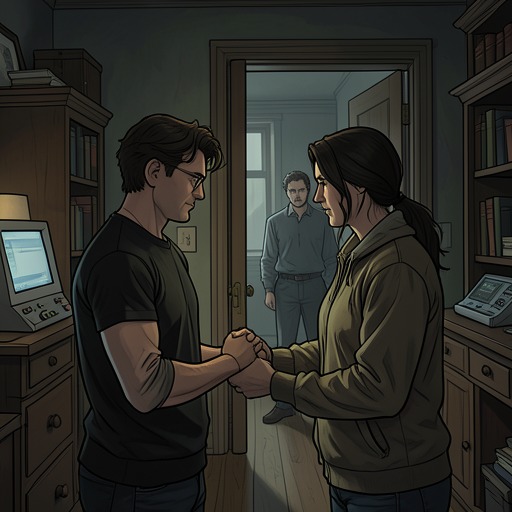
The dispute enters the Barbers’ home before Jacob’s trial. Andrew summons Laurie to talk about something that will soon come out, and later their conversation turns to what they may have missed when raising Jacob. Laurie remembers him as rough and boisterous when he was young and wonders whether the parents made mistakes or should have sought medication or counseling. Andrew rejects the suggestion that their past carelessness explains the present crisis; he says Jacob outgrew that behavior and insists that they did nothing wrong. As they argue, Laurie first rests a hand on her chair, then withdraws it and folds her arms over her belly. The small movement marks a widening distance between their attempts to understand their son.
During the trial, that distance becomes more visible. Laurie sits alone on the front bench each day, refusing Andrew’s offer to have her parents join her. She has been shaken by Dr. Vogel’s diagnosis and asks Andrew what they would do if Jacob were guilty. He answers that they must wait for the jury, but his effort to comfort her only makes her withdraw to the edge of their bed. The courtroom’s verdict has not yet come, yet the question already presses on their private life: whether their role is only to protect Jacob through the process, or also to face what the process might reveal.
The Question of Responsibility
Laurie insists that her fear is not merely about whether Jacob will be acquitted. She asks Andrew to consider whether he might be wrong, whether Jacob might commit another crime if released, and whether the parents have responsibilities beyond securing a favorable verdict. When she asks directly whether Andrew thinks Jacob did it, he avoids a direct answer, saying that there are things a parent should never think about a child. Laurie refuses that evasion. If Jacob is guilty, she argues, the parents are implicated too: they made him and sent him into the world. Andrew replies that they are responsible for their son and must stick with him. Their disagreement is not simply over whether to love Jacob, but over what that love requires when protection and truth appear to pull in different directions.
The trial’s outcome briefly seems to resolve the conflict from the outside. After Patz confesses, Andrew and Laurie celebrate the news, and Andrew regards the confession as more than an acquittal: in his understanding, Jacob has been proven innocent rather than merely left unconvicted for lack of proof. The prosecution files a nolle prosequi before the judge takes the bench, and the judge tells Jacob that he is a free man. But the family’s relief depends on treating Patz’s confession as conclusive; it does not erase the earlier questions about Jacob, the Barbers’ responsibilities, or what certainty can mean in a criminal case.
Loyalty After the Case
The unresolved issue returns years later in Andrew’s grand-jury testimony. Neal Logiudice challenges Andrew’s assurance that Jacob did not commit another crime, asking how he can be so sure. Andrew answers that no one can be sure of anything, but that he trusts his son and has to. He also states that Jacob did not kill Hope Connors. Logiudice then asks what Andrew and Laurie’s moral obligation would have been if they were the parents of a murderer. Andrew rejects the premise, says he does not believe they were, and finally refuses to answer the hypothetical, insisting that it never happened. Logiudice throws down his yellow pad in frustration, but the exchange supplies no new proof about Jacob’s guilt.
Andrew’s position therefore remains both an act of loyalty and an admission of the limits of knowledge. He does not claim that a parent can establish certainty; he says that he trusts Jacob and must do so. Laurie’s earlier demand, meanwhile, preserves a counterpressure within the family’s history: loyalty should not make the possibility of guilt unthinkable, because parents may also have to confront their own responsibility. The case’s dismissal resolves the legal charge against Jacob, but the distinction between legal outcome, belief, and truth remains the concept’s enduring tension.