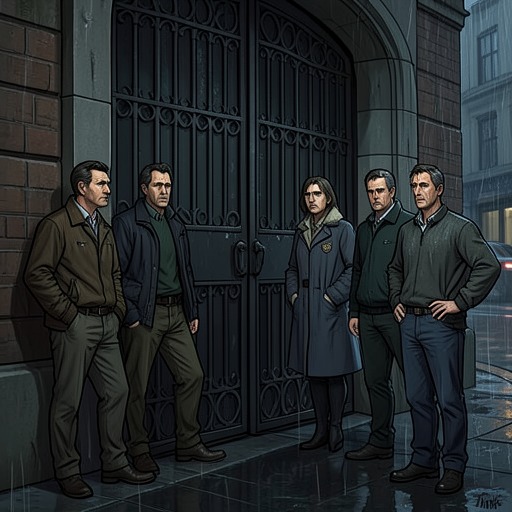
Paul Duffy
Defending JacobPaul Duffy is a state trooper and homicide detective, Andrew Barber’s close friend and frequent investigative partner. His role in the Ben Rifkin case moves between private loyalty and public duty: he helps conduct the inquiry, counsels restraint in pursuing Leonard Patz, and later delivers a search warrant to Andrew. The friendship makes that official act more than a procedural turn, while Duffy’s eventual appearance as a trial witness shows how thoroughly the case has drawn their shared professional life into conflict.
Identity and Background
Duffy arrives in Andrew’s office in plain clothes, gives the familiar perfunctory knock, and sits opposite Andrew’s desk, evidently excited. The ease of the entrance belongs to a relationship already established beyond the workplace. Andrew describes Duffy as virtually the only police officer he worked with who was also a personal friend. The two regularly handled cases together as the district attorney’s top lawyer and top detective, and their families knew one another.
Their intimacy is marked by a reciprocal, though not identical, place in each other’s family life. Duffy named Andrew godfather to Owen, the middle of his three sons. Andrew says he would have done the same for Duffy had he believed in God or fathers. He presents Duffy as more outgoing, gregarious, and sentimental than himself, but regards the difference as a complement rather than a barrier. Their friendship is not merely Andrew’s professional convenience: it is a family connection and an enduring personal attachment.
Andrew’s sense of Duffy is shaped by time as well as affection. At trial, Duffy wears a blue blazer, a rep tie, and gray flannel pants—formal by his usual standards. Andrew sees a boyish quality in his manner and says that, to him, Duffy remains twenty-seven, the age he was when they met. The description conveys how Andrew’s perception of his friend remains anchored in their long history even as the case gives that history new and difficult meanings.
Work on the Investigation
When the investigation turns toward Leonard Patz, Duffy resists moving too quickly. He suggests showing Patz’s photograph around to see whether anyone can place him in Cold Spring Park that morning, speaking with Patz’s neighbors, or approaching him casually rather than alarming him. Duffy’s reasoning is practical: if the police arrest Patz, Patz will call a lawyer, and investigators may lose their only opportunity to speak with him. The proposal reveals a detective’s preference for developing information before taking a step that could close off access.
Duffy also takes part in the investigation at McCormick School. At two o’clock, he and Andrew take over the principal’s office to interview the highest-priority witnesses: Ben Rifkin’s close friends, students who walked to school through Cold Spring Park, and students who had specifically asked to speak to investigators. Two dozen interviews are scheduled for them, while other CPAC detectives conduct interviews in parallel. Andrew understands most of these conversations may be brief and unproductive, but the investigators proceed broadly, searching for leads rather than assuming the interviews will yield a solution.
The procedural partnership is underscored by Andrew’s later reliance on Duffy when he wants to be careful. After thinking it safer not to proceed alone, Andrew calls him. The brief decision points back to the trust that has long made Duffy a natural person for Andrew to consult. The investigation may put pressure on their friendship, but at this point Andrew still turns to Duffy as a dependable colleague.
Friendship Under Institutional Pressure
That trust acquires a sharper edge when the investigation reaches Andrew’s own family. Duffy is the officer who appears at Andrew’s door to hand him a search warrant, apologizing as he does so. The gesture is brief, but the situation carries the weight of the relationship already established: the friend who belongs at Andrew’s family table now performs an official act against the family. Personal warmth does not prevent the investigation from crossing into Andrew’s home, and Duffy’s apology cannot make the warrant an ordinary exchange between colleagues.
The tension does not reduce Duffy to an adversary. Andrew’s response to him remains bound up with affection, and the trial later makes the overlap between professional obligation and personal history explicit. When Duffy is on the stand, Andrew describes not only what he is wearing but the familiar boyish quality that has persisted in his memory of him. The courtroom turns a longtime friend into a witness, while Andrew’s recollection keeps the witness connected to the person he has known for years.
Duffy’s connection to Andrew is also distinct from Andrew’s relationship with his lawyer, Jonathan Klein. Andrew respects Klein’s intelligence and wisdom, but the trust between the two men has a different basis; Duffy is the friend with whom Andrew has worked cases, socialized, and shared family ties. The contrast helps explain why the official steps Duffy takes against Andrew’s household carry a personal force that a lawyer’s courtroom role does not have in the same way.
Trial and the Limits of Loyalty
The trial places Duffy’s friendship with Andrew inside the public record. His presence on the stand is itself a change in their relationship’s setting: the detective who once sat opposite Andrew’s desk now appears as a witness in the case that has engulfed Andrew’s family. Andrew’s description is affectionate, but the courtroom frame makes clear that affection does not erase the institutional role Duffy occupies.
The evidence also presents a moment when Andrew learns that Duffy was involved in an event he had not previously known about. The revelation lands as a hammer blow; Andrew had suspected something like it but had not understood that Duffy himself was involved. Duffy sees Andrew’s face fall, and a helpless look crosses his own. The scene gives their friendship a limit and a cost: Andrew’s faith in Duffy’s closeness does not mean he knows everything Duffy has done, and Duffy cannot undo the hurt simply by being sorry.
Later, Duffy tells Andrew that Andrew’s lawyer had contacted him because he was getting no traction in Newton or Cambridge. His continued involvement shows that the relationship still has practical consequences even after trust has been strained. Duffy remains a channel through which the case and Andrew’s personal predicament meet, though the terms of that help now exist alongside what Andrew has learned and the apology Duffy has offered.
Narrative Role
Duffy’s importance lies in the sustained collision of roles rather than in a single decisive intervention. He is the trusted detective who conducts witness interviews with Andrew, the cautious investigator who argues against prematurely confronting Patz, the friend who brings a warrant to Andrew’s door, and the longtime colleague who must testify at trial. Each role is supported by the same established bond, so professional acts acquire personal consequence without ceasing to be professional acts.
The narrative also gives Duffy’s appearances a recurring pattern of approach and interruption. He enters Andrew’s office with familiar ease; later he stands at Andrew’s door with a warrant; at trial he is placed on the witness stand. These shifts in setting register the changing terms of the friendship. Duffy is never simply outside the case or safely inside Andrew’s private circle: the investigation repeatedly makes him occupy both positions, and the difference between them becomes increasingly difficult for Andrew to ignore.