Reopening of McCormick School after Ben Rifkin's murder
Defending JacobThe reopening of McCormick School five days after Ben Rifkin’s murder is presented not as a return to normal, but as an uneasy performance of normality under public scrutiny. Andrew Barber accompanies Jacob to school amid heightened security, while the family’s tension, the students’ online conversations, and increasingly sensational news coverage reveal how the murder has altered ordinary life.
Anxious return to school
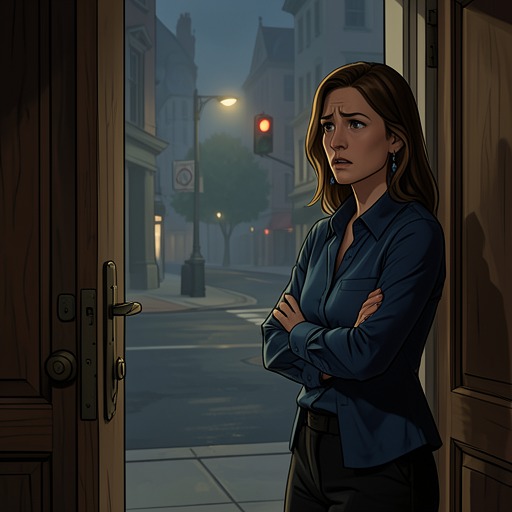
That morning, Andrew, Laurie, and Jacob follow their usual routine—showers, coffee and bagels, and a glance at email, sports scores, and the news—but move through it tensely. They are all up by six-thirty and still dawdle until they are running late. Laurie’s unease is particularly visible: although she has lived alongside Andrew’s work as a prosecutor, the violence has entered her own life, and she struggles to maintain her composure. The reopening, only five days after the murder, has rattled all three.
The school entrance is crowded with parents escorting children, family vehicles, and nearby news vans. Police sawhorses block both ends of the circular driveway; officers guard the entrance and wait in a cruiser. Andrew parks the family minivan almost a block away, and he and Jacob sit watching the scene before Jacob murmurs his reaction. The familiar school has become a place approached through barriers, cameras, and adult vigilance.
Security as public reassurance
Inside the foyer, the security station combines hand inspections of coats and backpacks with metal-detecting wands used by four Newton police officers. Andrew considers the searches disproportionate: the murder victim’s body was not found on school grounds, and, in his view, there is no reason to think the killer would bring a weapon into the school. He understands the measures chiefly as a display for anxious parents, a visible attempt to make the return feel controlled.
A dispute over a student’s sweatshirt exposes the improvised character of that control. An officer deems its lettering forbidden under the school’s hastily devised rules, while the student argues that it is a clothing brand and refuses to surrender an expensive garment. Andrew approaches as the disagreement reaches an impasse. The episode gives the security procedure a small but telling consequence: fear has brought an institutional show of protection, yet applying it also creates new conflicts at the school door.
The school and the online audience
The reopening exists alongside an expanding online conversation about the murder. Students post casually about the case and the park, while Andrew reads their messages with an eye to preserving them through a subpoena to Facebook. The apparent intimacy of students’ online exchanges does not make them private from adults or from the legal process. The school’s return to routine is therefore accompanied by a second kind of scrutiny, less visible than the police presence but consequential to the investigation.
Jacob’s public image also spreads beyond the school. A supportive website and Facebook group collect messages affirming his innocence, while negative posts are filtered out. His name trends on Twitter, and strangers send him texts: many are hostile, though some are admiring or flirtatious. Jacob says the messages are about two to one negative, considers the attention sufficient, and does not want to change his number. Laurie advises him to stay off social media until the case is over; he says he only reads and does not post. The support and hostility coexist, turning the charged school reopening into part of a much wider public judgment of a teenager whose case is still unfolding.
From school gates to courtroom headlines
The coverage accompanying the reopening soon becomes explicit in its judgment. After Jacob is charged, a Globe front-page headline identifies him as the district attorney’s teenage son charged in the Newton killing. The Herald’s cover labels him a monster and pairs his photograph with a claim that he has been unmasked in a knife murder; its teaser also invokes Andrew’s removal from the case and alleged cover-up. The family’s earlier concern about appearances now meets a media narrative that presents accusation as revelation.
The publicity continues at the courthouse. A Fox 25 news van films the family as they leave home, and reporters and cameras gather at the courthouse entrance. Andrew is relieved that Jacob can walk in from the street rather than arrive through the prisoners’ exit: remaining out on bail preserves some freedom and dignity while the case proceeds. The school reopening thus marks an early point in a widening sequence, from guarded school gates to a public trial of Jacob’s character in headlines and online forums. Its central contrast is between the ordinary routines the family tries to resume and the security measures and public narratives that make those routines impossible to recover unchanged.