The Limits of Criminal Justice in Knowing the Truth
Defending JacobThe Limits of Criminal Justice in Knowing the Truth describes the gap between a criminal trial’s formal promise of a reliable verdict and the uncertainty that persists beneath its procedures. The novel makes that gap visible in the jury box, where strangers must judge a case they did not witness; in the investigation, where silence and manner become clues; and in the courtroom, where lawyers shape incomplete facts into stories. The result is not a claim that every account is equally credible, but a sustained doubt that the system can convert limited evidence into certain knowledge of guilt or innocence.
Procedure and the jury
The trial’s effort to identify truth begins with selection of the people who will decide it. Andrew Barber and Jonathan Klein use seating charts for fourteen candidates—twelve jurors and two alternates—and assess education, occupation, background, and apparent temperament. They have six peremptory challenges, alongside challenges for cause, but the procedure cannot eliminate guesswork. Massachusetts rules restrict questioning, and Andrew regards predictions about how strangers will judge a case as more art than science. The defense hopes for coolheaded jurors able to understand technical evidence; Neal Logiudice seeks working people and parents who may respond strongly to the crime.
After two hours, the lawyers have their jury. Their nicknames—among them the Schoolteacher, Grandpa, Waltham Mom, and Construction Guy—make the selected people memorable to the trial team, but do not make them legal experts. Andrew sees their limited familiarity with law and trial procedure as more than comic inconvenience: the system ultimately places a consequential judgment in the hands of ordinary people chosen through a process that cannot reliably predict their reasoning. The trial’s authority rests on deliberation, yet the people deliberating begin as strangers whose ability to distinguish truth from persuasion is unknown.
Investigation, silence, and interpretation
The same uncertainty appears before the trial, in interviews with students at McCormick School. Andrew and Paul Duffy schedule two dozen interviews, prioritizing the victim’s close friends, students who walked through Cold Spring Park, and those who asked to speak with investigators. After only a few conversations, they suspect that students are withholding information. Some deny not just knowledge of the murder but even knowing Ben Rifkin, whom Andrew understands to have had friends. Other students seem to overplay signs of honesty, while some become more tentative. Their contrasting behavior sharpens suspicion, but it does not by itself establish what any particular student knows or why that student is silent.
A later conversation with Sarah Groehl exposes the limits of adult interpretation from another angle. When Andrew suggests that she may believe Jacob is innocent, she rejects his characterization of what she has said. He tells her that adults do not really know what is happening in the children’s lives and asks some of them to open up. Sarah’s answer—that they have—does not resolve the distance between what the adults ask, what the students disclose, and what the adults are able to understand. Testimony is not simply information waiting to be collected: its meaning depends on what a speaker knows, what the speaker chooses to say, and how an investigator reads the response.
Andrew’s own pursuit of Leonard Patz demonstrates how an investigator’s certainty can outlast the evidentiary force of his observations. By August, Andrew has followed Patz for weeks, hoping to find something that could support the case beyond Matt Magrath’s account, which Andrew believes would not persuade a jury. Patz’s ordinary routine—work, shops, meals, and time at his apartment near Cold Spring Park—produces no significant evidence. Yet the absence of suspicious activity does not loosen Andrew’s conviction; instead, he interprets Patz’s apparent inactivity as concealment. His investigation thus becomes a test not only of what can be proved, but of how a strong prior belief can govern the meaning assigned to what is seen.
The courtroom as a contest of stories
The novel presents the opening statement as an explicit exercise in narrative construction. Logiudice must give the jurors a story that explains what the case is about, not merely a collection of facts. He casts Jacob as a privileged teenager with a lethal temper and frames Ben’s killing as the moment that temper “snapped.” The prosecution’s account places the fatal act within a familiar sequence: teasing, provocation, and sudden loss of control. Logiudice also acknowledges that Ben was an ordinary, imperfect fourteen-year-old, rather than an idealized victim, while emphasizing that the teasing described would not ordinarily explain a killing.
That story’s explanatory weakness becomes central. Logiudice offers possible triggers, including names Ben may have called Jacob, but Andrew notes that the prosecution has no firm answer to the question of why the crime happened. The suggestion that Jacob “probably” faced some provocation remains conjecture, while the case requires jurors to connect evidence to a coherent motive. Andrew regards the opening as effective advocacy, but not a complete answer: beneath its polished structure remains a hole where an account of the decisive cause should be.
The defense, too, enters a contest of interpretation rather than a realm of uncontested fact. Andrew’s account of the courtroom records how each side seeks a phrase the jurors can carry into deliberation. The prosecution’s “snapped” supplies a compact causal theory, one that links ordinary school conflict to a sudden act. Its rhetorical usefulness does not establish its truth. By showing how a lawyer is instructed to build a theme and make facts serve it, the novel distinguishes the persuasive organization of evidence from proof that the resulting story is complete.
Evidence, documents, and unresolved knowledge
The book’s documentary and testimonial forms reinforce that distinction. Its frame opens with a grand-jury exchange in which Neal Logiudice asks the witness to state his name and Andrew answers, “Andrew Barber.” Elsewhere, trial testimony identifies an exhibit as a letter from Dr. Vogel to Jonathan Klein. Such records anchor the account in named speakers and documents, but they also show that what readers receive is mediated: a witness answers questions, a lawyer directs attention to an exhibit, and a remembered event is narrated through Andrew’s perspective. A record may establish what was said or presented without settling every question about the event itself.
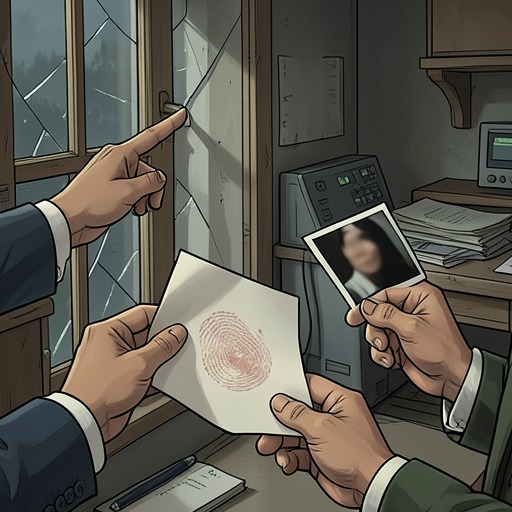
Even a concrete observation can remain narrower than the conclusion drawn from it. In testimony about an exhibit, a witness is asked whether anything was on a hand and answers that there was a large spot that looked like blood. The qualification matters: the testimony reports an appearance, not a completed determination of what the spot was. Across the investigation and trial, the novel repeatedly keeps the reader attentive to that distinction between an observed detail, the inference built from it, and the larger narrative that the inference is asked to support.
The eventual force of this theme lies in the difference between a verdict and omniscience. The legal process must reach decisions through rules, examination, and deliberation, but none of those steps gives its participants direct access to the whole truth. Students may withhold what they know; investigators may interpret silence through expectation; lawyers may turn uncertain motives into memorable themes; and jurors may decide on evidence without ever knowing everything that happened. The novel therefore leaves its central uncertainty intact: criminal justice can test accounts and produce judgments, but the judgment itself cannot make an incomplete record complete.