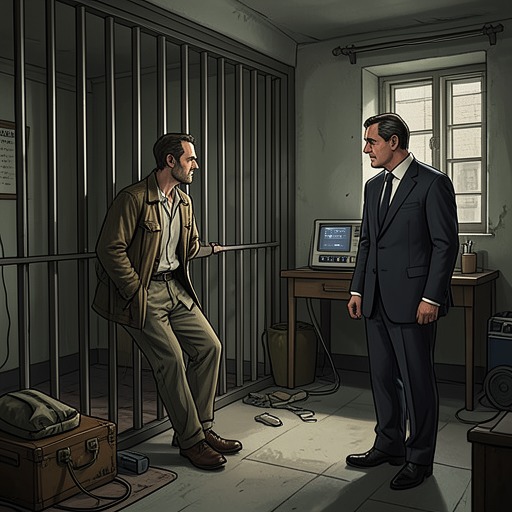
The Policeman’s Dilemma
Defending JacobThe Policeman’s Dilemma names a practical and moral impasse in criminal investigation: a confession may be necessary to prove a case, but proof may be necessary to obtain a confession. The narrator encounters the problem both as a former prosecutor and as a father trying to understand how a confession connected to Leonard Patz came about. The phrase also resonates with the trial’s competing stories, where confident narrative form does not close the gap between evidence, motive, and truth.
The phrase and its investigative bind
The narrator explains the dilemma while reflecting on his father, Bloody Billy, and Billy’s conspicuous denial. In the narrator’s account, the words denying responsibility can carry the opposite implication: a speaker may communicate that the listener knows what happened but cannot prove it. This kind of confession-denial offers neither a usable admission nor a clear path to disproof. The investigator must recognize the performance without being able to convert recognition into evidence.
The narrator describes this stalemate as part of the work rather than an exceptional failure. Investigators can learn to accept that a case may be impossible to establish while a confession remains unavailable, even as a confession may remain unavailable until a case is already established. The dilemma is therefore not simply that someone lies; it is that the ordinary means of proving a crime can depend on one another in a way that locks the investigation in place.
The trial’s story and its missing motive
The phrase has a broader counterpart in the courtroom’s demand for a story. Neal Logiudice presents the killing of Ben Rifkin as a purposeful act, emphasizing that Ben, fourteen, was found dead at Cold Spring Park on the morning of April 12, 2007. He tells the jury that Jacob Barber had a lethal temper and that, after being teased, he “snapped.” The narrator recognizes the force of Logiudice’s performance, but the prosecution’s central explanation remains uncertain.
Logiudice has to supply a trigger that can turn a supposed fantasy of murder into an actual killing. The narrator observes that a motive matters to jurors even if it is not itself a legal element: they want to understand why the crime occurred. Logiudice concedes that the precise provocation may never be known and offers possibilities, including insults or bullying. The narrator’s brief reaction—“Probably?”—marks the distance between a plausible courtroom account and an established explanation. The polished story gives the jury a theme, but the uncertainty beneath it remains.
Leonard Patz, Billy, and the limits of proof
The dilemma returns in the narrator’s later encounter with Bloody Billy. The narrator has come to believe that Billy contacted James O’Leary, an old associate described to him as a fixer, and that O’Leary made the problem involving Leonard Patz go away. The account the narrator imagines is that O’Leary frightened Patz into signing a confession. Yet this is presented as what the narrator and Billy both understand, not as a newly proved account: Billy does not confirm it, and the narrator acknowledges that Billy has no reason to help him by talking.
Billy makes the resulting choice explicit. He tells the narrator to report what he suspects, while warning that doing so could put Jacob back in jeopardy; the narrator replies that Jacob cannot be tried again because jeopardy has attached. Billy turns the question back on him: if the narrator believes O’Leary committed a murder, why not report it? His challenge leaves the narrator caught between pursuing what he believes happened and protecting his son from renewed legal danger. Suspicion may be consequential without being straightforwardly usable.
Denial, silence, and professional consequences
The same structure appears at the grand jury when Neal Logiudice questions the narrator about Leonard Patz. Asked whether he has ever heard of Patz, the narrator answers that he has not, despite knowing the name. He describes the answer as harmless perjury and recalls Logiudice standing with his arms crossed, visibly frustrated. The denial obstructs Logiudice’s effort to restore his reputation, but it does not supply a public account of the Patz matter.
The narrator interprets Logiudice’s insistence as more than a renewed concern with Patz’s case: by then, he believes, the questioning is not really about Leonard Patz. Logiudice soon leaves the district attorney’s office and becomes a defense lawyer in Boston. The narrator imagines his former protégé’s case and career collapsing in the grand jury room and frames that ending as a final lesson in the dilemma: evidence, testimony, and personal knowledge do not always combine into a provable account.
The expression’s significance
The Policeman’s Dilemma connects the book’s legal uncertainty to its uncertainty about family loyalty and truth. The narrator sees an apparent confession-denial from Bloody Billy, suspects that Billy helped bring about Patz’s confession through O’Leary, and nevertheless lacks the confirmation that would turn suspicion into proof. His own answer to Logiudice shows that he, too, can withhold what he knows when disclosure may endanger Jacob. The phrase thus describes not only an investigative obstacle but a conflict over what truth can be spoken, established, and acted upon.
Its force lies in the unresolved distinction between knowing and proving. The trial can offer a memorable explanation for a killing while leaving the motive speculative; Billy’s silence can appear to confirm the narrator’s suspicion while remaining unusable as confirmation; and the narrator’s denial can frustrate Logiudice without settling the underlying events. The phrase names a recurring limit of criminal justice: the truth a person believes he recognizes is not necessarily the truth he can establish in court.