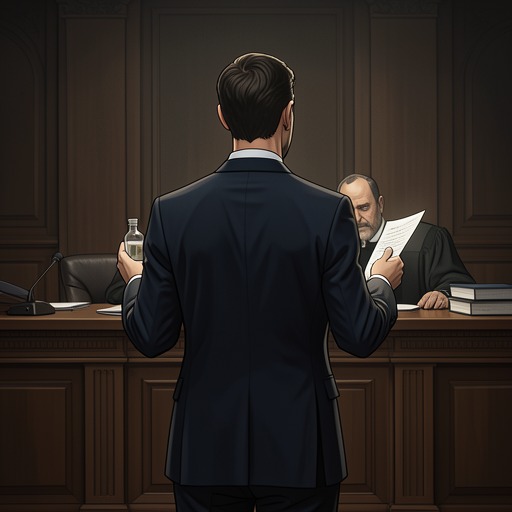
The Prosecution’s Burden of Proof
Defending JacobThe Prosecution’s Burden of Proof is the rule that the state must prove its case, rather than requiring a defendant to establish innocence. In Jacob Barber’s murder trial, that distinction is central to the defense strategy and to Andrew Barber’s unease: Jonathan Klein insists that the burden belongs entirely to the prosecution, while Andrew worries that simply exposing weaknesses will not satisfy jurors who want a coherent story. The tension between legal sufficiency and narrative persuasion gives the principle its particular force in the novel.
The Rule and the Defense Strategy
Jonathan explains the burden directly when Jacob asks what his defense will be. Jacob cannot take the stand, Jonathan tells him, but the defense need not present a case of its own; it can attack the prosecution’s evidence until nothing remains. The approach is not a demand that Jacob prove where he was or identify the actual killer. It rests on the prosecution’s obligation to establish guilt.
Andrew is not convinced that this formal protection will be enough in practice. The prosecution has a fingerprint and a witness who places a knife in Jacob’s hand, and Andrew fears that a few pointed challenges will not dislodge their combined effect. He wants the jurors to be given something more: an affirmative defense, a narrative that offers another account of the crime. His instinct is shaped by his belief that people respond more readily to stories than to abstract principles such as presumed innocence or the burden of proof.
Jonathan pushes back on that instinct. He reminds Andrew that he understands the defense has no burden, but may not truly believe it. As defense counsel, Jonathan cannot choose his clients or abandon a case because the evidence looks difficult; he has to work with the cards dealt to him. Andrew answers that they must find new cards. Their disagreement is not over the rule itself so much as whether the rule, properly applied, can overcome the prosecution’s existing evidence without a competing culprit and a complete alternative story.
The Prosecution’s Story
The trial demonstrates why the legal burden can be overshadowed by the demands of narrative. In his opening, Neal Logiudice frames Ben Rifkin’s death as a story of a privileged but isolated boy whose temper finally snapped after ordinary teasing. He describes Ben as a fourteen-year-old found dead in Cold Spring Park, and presents Jacob as having left home for the park with a knife and an idea. The account supplies a sequence and a motive-shaped trigger, turning scattered facts into a theme the jurors can carry into deliberations.
Logiudice also acknowledges a hole in his explanation. The question of what could have turned an apparently ordinary boy into the perpetrator of a brutal crime remains unanswered; he can offer possibilities about insults or bullying, but not a definite trigger. Andrew recognizes that jurors will want to know why, even though motive is not itself a legal element of the case. In his view, the prosecution’s speculation about “murder genes” tries to fill that explanatory gap. The example exposes a pressure point: the state must prove guilt, but a persuasive account of motive may influence how jurors interpret the evidence.
The opening statement explicitly treats trial as a contest over the “story of the case.” Facts, Logiudice’s courtroom performance suggests, must be woven into a tale that gives the jury a way to understand them. His theme of a boy who “snapped” is powerful as rhetoric, but its coherence does not itself prove the charge. The novel holds the audience between those two things: the story’s persuasive shape and the separate legal question of whether the evidence establishes guilt.
Andrew’s Counter-Narrative and Its Risk
Andrew’s preferred response is to give the jury an alternative narrative. He settles on Leonard Patz as the person who committed the murder and tells himself that this is not merely a tactical choice: he believes Patz actually did it and that following the evidence will show the truth. Yet Andrew also admits the circularity in his reasoning. His conviction that Patz is guilty rests, in part, on the conviction that Jacob is not. The defense’s proposed story therefore carries both a strategic purpose and the danger of becoming another form of certainty that outruns what has been proved.
Andrew’s treatment of the burden is complicated by his role as Jacob’s father. He understands the legal distinction, but the fingerprint and the witness weigh on him, and he doubts that a defense limited to dismantling the prosecution’s case will persuade the jury. His response reveals a gap between knowing the rule and trusting its practical force. The defense is entitled to hold the state to its burden; Andrew fears that jurors may nevertheless demand an answer to the question of who did it.
That fear does not change the legal allocation of proof. Rather, it shows how an alternative suspect can become rhetorically necessary even when the defense’s formal position requires no such proof. Andrew’s certainty about Patz offers a counter-story capable of competing with Logiudice’s account, but the novel makes visible the emotional and argumentative work required to treat that counter-story as fact.
Evidence, Interpretation, and the Jury
The broader account of the case repeatedly shows how evidence acquires meaning through interpretation. During interviews at McCormick, Andrew and Paul Duffy encounter students who deny even knowing Ben, despite investigators’ knowledge that some were his friends. The students’ varying manners—some appearing unusually direct, others tentative—make the investigators read behavior as a clue to truthfulness. Such observations may shape suspicion, but they are not equivalent to proof of the murder. The burden principle offers a standard against which these inferences should be measured.
The book’s documentary forms sharpen the same distinction. It opens with Andrew identified as a witness before a grand jury, and later places courtroom questions about documents and testimony alongside his retrospective account. A late-night email directs him to a newly created Facebook group called “Friends of Ben Rifkin”; the message and the online page provide material to investigate, but their appearance does not settle what happened. Records and testimony can seem authoritative while remaining partial, dependent on who produced them and how they are interpreted.
The principle’s significance, then, is not that it automatically resolves Jacob’s case. It marks the difference between suspicion and a legally sufficient case, while the trial’s competing narratives press the jury toward explanations that may feel complete before the evidence is. Andrew’s struggle captures that tension: he knows the defense need not prove Jacob innocent, but as a father and a narrator of the case he keeps searching for a story strong enough to answer the prosecution’s story. The novel leaves the burden where the law places it, while showing how difficult it can be to keep that boundary clear in the jury’s imagination.