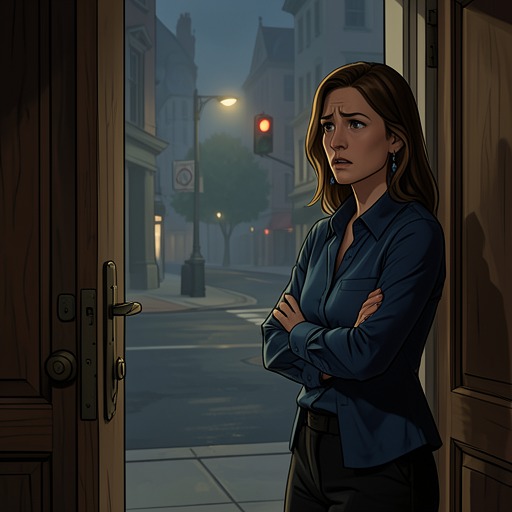
Toby Lanzman
Defending JacobToby Lanzman is one of the most visible and dependable members of the school-parent circle formed around the children who attended school with Ben Rifkin. A close friend of Laurie Barber, she combines physical confidence with practical care: she organizes food, gathers people, and urges them to reach out to the Rifkins. In the immediate aftermath of Ben’s murder, Toby’s directness gives shape to a community’s shock, even as its attempts at solidarity cannot remove the uncertainty or grief at its center.
Identity and Place in the Parent Community
Toby belongs to a group of parents whose children had moved through the Newton schools together since kindergarten. Their years of drop-offs, pickups, soccer games, fund-raisers, and a school production had created familiarity and camaraderie, but not necessarily deep personal connection. Ben’s murder briefly changed that distance: the parents felt newly exposed to one another through shared dread and grief. Toby’s role in this gathering is practical rather than abstract. At the Rifkins’ home, she arranges hors d’oeuvres at the kitchen island, a dish towel over her shoulder, while the adults talk about insomnia, sadness, and fear for their own children.
Toby is one of Laurie’s few enduring friendships in the community. The narrator describes her as someone worth relying on in a crisis, and her actions repeatedly support that impression. At school, she takes the lead in a small circle of mothers whose children are in Jacob Barber’s class. Her confidence makes her the group’s implicit captain; Laurie, by contrast, is its emotional center, the person to whom the women turn with private troubles. The division of roles suggests the group’s dependence on both Toby’s ability to organize and Laurie’s capacity to listen.
Practical Care After Ben Rifkin’s Murder
At the gathering in the Rifkins’ home, Toby notices the narrator searching for Laurie and points him across the room. Her brief exchange with him names the need of the moment: Laurie is tending to the other mothers, and Toby observes that the adults themselves could use some mothering. The comment reflects a community in which parental roles have become unsettled by the murder. They have come together partly to support the bereaved family, but also to seek comfort from one another.
The next morning, as the parents gather outside the school, Toby redirects their attention toward Dan and Joan Rifkin. After Jacob goes inside, the group’s appearance of cheerfulness falls away, and Toby asks whether anyone has contacted Ben’s parents. When Laurie says she does not think so, Toby insists that they should. Her response is concrete and immediate: sympathy is not enough if it does not lead to an attempt to reach the people who have lost their child.
Toby’s concern does not erase the boundaries between the two families. Later, the Barbers and the Rifkins encounter one another at Whole Foods, where Dan and Joan’s presence makes the unequal fact of their loss impossible to overlook: one family still has its son, while the other does not. That painful encounter is not presented as a failure of Toby’s earlier effort, but it shows the limits of what a school-parent network can repair. Community can offer contact and care; it cannot make the families’ positions equivalent.
Humor, Fear, and the Limits of Protection
At school, Toby tries to ease the parents’ strain by recalling how carefully she and her husband, Bob, had kept their children away from toy guns and violent television and video games. She says they would not even allow water guns, and that they used a different name for them. The joke is an attempt to make sense of a murder that has made ordinary parental precautions seem inadequate. It falls flat; Wendy agrees that the contrast is ironic, but does so somberly, more to acknowledge Toby than to lighten the room.
That moment captures the tension in Toby’s place within the group. She is willing to act as its energetic organizer and to use humor, but neither role can restore the parents’ former confidence. The community had tried to keep violence at a distance through household rules and careful language; Ben’s death has made the gap between those everyday safeguards and the danger they feared impossible to ignore. Toby’s raised hands express exasperation, while the group’s subdued response marks how little comfort the joke can provide.
Narrative Significance
Toby’s appearances are brief, but they give the school-parent community a practical form. She prepares food during a gathering marked by confessions of fear, takes the lead outside the school, and presses the parents to make contact with the Rifkins. Her actions connect private distress to visible gestures of support. At the same time, the failed joke about avoiding toy guns shows that care and caution cannot guarantee control over what has happened.
Through Toby, the parents’ temporary closeness is neither dismissed as false nor mistaken for a cure. Their shared routines have left them with real ties, though many of those acquaintanceships may not endure beyond their children’s school years. In the crisis, Toby helps those ties become active: she makes room for comfort, calls for outreach, and tries to keep the group speaking. The tragedy remains beyond her power to resolve, but her steadiness helps define what mutual responsibility looks like in the first days after the murder.