Disguise and Concealed Identity
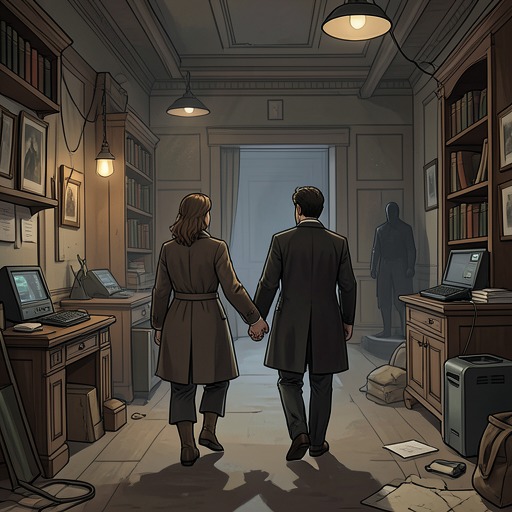
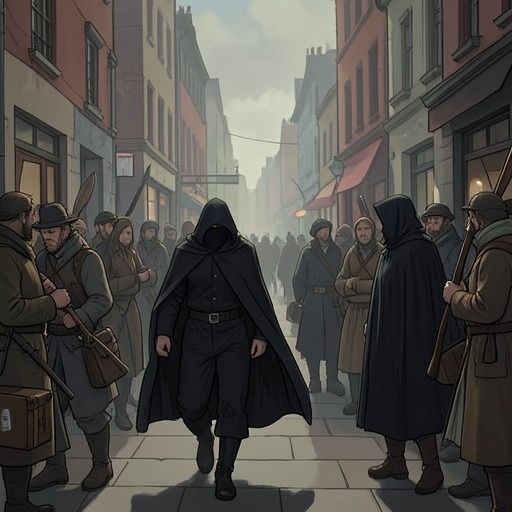
Demi-Gods and Semi-DevilsDisguise and Concealed Identity is more than a change of face: in these episodes, it is a coordinated practice of altering appearance, suppressing recognizable habits, and shaping what observers expect to see. A'Zhu repeatedly devises disguises for herself and Qiao Feng, using them to move through the Central Plains and to approach people whose knowledge could unlock a concealed past. The disguise succeeds when appearance, conduct, and circumstance reinforce one another—and falters when an observer knows more than the pair can anticipate.
Purpose and Method
While seeking Elder Xu, A'Zhu recognizes that an open journey would draw attention and could warn him away. She proposes disguising Qiao Feng, who is famous throughout the land, as an unremarkable jianghu traveler: someone so ordinary that several hundred similar men might be seen on the roads in a day. Qiao Feng accepts the plan, though he notes the difficulty of wearing Khitan clothing in the Central Plains. The exchange makes disguise a practical answer to a specific problem: concealment can preserve the search by preventing potential witnesses from recognizing the travelers and alerting their quarry.
A'Zhu transforms his face with flour, paste, and ink glue, removing the features that make him recognizable and adding a sparse mustache. After drinking twenty jin of wine, Qiao Feng sees himself in a mirror and cannot recognize his own face. A'Zhu then disguises herself as a middle-aged man. Yet the scene also establishes that visual alteration alone is not enough. A'Zhu warns that Qiao Feng’s voice and his habit of drinking could expose him, so he resolves to speak less and drink less. On the journey south, he follows that advice, speaking sparingly and limiting himself to two or three jin of wine at each meal. The disguise therefore extends from the face into daily conduct.
Recognition and Its Limits
The pair’s altered appearance initially seems persuasive, but their arrival in Tiantai exposes the limits of their control. At an inn, Qiao Feng has given the surname Guan; nevertheless, the innkeeper announces that a monk from Zhiguan Temple has come to see Great Master Qiao. The monk, Pozhe, identifies the pair by a description supplied by his master, Zhiguang, and knows that the woman traveling with Qiao Feng is surnamed Ruan. He fails to recognize A'Zhu’s male disguise, but the concealed identities have already been penetrated by information passed ahead of them.
The encounter turns disguise into a contrast between appearance and knowledge. A'Zhu can make herself visually unrecognizable to Pozhe, while Zhiguang’s prior description is accurate enough for the innkeeper to identify Qiao Feng. When Qiao Feng and A'Zhu meet Zhiguang in person, they remove their disguises. Qiao Feng had feared that the man pursuing him might reach the monk first; seeing Zhiguang alive and safe, he is relieved. The unmasking marks a change in the purpose of concealment: before Zhiguang, direct recognition is no longer the central concern, because Qiao Feng has come to hear what the monk knows.
Disguise as Performance
A'Zhu later uses disguise not simply to hide the pair but to enter a particular social role. She dresses Qiao Feng as a five-bag disciple of the Beggar Society, apparently an attendant of Elder Bai, while she impersonates Bai Shijing. She reproduces not only Bai’s appearance but also his solemn manner and speech. Qiao Feng, who has known Bai for almost ten years, cannot detect a difference. The effectiveness of the impersonation rests on the combination of visual likeness and behavioral detail: A'Zhu performs the identity as others expect to encounter it.
She also directs the conditions under which that performance will be judged. Because Madam Ma is observant, A'Zhu tells Qiao Feng to speak as little as possible. On the road to Xinyang, he uses Beggar Society argot with the Society’s disciples and asks about the movements of its leaders. He also makes Elder Bai’s arrival known in advance, so Madam Ma will already expect Bai when the visitors reach her. They travel slowly and arrive at dusk, when the light is less favorable for close inspection. These details turn disguise into a managed encounter: the assumed identity is supported by insider language, a plausible subordinate, prior expectation, and carefully chosen timing.
A Mask That Opens a Secret
At Ma Dayuan’s home, Madam Ma accepts A'Zhu as Elder Bai and addresses Qiao Feng only as the supposed attendant. A'Zhu speaks to her as a younger sister-in-law and asks permission to discuss an important matter. She then sends Qiao Feng outside, presenting the conversation as too secret for even a trusted subordinate to hear. Qiao Feng understands that the gesture is calculated to earn Madam Ma’s confidence: A'Zhu appears to disclose something privately by excluding him, while he remains close enough to listen from outside.
The impersonation gives A'Zhu access to Madam Ma’s account of the Leading Big Brother. Madam Ma identifies him as Duan Zhengchun, the Prince of Dali, and warns that the secret must not pass to another person. A'Zhu answers in Bai Shijing’s assumed identity and swears that Bai will bear the consequences if the information is revealed, cleverly attaching the oath to the person she is impersonating rather than to herself. The mask thus becomes an instrument for obtaining and managing information, not merely a shield against discovery. Across these episodes, disguise works through other people’s beliefs: it can conceal a face, establish a role, and invite confidence, but the Tiantai recognition shows that a convincing performance cannot control knowledge already held by others.