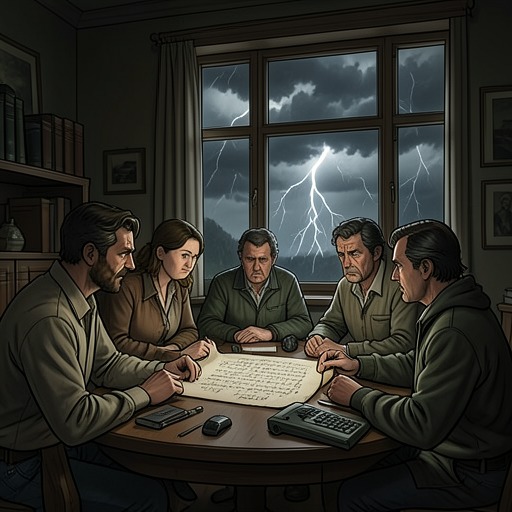
Duan Zhengchun’s calligraphic scroll
Demi-Gods and Semi-DevilsDuan Zhengchun’s calligraphic scroll is both a private record of his relationship with Ruan Xingzhu and the material clue that breaks Xiao Feng’s certainty about the identity of the “leading big brother.” Its poem and dedication link Duan Zhengchun to A'Zhu’s parents, while its distinctive handwriting contradicts the script of the incriminating letter that Xiao Feng had taken as proof. In the shadow of A'Zhu’s death, the scroll turns a keepsake into evidence and interrupts Xiao Feng’s resolve to die beside her.
Appearance and inscription
The scroll hangs on a wall in a room at Ruan Xingzhu’s home. Xiao Feng notices it while preparing a bamboo grave tablet for A'Zhu. Though he has limited command of written language, he can follow the poem’s plain sense: it describes drinking, shyness, a brief meeting followed by a long separation, and the sorrow of parting. The poem’s romantic subject is not an abstract literary exercise; its inscription identifies the writer and the intended recipient.
Beneath the poem, Duan Zhengchun has recorded a youthful visit to his beloved Zhu and described being so absorbed in the company of a woman with bright eyes and a slender figure that he lost awareness of time and the world. The signature names him as “Duan the Second of Dali.” Xiao Feng recognizes that the scroll belongs to Duan Zhengchun and that its contents concern the relationship between A'Zhu’s father and mother. He is struck by the incongruity of such an intimate poem being displayed openly, but the immediate question of A'Zhu’s burial leaves him little time to consider it.
A keepsake becomes evidence
The scroll acquires a different meaning when Xiao Feng’s eye returns to its handwriting. The characters are rounded, fluent, elegant, and evenly spaced. They look unlike the skewed, angular writing of the letter from the Apricot Forest, which Zhiguang had shown him and whose signature he had destroyed. Xiao Feng remembers the letter’s appearance clearly enough to see that its writer and the author of the scroll were not the same person.
That difference challenges the conclusion on which his search for vengeance has rested. Madam Ma had identified the “leading big brother” as Duan Zhengchun, and Xiao Feng had accepted the claim. But if Duan Zhengchun wrote the scroll in his own polished hand, why would he have another person write an important letter to Chief Wang—or compose a love poem for him? The scroll does not itself identify the letter’s author, but the contrast between the two hands makes Duan Zhengchun’s authorship of the letter doubtful. Xiao Feng is left confronting the possibility that Madam Ma’s accusation was false and that the identity of the leading big brother remains unknown.
The possibility also reopens the meaning of A'Zhu’s death. Xiao Feng had believed Duan Zhengchun to be the man responsible for his parents’ deaths and had killed A'Zhu when she took Duan Zhengchun’s place. If that identification was mistaken, then A'Zhu may have died to shield him from a man who was not the culprit. The scroll does not settle who killed Xiao Feng’s parents or why Madam Ma named Duan Zhengchun; instead, its evidence restores uncertainty where Xiao Feng had thought the case closed.
The scroll confirmed
Xiao Feng’s reconsideration is interrupted when Ruan Xingzhu and A'Zi return for the scroll. A'Zi takes it from the wall, explaining that they came back specifically to retrieve it. Xiao Feng asks Ruan Xingzhu whether “Duan the Second of Dali” really means Duan Zhengchun. Her answer confirms that no one else could be meant, and her visible pride at his name reinforces the identification.
This confirmation matters because Xiao Feng’s reasoning depends on knowing who wrote the scroll. Once Ruan Xingzhu confirms its authorship, he can no longer dismiss the discrepancy as a mistaken attribution: the man who wrote the beautiful poem did not write the letter to Chief Wang. The scroll therefore becomes more than a family memento. Its named author and legible style provide a point of comparison against another written object, while Ruan Xingzhu’s testimony anchors that comparison in a personal relationship.
Consequences for Xiao Feng
Before noticing the difference in handwriting, Xiao Feng had prepared two bamboo tablets, including one bearing A'Zhu’s name, and intended to bury her and then take his own life. The scroll changes the course of that moment. After Ruan Xingzhu confirms that Duan Zhengchun wrote it, Xiao Feng abandons his immediate intention to die and decides that the questions surrounding Madam Ma’s accusation must be untangled first. His grief and remorse remain, but they no longer lead directly to his death: uncertainty about the evidence gives him a reason to continue.
Later, Xiao Feng asks A'Zi to let him examine the scroll again and questions Ruan Xingzhu about where Duan Zhengchun is. Ruan Xingzhu fears he will seek him out over A'Zhu’s death; Xiao Feng says he wants to ask him questions, not make trouble for him, though she does not believe the reassurance. The scroll has thus changed the purpose of Xiao Feng’s pursuit. Rather than treating Duan Zhengchun as a proven enemy, he needs to establish what happened and who truly bears responsibility.
Material proof and its limits
The scroll’s importance lies in what it can establish—and what it cannot. Its inscription identifies Duan Zhengchun as the author and records his connection with Ruan Xingzhu; its handwriting can be compared with the letter that helped direct suspicion toward him. Together, attribution, personal testimony, and remembered script undermine a mistaken certainty. Yet the scroll supplies no name for the writer of the letter and no direct explanation of Madam Ma’s motive. It is decisive not because it solves the conspiracy, but because it exposes a gap between accusation and proof.
That distinction gives the object its narrative force. A poem written as an intimate recollection becomes an evidentiary text when Xiao Feng reads it beside the remembered letter. The scroll does not change its words; the crisis changes what those words can mean. At a point when grief has narrowed Xiao Feng’s choices to burial and death, the surviving handwriting opens the case again, turning a private keepsake into the first concrete reason to doubt the story that had led him to kill A'Zhu.