Helibu's Jurchen tribe
Demi-Gods and Semi-DevilsHelibu's Jurchen tribe is a northern community whose reception of Xiao Feng reveals a form of belonging grounded in personal reputation and hospitality, even amid conflict between the Jurchens and Khitans. Led by Helibu, it welcomes Xiao Feng through his friendship with AguDa, while its encounter with Khitan forces exposes the dangers of life on the frontier.
Leadership and Community
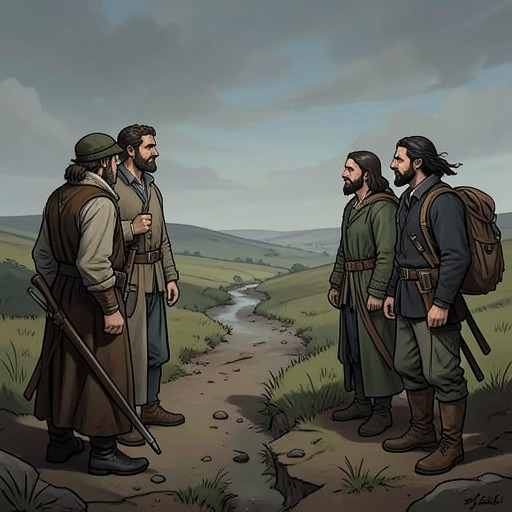
The tribe is led by Helibu, a black-bearded elder with eleven sons, all described as capable heroes. AguDa is his second son. The community is encountered among a dense spread of skin tents on a mountain slope, after Xiao Feng and AguDa travel through a heavy blizzard for two days and reach the area on the third afternoon. AguDa knows the terrain well enough to guide them toward the settlement; his whistle brings someone out to welcome him.
A Han merchant named Xu Zhuocheng also connects the settlement to the wider region. He comes each winter to buy ginseng and animal furs, stays until early spring, and speaks the Jurchen language. When Xiao Feng arrives, Xu Zhuocheng serves as interpreter, making communication between the visiting Han-born traveler and the tribe possible.
Hospitality and Reputation
Although the Jurchens are at war with the Khitans, the tribe admires capable heroes. AguDa praises Xiao Feng to his father and fellow tribesmen, and his standing within the community helps ensure that Xiao Feng is received without resentment over his Khitan identity. The tribe treats him as an honored guest rather than as an enemy defined solely by ethnicity.
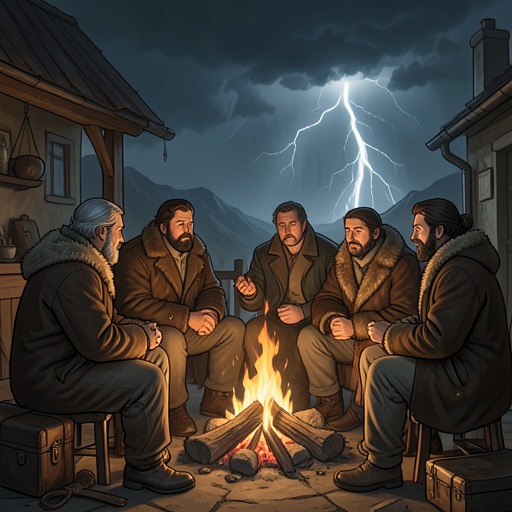
AguDa gives up his own tent for Xiao Feng and A'Zi. Xiao Feng initially tries to decline, but accepts when AguDa persists. At the welcoming feast, the meat of the two tigers Xiao Feng had killed is served. Xiao Feng has not drunk for more than half a month; he drinks more than ten bags of the tribe's strong wine without appearing affected. The gathering makes drinking prowess a public measure of heroism: even tribesmen who did not witness the tiger hunt can judge his strength by what they see at the feast.
Conflict on the Frontier
The tribe's welcome does not erase the danger of the Jurchen-Khitan conflict. AguDa later leads a dozen tribesmen north to hunt bears and invites Xiao Feng to join them. He notes that bear fur, fat, paws, and gall are valuable, with the gall used to treat injuries. Xiao Feng agrees after seeing that A'Zi is recovering sufficiently for him to leave her without worry.
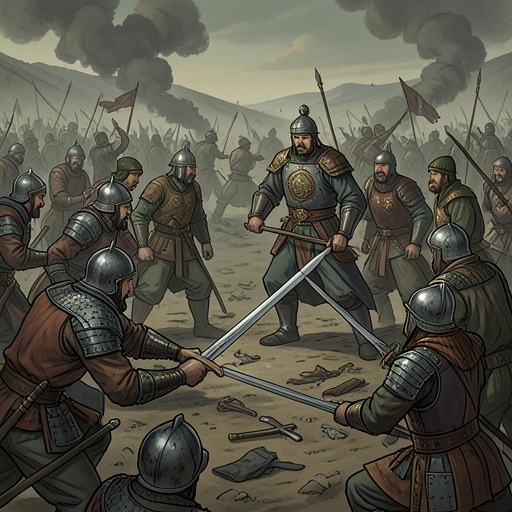
During the excursion, Khitan forces identify the Jurchens as enemies and attack with arrows. AguDa recognizes that his party is outnumbered and signals Xiao Feng and the others to retreat. Jurchen hunters return fire with bows and crossbows, bringing down ten Khitan riders, but several Jurchens are also lost and the party must flee while fighting. The episode shows the tribe operating not only as a household community but as a group exposed to armed conflict while traveling through contested country.
Place in the Wider Story
The tribe's experience belongs to a frontier shaped by reciprocal raids and captive-taking. Xiao Feng later sees Liao soldiers capturing Great Song civilians and reflects on the practice of raiding across borders for supplies, described as Beating the Grass Valley; Great Song troops retaliate with raids of their own. The captives' plight and Xiao Feng's questions about distinctions among Khitan, Song, Jurchen, and other peoples sharpen the contrast between the tribe's acceptance of him and the political hostility surrounding him.
The tribe's welcome offers a local alternative to fixed ethnic allegiance: Xiao Feng is accepted because AguDa vouches for him and because the community values his demonstrated prowess. Yet the attack during the hunt shows the limits of that personal bond in a landscape where armed groups classify one another as enemies. Through this contrast, the tribe gives concrete form to the book's portrayal of frontier identity as both a source of conflict and something that can be crossed through hospitality and individual loyalty.