Liao Empire
Demi-Gods and Semi-DevilsThe Liao Empire is both a formidable state and a political world whose inherited institutions shape the choices available to Xiao Feng. Its imperial authority rests on a Yelu dynasty, powerful Xiao empresses and regents, and military structures that reach across a contested frontier; its conflicts with the Song and Jurchen turn civilians into targets and force Xiao Feng to confront what belonging to the state demands of him.
Dynasty and Political Structure
The national surname of the Liao imperial house is Yelu, while successive empresses have come from the Xiao clan. Because the Xiao women occupy the throne’s marital line across generations, their relatives hold many court and military posts and wield exceptional influence. When an emperor is young, an empress dowager may assume power, further strengthening the clan. This is not merely a matter of court prestige: the ability of a dowager to intervene in succession becomes part of the political inheritance that shapes later claims to rule.
That inheritance is visible in the succession history recounted during Yelu Hongji’s crisis. His grandfather Yelu Longxu, remembered as the Holy Emperor, designated his eldest son Yelu Zongzhen to succeed him, although the empress favored her second son, Yelu Zhongyuan, and sought to place him on the throne. Zongzhen disclosed the scheme to his brother, and Zhongyuan ultimately supported him rather than taking power. In gratitude, Zongzhen granted Zhongyuan the status of royal emperor brother and made him next in the succession. Yet after Zongzhen’s death, the throne passed not to Zhongyuan but to Zongzhen’s son Hongji.
Hongji tried to reconcile the resulting tension by elevating his uncle to royal emperor uncle, again placing him next in line, and giving him supreme command of the army. Zhongyuan received court privileges and material honors, while Zhongyuan’s son Yelu NieLugu became Prince of Chu and controlled military affairs in the Southern Chancellery. These grants made the uncle and nephew exceptionally powerful, but they also concentrated military authority in a family whose place in the succession remained unsettled. The later rebellion therefore grows out of both personal ambition and a political order that had already made Zhongyuan and his son central to the state.
Frontier and Military Power
The Liao’s military arrangements give the frontier a decisive strategic role in its rivalry with the Song. The narrative links that advantage to earlier territorial concessions: after Shi JingTang sought Liao support, he ceded sixteen prefectures to the empire. These lands occupied strategic positions, allowing Liao forces to advance deeply into Song territory, while the Song lacked comparable defensive strongholds. The account attributes the long military imbalance between the states in part to this geography, noting that the Song fought for generations to recover the territory without success.
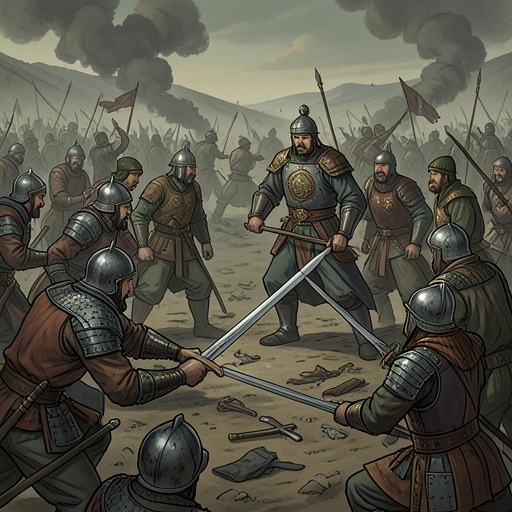
Liao military power is also sustained through a harsh frontier economy. Its troops do not receive provisions or regular salaries in the account given, and are expected to obtain what they need by raiding neighboring peoples. These expeditions, directed against the Song, Western Xia, the Jurchen, Korea, and other neighbors, are called “Beating The Grass Valley.” Song forces retaliate with raids across Liao territory, called “Beating The Standing Valley.” The labels belong to opposing sides, but the result falls especially heavily on border communities, whose families live under recurring threat of capture and loss.
The Jurchen encounter makes the instability of that frontier immediate. At the tent of the Jurchen chief HeLiBu, Xiao Feng learns that the chief has eleven sons and that AguDa is his second son; a Han merchant, Xu Zhuocheng, serves as interpreter. Although the Jurchen and Khitan are at war, the Jurchen admire strong heroes, and AguDa’s regard for Xiao Feng helps secure him an honored welcome despite his Khitan identity. Soon afterward, a Khitan force attacks a Jurchen party without first clarifying who it has encountered. Xiao Feng intervenes to prevent deaths, disarms and drives off Khitan riders without killing them, and helps AguDa’s men escape. The clash shows that shared admiration and personal loyalties can cross ethnic lines even while armed groups continue the violence of the border.
Rebellion and Contested Authority
The succession settlement fails when Yelu NieLugu rebels while Hongji is away hunting. The emperor’s uncle, Yelu Zhongyuan, is supreme commander of the army, and the Southern Chancellery is under NieLugu’s control, so the crisis places the imperial ruler against powerful members of his own family and the military apparatus they command. A proclamation issued in Zhongyuan’s name declares Hongji a false emperor and presents the uncle as the legitimate ruler. Hongji recognizes the danger: the edict could weaken the army’s loyalty, and his own force is much smaller than the troops available to his uncle and cousin.
The rebellion exposes the fragility within the authority that Liao’s institutions appear to secure. Zhongyuan had once declined the throne in favor of his brother and kept the earlier succession scheme quiet; Hongji had since entrusted him with military command and renewed his place in the line of succession. Yet the rebellion is led by Zhongyuan’s son, and Hongji cannot be sure that the father will oppose him. The crisis turns an old act of loyalty and a later arrangement of honors into uncertain grounds for trust.
Xiao Feng’s Place in the Empire
Xiao Feng’s relation to Liao begins with the revelation that he is Khitan. After learning that his father’s surname is Xiao, he declares that he will henceforth be Xiao Feng rather than Qiao Feng. The name links him to a prominent Khitan clan and to a state whose imperial family is Yelu and whose empresses belong to the powerful Xiao line. But discovering that heritage does not immediately settle where he belongs: he has been raised in the south, and the change of name intensifies rather than resolves the conflict between personal history and political identity.
Among the Jurchen, Xiao Feng encounters a form of fellowship that does not depend on Liao office. Yelu Ji, the red-robed Khitan commander he captures and later releases, is impressed by Xiao Feng and asks to become his sworn brother. They establish the bond with three arrows planted in the ground as incense and worship toward heaven. When Yelu Ji learns that Xiao Feng is Khitan, he welcomes the discovery and invites him to return to the Liao capital and share in its prosperity. Xiao Feng declines the rich life, preferring his present freedom among the Jurchen, where he hunts and drinks. He nevertheless leaves open the prospect of visiting his sworn brother in Liao. His choice separates Khitan kinship from immediate service to the Khitan state.
That distinction is tested when Hongji’s rebellion places the emperor, now Xiao Feng’s sworn brother, in danger. Xiao Feng would rather leave with A'Zi than accept an official post, but he cannot simply abandon Hongji in a crisis. His attachment to a particular person draws him into the machinery of the state, even as his reluctance to serve the empire remains evident.
Rule, Raiding, and Responsibility
Liao’s frontier policy becomes a moral question when Xiao Feng encounters Song captives taken by its soldiers. A force of about eight hundred men returns with goods and roughly seven to eight hundred people, mostly young women, and offers selected captives and valuables to Xiao Feng as the Lord of the Southern Chancellery. He recognizes in their treatment a reversal of what he saw at Yanmen Gate, where Song soldiers had captured Khitan civilians: across the border, the identities of captor and victim change, while the misery does not.
A young captive from Zhang Village asks to be allowed to return to her parents, and the rest of the prisoners also plead for release. Xiao Feng reflects that he once considered himself a citizen of the Song; he and the captives speak the same language and eat the same food. From that recognition he questions the cycle in which each side raids the other and answers contempt with contempt. He orders the captives freed and advises them to move farther from the frontier, warning that he may not be able to save them another time. Their relief makes plain what imperial policy costs people who have no wealth with which to ransom themselves.
The episode defines the tension in Xiao Feng’s eventual service: Liao can offer him a name, kinship, rank, and a place in government, but its military practices also ask him to accept harm done to people among whom he was raised. His intervention does not end the frontier raids or erase the conflict between states. It shows instead how his personal authority can be used against the immediate consequences of an imperial policy, and why his loyalties cannot be reduced to either Khitan ancestry or his official position.